Pandemic learning causing anxiety and stress among families, educators; COVID-19 vaccinations may be the only cure

photo by: Sylas May/Journal-World Illustration
Working a full-time job from home during the coronavirus pandemic is hard enough for Lawrence resident Ellie Heath.
But trying to make sure her elementary-aged children are staying engaged with their learning while they attend school from home half the week has only added to the stress and anxiety she is facing.
Heath, a parent of two children who attend Langston Hughes Elementary School, told the Journal-World that she is constantly splitting her attention between her work and her son’s kindergarten classes to make sure he is participating in his lessons, while she has largely left her third-grade daughter to her own devices.
“My mental load is close to breaking most days,” she said. “How long can I drag my kids through this? … My kindergartner is only 5 for so long and he has so many skills he needs to learn at this age.”
Heath and her children are not alone. She understands that other parents and the faculty and staff who educate her children are under similar stress. And solutions that satisfy everyone have remained elusive.
As the pandemic continues into the second half of the Lawrence school district’s academic year, there is still a divide between many of the parents and the school district’s educators on how they believe school should be conducted.
A significant portion of Lawrence parents believe the district should further reopen schools and allow students to attend in-person classes more often to help those falling behind. But many faculty and staff members believe that the district should return to remote learning until everyone’s personal safety from the virus can be ensured.
Arguments from both sides were expressed routinely during Lawrence school board meetings in the fall as the district continued to work out how to reopen schools. The district eventually settled on a hybrid learning model, opening schools to students for the first time since March 2020 through the model that has students attend in-person classes twice a week.
While the local spread of COVID-19 has fluctuated since, the district has used the same model. Parents and educators told the Journal-World they all believe the ultimate goal is to get students back into classrooms five days a week, but they both continue to question whether the hybrid model, which could appear to be a compromise between the two stances, is best for anyone.
The only matter that appears to unify the parents and the educators is the effect the pandemic is having on them. Both groups say that they are under immense stress and that the district’s learning method does not help relieve it.
Parents have told the Journal-World they are seeing their children fall behind in their education as anxiety and depression have made it difficult to learn.
Meanwhile, teachers say their anxiety levels are also through the roof, as their workload has increased during hybrid learning and they fear their health is at risk every time they set foot in a school building. The virus has now killed more than 2 million people worldwide.
“It’s contagious, and it’s not ill-founded either. There’s a pandemic out there and kids coming to school every day,” said Steve Wilson, a library media aide at Lawrence High School.
There does appear to be at least one clear solution to the problems both groups are facing. As the state enters Phase 2 of its COVID-19 vaccine rollout, educators are slated to be vaccinated, which could in turn allow the district to begin opening school buildings for fully in-person learning, as younger people generally have been less affected by the virus.
But how long it will be until those vaccinations have been administered remains unclear.
•••
Some Lawrence parents are frustrated with their school district as they see some other area districts and private schools allow their students to attend in-person classes more regularly. They wonder what it will take to get the same thing for their children.
Heath said that she has specifically asked what the district’s plan was to get back to fully in-person learning, but that she had not received what she considered to be good answers.
But on Monday, Superintendent Anthony Lewis said the district would only be able to further expand its learning model when Douglas County’s COVID-19 protocols allowed people to gather in larger numbers without social distancing.
Heath said that was the first time she had heard any specifics on getting schools back to fully in-person learning. But that explanation wasn’t satisfying, as she believes students are falling too far behind in their learning. She said the district needed to be more creative in making safe spaces for students and teachers to be able to meet in person.
“Everybody seems to be dragging their feet,” Heath said. “These kids can’t wait.”
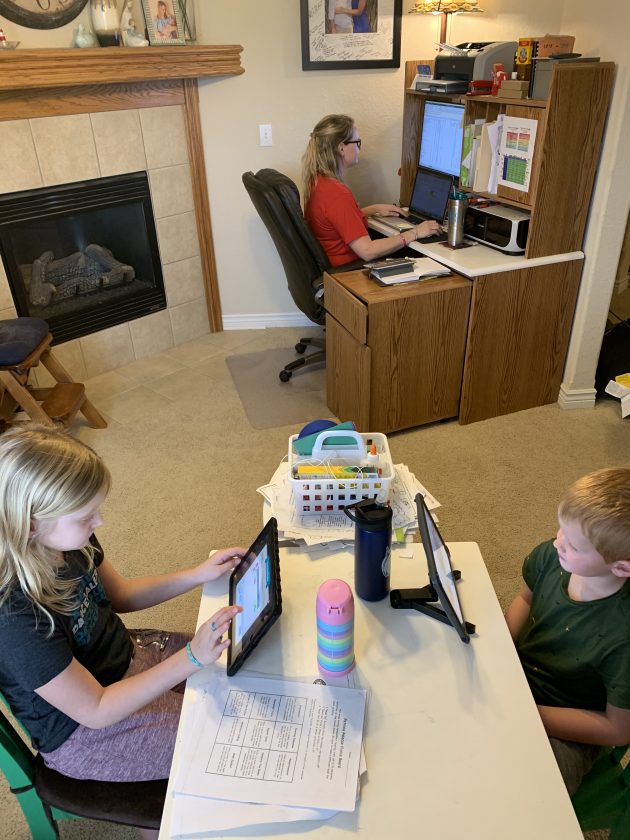
photo by: Contributed photo
Lawrence resident Ellie Heath, background, works at home while her children, Reagan and Austin, work on their elementary school work.
Meanwhile, Adam Didde, a father to two students at Lawrence High School, said his children were suffering mentally and academically. One is a high school senior who has “given up” on seeing any sort of standard learning method during his final year in school and is just trying to get through the year intact, Didde said.
The other, a sophomore, has been hit harder. Didde said the situation has been devastating socially and academically for his son, who has lost contact with many of his friends and does not seem to be able to connect to any of the material he is studying.
“It’s been extremely difficult on him, and it’s caused a lot of strain and tension on his mom’s and my relationship with him,” Didde said. “The remote model does not work for him at all.”
Jody Meyer said she and one of her children were in the same situation. Her youngest son in middle school is struggling academically. Seeing a child who normally gets As and Bs now have grades that are “in the toilet” has been difficult.
While the district has allowed some students who are considered “at-risk” to attend in-person classes four days a week, Meyer said her struggling son hasn’t been granted that privilege.
Additionally, while Meyer said she understood that teachers were under increased workloads, she said parents were also being asked to “pick up all the slack at home.” She said the students’ issues were not being considered enough.
“I just think the present course of education is detrimentally harming kids,” Meyer said. “We just don’t hear reports on how kids are doing or the problems kids are having,” she added.
The CDC also thinks students should return to learning as quickly as possible, noting that schools appear to not contribute much to COVID-19 spread, according to a recent article in The New York Times. But to do so, the federal agency said local officials would need to put other restrictions in place, such as closing indoor dining establishments and bars, among other businesses where people gather.
•••
Educators, on the other hand, are scared for their lives. They are also worried that their students could be contracting the virus and taking it home to their families.
Prior to Lewis’ comments on Monday, the district’s union representing hourly staff, such as paraeducators and custodians, said in a statement that the district should return to remote learning until all teachers and staff are vaccinated.
Jeff Plinsky, a teacher at LHS and vice president of the Lawrence teachers union, said the teachers largely agreed, adding that the union’s stance has always been ensuring the safety of educators and students.
But he said that the teachers were aware changes could be made, including how high schools will soon change the hybrid model to allow two days of in-person learning rather than just one. As that change is slated to come on Feb. 15, Plinsky said the teachers’ concerns continued to be safety and ensuring that school buildings did not become COVID-19 hotspots.
Despite being at odds with many parents on how to conduct school, Plinsky said teachers clearly understood that education was best when students were learning in person, but it’s just not safe to do that yet.
“Until it is safe, we have no interest in putting ourselves, our students or our families in larger jeopardy than they already are,” Plinsky said.
Chrystal Hunter, a paraeducator working with special education students at Cordley Elementary, said the issue was bigger than fear, as danger of the virus is real. While students may be less likely to suffer symptoms from the virus, she said that even during remote learning some teachers and staff, including herself, still needed to come into close contact with students who needed special assistance.
Hunter pointed to national reports of teachers catching the virus and dying, including two Georgia teachers who died on the same day, according to NBC News. In Lawrence schools, 41 COVID-19 cases have been reported among students and staff since the district returned from winter break earlier this month, according to the district’s website.
“We’re just being told things are safe while we see our coworkers get sick every week,” Hunter said. “There’s no other way to say it: We’re being asked to put our lives in danger.”
•••
Lewis said during the school board meeting this past week that he was “beginning to see the light at the end of the tunnel” now that vaccines are rolling out.
Lawrence-Douglas County Public Health has said educators would begin receiving a portion of its available Phase 2 vaccines soon, the Journal-World has reported.
Some educators have already been vaccinated. Julie Boyle, a district spokeswoman, told the Journal-World Thursday that at least 100 staff members had the opportunity to get vaccinated in Phase 1 of the rollout. Additionally, Plinsky said the teachers union has heard anecdotally that some teachers have received the vaccine through other avenues, such as through a VA hospital because they are military veterans.
But even the vaccination solution comes with its own conflict.
How long it will take for all educators to be vaccinated is anybody’s guess. As Lewis noted, the county just isn’t getting a lot of doses to administer quickly. Boyle said the district continued to advocate for faculty and staff.
“Teachers and support staff roll up their sleeves and work hard for the children of Lawrence every day, supporting their academic achievement and social-emotional health and well-being,” Boyle said in an email. “While we understand that time lines are dependent on the availability of vaccines, we anxiously await opportunities for more school staff to take advantage of opportunities to get vaccinated.”
While educators are lining up for vaccines, Meyer, the parent, said she didn’t believe that every single staff member being vaccinated should be the threshold for reopening schools.
“If they want to be vaccinated, that’s fine, but that shouldn’t be an impediment to getting our kids back into school,” Meyer said.
Contact Dylan Lysen
Have a story idea, news or information to share? Contact reporter Dylan Lysen:
- • dlysen@ljworld.com
- • 785-832-6353
- • Twitter: @DylanLysen
- • Read other stories by Dylan
K-12 Education
Student-run coffee shop opens at Community Connections at Pinckney, teacher receives surprise $1,000 award
Perry-Lecompton voters to weigh new joint recreation system funded by property tax levy
KU professors, middle school band director, radio personality among this year’s Phoenix Award honorees: ‘It’s a cool mix’
Baldwin High already has won $25K and is competing for $1M through national sports program

A student-run coffee shop will open at Community Connections at Pinckney next week