Judge says no to lawyers seeking to intervene in lawsuit to get part of medical malpractice settlement
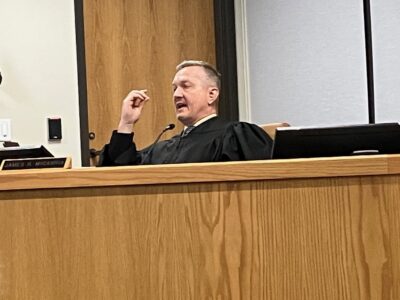
photo by: Kim Callahan/Journal-World
Judge James McCabria is pictured on Thursday, Oct. 30, 2025.
Two individuals who believe they deserve a piece of a medical malpractice settlement were disappointed Wednesday when a Douglas County judge ruled that they did not have standing to intervene in the case in pursuit of attorney fees.
The unusual request – Judge James McCabria said he had never handled anything like it – came from two attorneys, Donna Huffman and Jason Belveal, who had previously worked on behalf of Jeannine Williams-Davidson, who went to Stormont-Vail Hospital in Topeka several years ago to have an adrenal gland removed, but wound up with part of her pancreas removed instead.
On June 15 of this year, the day the medical malpractice trial was to begin, the parties reached a confidential settlement. Williams-Davidson’s sole attorney at the time was Shawn Lee.
Lee told McCabria during Wednesday’s hearing that he was “frankly a little shocked” by the previous attorneys’ motions to intervene.
“I’ve never heard of it before,” he said. “My client has one lawyer on this case, and she does not dispute the fee agreement she has with her lawyer.”
Belveal attempted to argue that standing existed and that his claim would not interfere with the amount Williams-Davidson would recover, but McCabria said he struggled to see what jurisdiction the court had over what was essentially a fee dispute between prior counsel and current counsel, describing the attempted intervention as a “lawsuit within a lawsuit that has nothing to do with the original subject” of the malpractice case.
“It’s outside the scope of this litigation,” McCabria said, telling prior counsel that they’d have to pursue a separate lawsuit to enforce what they believed they were owed.
Belveal then asked McCabria if they could be “looped in” on the amount of the confidential settlement, stating that he did not know what the defendants had agreed to pay and asserting that the defendants wouldn’t mind the disclosure.
No defendants were present in the courtroom Wednesday. They had filed a motion to pay what they owed directly to the court since the disbursement of the funds to plaintiff’s side was in dispute.
Lee opposed publicizing the settlement agreement, and McCabria made no such disclosure.
Lee’s contract for attorney services, included as an exhibit in the court record, indicated that he would receive 50% of anything that this client recovered and the client would have to also pay any court costs and fees out of her share of the settlement.
Public Safety
In domestic violence case, Lawrence woman is acquitted of 5 of 6 charges; jury finds her guilty of one misdemeanor
Man ordered to stand trial after friend testifies that night of drinking ended with a rape

24-year-old ordered to stand trial in connection with Lawrence mother’s drug death
Former LHS teacher admitted having sex with a sophomore 26 years ago, but a lot turns on whether she was 15 or 16 at the time
23-year-old man charged with second-degree murder in downtown Lawrence homicide