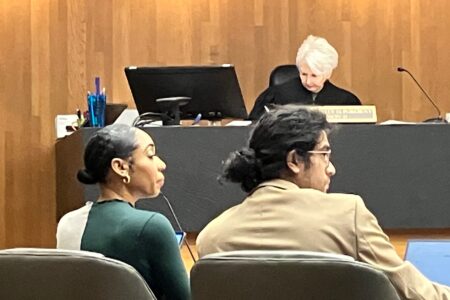
Judge finds Lawrence police unlawfully detained man; after she suppresses evidence, DA drops case

photo by: Mugshot courtesy of the Shawnee County Sheriff's Office
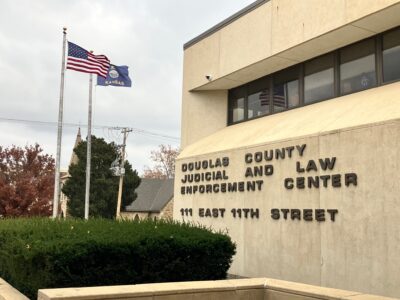
Elijah Joseph Garcia is pictured with the Douglas County Judicial and Law enforcement Center.
A case against a criminal defendant was dismissed on Wednesday after a Douglas County judge found that Lawrence police officers had acted unlawfully.
Judge Stacey Donovan on Aug. 28 granted a motion to suppress evidence in the case of Elijah Joseph Garcia, who was facing felony charges of aggravated battery and possession of cocaine. Donovan determined that police conduct related to Garcia’s arrest was unconstitutional and “must be condemned by the judiciary, and its fruits must be excluded from evidence.” Three days after Donovan’s ruling, the Douglas County District Attorney’s Office moved to dismiss the case without prejudice, meaning it could potentially be refiled.
Garcia’s case originated from an incident two years ago in which he was alleged to have taken part with two other men in a brutal beating of a fourth man — allegedly over the man’s refusal to chip in money to buy cocaine.
When Lawrence police responded in the middle of the night on Sept. 7, 2024, to the report of the man’s beating, they encountered Garcia in a nearby parking lot in the 1100 block of Louisiana Street. Knowing that they were investigating a fist fight, they asked to see his hands, which he displayed. That action led to Garcia being detained, a warrant check being performed and a search being conducted that uncovered cocaine in Garcia’s pocket.
Garcia’s attorney, Razmi Tahirkheli, argued that the initial detention was unlawful and that evidence collected as a result of it must be suppressed. Judge Donovan agreed.
Donovan said the incident started as a voluntary encounter, which does not trigger the Fourth Amendment’s prohibition against unreasonable searches and seizures. However, the encounter became involuntary because the officers used a “show of authority” that under the totality of the circumstances would have communicated to a reasonable person that the person was not free to disregard the officers’ questions, decline their requests or end the encounter and leave.
In Garcia’s case, two officers approached him with flashlights as he was “boxed in” between a vehicle and a garage wall, Donovan said, creating a situation where a reasonable person would not have felt free to decline the officers’ requests to see one’s hands or to walk away. Prior to seeing his hands, she said, officers did not have “reasonable, individualized suspicion” of Garcia’s involvement in criminal activity.
“Reasonable and articulable suspicion must exist before a lawful Terry stop,” Donovan said, citing the landmark U.S. Supreme Court case Terry v. Ohio, which established the constitutional framework under which stop-and-frisks and police detentions are analyzed.
At the time that they detained Garcia, officers had no descriptions of individuals involved in the fight. Later, as Garcia was handcuffed next to a police car, the beaten man looked toward the car and positively identified him as one of his attackers, but Donovan agreed with the defense that the identification “was impermissibly suggestive and unreliable,” not the least because the man had earlier shown a different officer a picture on his phone of a man with a different name and claimed he was the attacker.
Because the initial detention by the garage was unlawful, Donovan said, the warrant check that followed (which led to pending warrants) and the arrest and search (which turned up cocaine) were “fruits of the poisonous tree,” which the law requires to be suppressed.
Garcia was originally supposed to stand trial in the now-dismissed case just days after he was acquitted by a jury of six felonies in another Douglas County case in which he was accused of beating and pistol-whipping people in a moving car and again on his front lawn. The second trial was delayed after Tahirkheli complained of newspaper coverage of the first trial and falsely claimed to the court that the media had published a confidential attorney-client conversation.
Public Safety

24-year-old ordered to stand trial in connection with Lawrence mother’s drug death
Former LHS teacher admitted having sex with a sophomore 26 years ago, but a lot turns on whether she was 15 or 16 at the time
23-year-old man charged with second-degree murder in downtown Lawrence homicide
Lawrence Police Department receives KDOT’s top traffic safety award for second straight year

Police arrest 23-year-old on suspicion of first-degree murder in downtown Lawrence homicide