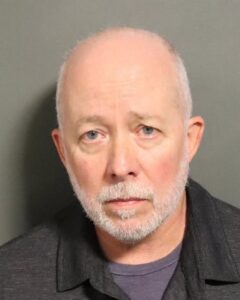

Public defender wants judge to toss jurors’ verdict in child sex abuse case; prosecutor denies that her conduct unduly prejudiced them

photo by: Kim Callahan/Journal-World
Jordey McTaggart appears at his sex-crimes trial on Monday, July 13, 2026, in Douglas County District Court.
Douglas County’s Public Defender Office is asking a judge to throw out a jury’s verdict convicting a Lawrence man of two child sex crimes.
The defense attorneys — Jessica Glendening and Allyson Monson — are arguing that statements made by the prosecutor during jury selection and closing arguments constituted misconduct and deprived their client, 36-year-old Jordey Michel McTaggart, of a fair trial. They are asking Judge Carl Folsom III, who did not preside over the trial, to order a new trial or to issue a judgment of acquittal.
The prosecutor, Megan Ahsens, has argued that her comments were well within professional standards and that the jury’s decision should stand. The two child victims both testified that McTaggart sexually abused them when they were around 8 years old.
“Their testimony was powerful and the jury believed them,” Ahsens said in response to the defense motion.
On Friday, the day McTaggart was supposed to be sentenced, the two attorneys appeared before Folsom to make their respective cases. Folsom did not rule immediately, saying he would need time — approximately 30 days — to review the entire trial transcript and issue a decision. He pushed back the sentencing from Friday to Feb. 19.
McTaggart was charged with three sex crimes against two girls under age 10 who spent the night with his kids at his family’s Lawrence home between 2018 and 2021. In July, jurors convicted him on two counts — aggravated indecent liberties with a child and rape — and acquitted him on a third count of aggravated indecent liberties. He is facing a life term for the off-grid felonies, or at least 25 years in prison without parole, when he is sentenced.

photo by: Kim Callahan/Journal-World Photo
Public Defender Jessica Glendening is one of Jordey McTaggart’s attorneys, along with Allyson Monson.
Defense attorneys argued that numerous statements by Ahsens were improper, including what they deemed characterizing herself as an “expert” during jury selection, when Ahsens noted that she has 25 years of trial experience and had taught courses about forensic science and the law. In her response, Ahsens said it was common practice for attorneys to introduce themselves to prospective jurors by citing their experience and by explaining the difference between circumstantial and direct evidence and what jurors could generally expect at trial.
Ahsens had told the prospective jurors that the case would not include direct forensic evidence because it was normal in child sex abuse cases for victims to report the abuse much later. She said jurors would hear evidence that the average age for such delayed disclosure was 51, but no such precise evidence was ever produced at trial. A detective testified that delayed disclosure was “really common,” but no evidence was admitted regarding the age of disclosure.
Ahsens said on Friday that the 51 number was simply a fact but that her point, regardless, was that it’s normal for people to not disclose sex abuse right away, which would explain the lack of forensic evidence like DNA or injuries.
The victims in this case disclosed the abuse when they were teens.
Defense attorneys also faulted Ahsens for telling the jury that trauma affects memory and that inconsistent statements were not unusual in child sex abuse cases. No evidence of this was presented, they said, except Ahsens’ say-so. But Ahsens disagreed, saying evidence did support her statements at trial, namely testimony from two witnesses, a detective and a foster mother, that children sometimes tell what happened in different ways to different people. Such testimony, she said, did not require a special expert.

photo by: University of Kansas
Douglas County Senior Assistant District Attorney Megan Ahsens
The defense also accused Ahsens, among other things, of improperly bolstering the girls’ credibility, citing facts that were not in evidence and of “creating scripts” of what she imagined McTaggart’s thought process to be — for example, by imagining that McTaggart thought to himself “I can get away with this. … No one is going to believe her.” They said this conduct, as well as an alleged description of McTaggart as a “predator,” was done with the purpose of inflaming the jury’s passions against their client.
Ahsens responded that she never called McTaggart a “predator” but simply made a statement of how predators behave, which she said fairly matched the evidence that had been presented at trial against him, namely that he had victimized more than one child and had a “type,” according to witnesses.
Ahsens also argued that it was fair for her to speculate that McTaggart’s wife may have had reasons for testifying on her husband’s behalf.
In her closing argument she had said the wife had a “vested motivation in testifying.”
“She doesn’t want her husband to get into any trouble,” Ahsens told jurors. “She doesn’t want him to be convicted of these charges. I’m sure she doesn’t want to be married to someone who is known as creepy or a child molester.”
Glendening argued that the statement — attributing such thoughts to a witness — was “inflammatory, improper and prejudicial.”
While Glendening faulted Ahsens for such comments on a witness’ credibility, Ahsens noted that Glendening had spent her entire closing argument attacking the credibility of the girls, basically accusing them of being liars and turning “gossip” and “stories” into accusations. Ahsens said she didn’t object to this, though, because in her view that was within the latitude of a closing argument.
Ahsens made a plea for common sense to be employed, noting that prosecutors try people for rape because they believe the evidence shows that they are rapists. “I’m asking the jury to convict him,” she said of her role in making a closing argument.
It’s fair and expected, she said, for attorneys to comment on the evidence, and jurors are always instructed by judges that the statements of attorneys are not evidence and that it’s up to the jury to decide what is fact and who is credible.
Ahsens described some of the arguments in Glendening’s motion as splitting “very fine hairs” and some as “beyond the pale of absurdity.”
Still, Glendening told Folsom that Ahsens’ conduct had been “extremely prejudicial.”
“This closing argument violated well-known rules of prosecutorial conduct again and again,” Glendening said.
But the notion that the jury was unduly prejudiced by anything she said during the trial was nonsensical, Ahsens said, because jurors actually acquitted McTaggart on one of the three charges — something they likely wouldn’t have done if they had been unduly prejudiced by Ahsens’ conduct.
Defense attorneys don’t have to object to prosecutorial error in real time, but Ahsens said it strained credulity that a defense attorney “would sit on her hands and fail to object to a single word that was said,” especially when she believed the prosecutor’s conduct had been so pervasively egregious.
Ahsens said that if she committed any errors during the trial they were harmless mistakes that did not warrant throwing out the verdict of a jury who had “weighed the evidence carefully.”
McTaggart’s case was originally handled by Judge Sally Pokorny, who retired in April. Senior Judge Nancy Parrish presided over the July trial, and Folsom got the case in mid-October.

photo by: Kim Callahan/Journal-World
Prosecutor David melton questions a witness on Wednesday, July 15, 2026, in the Jordey McTaggart trial in Douglas County District Court. Senior Judge Nancy Parrish is at left.
Public Safety
Public defender wants judge to toss jurors’ verdict in child sex abuse case; prosecutor denies that her conduct unduly prejudiced them

Jury convicts 74-year-old Lawrence landlord of sexually preying on child tenants

UPDATE: Lawrence schools briefly placed on lockout over ‘credible threat’ involving community member
State says Lawrence landlord sexually abused kids; defense dismisses girls’ accusations as ‘stories’

Teen charged with aggravated burglary of assisted living facility in Lawrence