Repeat felon who was granted a deal and secrecy is charged with another felony — before sentencing in previous case
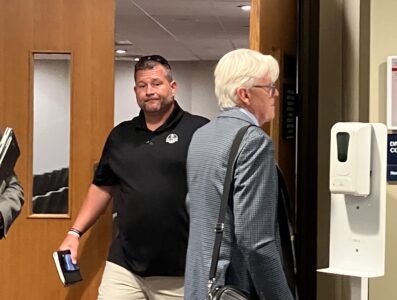
photo by: Kim Callahan/Journal-World
Convicted felon William Pope leaves the courtroom of Judge Stacey Donovan with his attorney, Gary West, on Oct. 15, 2025.
Updated at 5:56 p.m. Tuesday, June 23
A repeat felon whose case has been shrouded in secrecy and who received what some might consider an unusually generous plea deal has allegedly committed another felony less than eight months after his most recent conviction.
In the new case, which came to light Tuesday, William Michael Pope, 45, was charged with felony theft. The charge stems from a May 4 incident in which he allegedly stole sterling silverware from an individual that was valued at more than $1,500.
Pope was in court Tuesday for a status conference on an October conviction for which — seven months later — he has yet to be sentenced. In that case, as the Journal-World reported, Pope pleaded no contest to one count of aggravated assault.
Judge Stacey Donovan entirely sealed the arrest affidavit, meaning no part of it could be viewed by the public, and also kept the written plea agreement completely under wraps. If the Journal-World had not been present at Pope’s plea hearing in October — and heard only what the parties were willing to put on the record — almost nothing would be publicly known about the liquor store case.
In that case Pope had originally been charged with attempted aggravated robbery and aggravated assault for the early 2025 incident in which he allegedly donned a face covering and aggressively demanded money from a person at Buddy’s Liquor on West Sixth Street while brandishing a gun. In a separate case from December 2024, he was accused of felony theft of a Trek bicycle worth more than $1,500.
After he pleaded to aggravated assault, the other felony charges in those cases were dismissed as part of the deal. Additionally, the state agreed that there would be “no finding” that a gun was used during the crime, which allowed Pope to evade a special state rule that presumes a prison sentence if a defendant uses a gun while committing a person felony. The state also did not object to Pope’s GPS monitor being removed in the months before sentencing, which still has not occurred, and said it would recommend that Pope be given probation, despite his lengthy criminal history.
Pope is a felon many times over. According to the Kansas Department of Corrections, he has convictions for theft and burglary in Osage County in 2012; for forgery in Anderson County in 2003; for burglary and aggravated assault in Shawnee County in 2012 and 2013; for robbery in Franklin County in 2013; and for robbery in Douglas County in 2006. He was most recently discharged from the prison system in May 2024, according to the KDOC, which indicates he also goes by the aliases William Scobee or Bill Scobee.
On Tuesday, Donovan appointed Gary West from the Public Defenders Office to represent Pope in the new theft case. West also represents Pope in the prior case. Donovan set an own recognizance bond of $5,000 for Pope and ordered him not to have contact with three witnesses in the new case and to stay clear of drugs and alcohol.
Pope’s next court hearing will be on July 7, when next steps in the cases will be scheduled. A motion to depart from sentencing guidelines — presumably from prison to probation — has been filed ahead of Pope’s sentencing in the liquor store case, but it too is under seal and not accessible to the public.
If Donovan doesn’t grant the departure, Pope faces a prison sentence of 27 to 31 months, if his criminal history score is what the parties believe it to be: a “B.” If it comes back on a presentence report as an “A,” the worst possible, he could face even more time.
In her Oct. 30, 2025, order sealing Pope’s arrest affidavit, Donovan said that releasing the document “may”:
• “Jeopardize the physical, mental or emotional safety or well-being of a victim, witness, confidential source or undercover agent, or cause the destruction of evidence;
• interfere with any prospective law enforcement action, criminal investigation or prosecution;
• reveal confidential investigative techniques or procedures not known to the general public; and/or
• endanger the life or physical safety of any person.”
Public Safety

Man accused of selling wristbands to enable minors to drink at time of Hawk shootings is sentenced to probation

36-year-old Lawrence man confessed to raping 13-year-old girl, affidavit says
Evacuation drill planned Tuesday at Lawrence City Hall

Douglas County’s newest pro tem judge sworn in

Woman has renewed hope for justice 17 years after reporting rape in Lawrence