As city and county planners consider traffic safety targets for next year, a closer look at how the data works
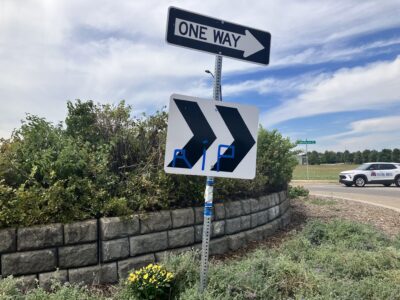
photo by: Kim Callahan/Journal-World
The roundabout at Lake Pointe Drive and Clinton Parkway is pictured Friday, Aug. 29, 2025.
Last November, when Lawrence and Douglas County planning officials set their traffic safety targets for 2025, their target was to have under 8.3 fatal crashes in Douglas County. So far, the county is under that, with just five.
Now, they’re considering a target for 2026 that looks a lot lower: 6.4 fatal crashes.
You might think that planners hope to see a drop in crashes because of the county’s performance so far this year. But what you might not realize is it could have just as much — if not more — to do with a spike in fatal accidents that took place in 2019 and 2020.
To see why, the Journal-World looked at the draft of the 2026 Transportation Safety Performance Targets for Lawrence and Douglas County, for which the public comment period began Thursday and ends Oct. 31. These targets are used to shape the city and county transportation plan known as Transportation 2050, which sets goals for improving all forms of transportation in the county, including roads, public transit and pedestrian and bicycle infrastructure. They’re set to come before the Lawrence-Douglas County Metropolitan Planning Organization’s Policy Board on Nov. 20 for approval, after which they’ll be incorporated into the plan.
You can see the draft targets at lawrenceks.gov and comment on them by emailing mpo@lawrenceks.gov. Here’s a look at how these statistics work, what the numbers represent, and what, if any, relationship they have to the fatal crashes that have happened in Douglas County this year.
What are the targets, and how do they compare to last year’s?
The targets cover several different traffic safety categories. Here are the targets that were approved in November 2024 for this year, and the targets that are now being proposed for next year.
• Number of fatalities: 2025 target 8.3, proposed 2026 target 6.4.
• Fatalities per 100 million vehicle miles traveled: 2025 target 0.78, proposed 2026 target 0.60.
• Number of serious injuries: 2025 target 36.9, proposed 2026 target 35.8.
• Serious injuries per 100 million vehicle miles traveled: 2025 target 3.51, proposed 2026 target 3.41.
• Number of bicyclists and pedestrians seriously injured or killed by vehicles: 2025 target 5.6, proposed 2026 target 5.8.
Almost all of the targets for next year would be lower. The only target that would be higher is the statistic referred to as “number of non-motorized fatalities & serious injuries” — in other words, the number of bicyclists and pedestrians seriously injured or killed by vehicles.
The draft of the targets says they’re crafted with the intent of reaching the goals of “Vision Zero” by 2050. Vision Zero refers to a set of strategies that officials are implementing in hope of reaching zero fatalities and serious injuries from transportation accidents.
What do the targets represent?
The 2026 targets don’t just represent the goals for traffic injuries and fatalities in 2026. Rather, they represent a period of five years averaged together. So, when planning leaders set their target for fatal crashes in 2026, that actually represents the average number of crashes per year for the years 2022 through 2026.
These five-year averages are specified by federal regulations for reporting this data, transportation planning manager Jessica Mortinger said via email. According to the Federal Highway Administration, these five-year chunks are intended to provide stability to the data while still reflecting broader trends in injuries and fatalities.
You can see that, for example, in the target for number of fatalities on all public roads in Douglas County. The number of fatalities rises to 12 in 2019 and 18 in 2020, before falling down to seven for the next three years and six in 2024. The five-year average stays more consistent over those years. It was 10.2 in 2020, hovered in the 10s in the next few years, and then fell to 9.0 by 2024, when the 2019 and 2020 data was further in the rear-view mirror.
In 2025, the rolling average will be based only on those years of seven or six fatalities, plus whatever 2025’s number turns out to be.
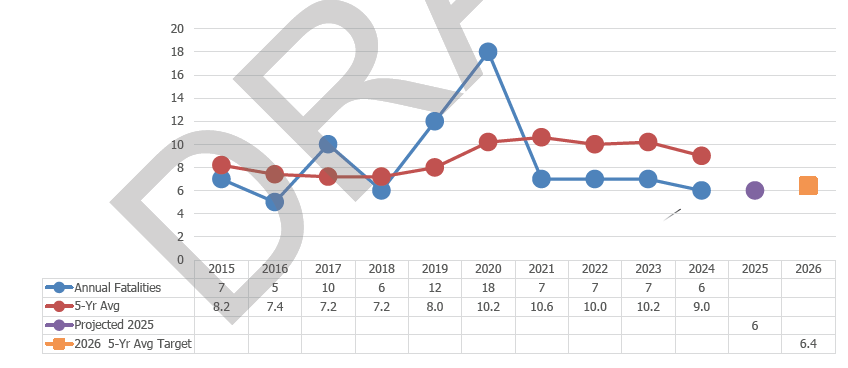
photo by: City of Lawrence
This chart included with the city and county draft transportation safety targets for 2026 shows fatalities by year, in blue, and the five-year running average, in red. Note the spike in fatalities in 2019 and 2020, and how the average responds.
Does the draft account for how well Douglas County is doing this year?
For each goal, the draft includes statistics for previous years, as well as a projection for 2025. But Mortinger said these are more like how Douglas County is expected to perform based on historical data.
Mortinger said the Kansas Department of Transportation provides crash data that the planners use. She also said, however, that “the numbers shown on the table for 2025 projected are based on historical averages and not tied to actual crashes.” In other words, you might want to wait for the final data if you’re trying to figure out how Douglas County has actually done this year.
What is the 2025 data on fatal crashes so far?
There have been five fatal crashes in Douglas County so far this year. The projection for 2025 was six, but that’s likely a coincidence because the data is not tied to actual crashes, as Mortinger said.
However, the actual number of crashes is still important, because it will become part of that historical data in the future.
Mortinger noted that in the Kansas Department of Transportation’s data, there are five fatal crashes listed for 2025. The Journal-World has also reported on five fatality crashes in Douglas County this year. One of them took place in May, two in July and two in August.
Three of the people killed in these crashes were on motorcycles, and one was on a bicycle. In only one of these crashes was the person who died in a car or truck.
• On May 9, a Topeka man was killed in a rollover crash near Midland Junction.
• On July 9, a motorcyclist died after crashing at Clinton Parkway and Lake Pointe Drive.
• On July 22, a bicyclist was struck by a vehicle in the 2000 block of North 1400 Road. The bicyclist died from his injuries the next day.
• On Aug. 8, a motorcyclist died after colliding with a car at the intersection of 21st Street and Naismith Drive.
• On Aug. 28, another motorcyclist died after crashing at Clinton Parkway and Lake Pointe Drive.
(There have been several other fatality crashes that the Journal-World has covered this year, but they either involved Douglas County residents but took place elsewhere, or occurred just outside of the county’s boundaries.)
City Government
Lawrence City Commission to weigh whether Costco should be included in STAR bond district
As they approve bikes plan, Lawrence city leaders ask about data collection, Kentucky and Tennessee streets
Lawrence city leaders want to toughen tobacco licensing rules ‘sooner than later’
Algerian government invites Mayor Brad Finkeldei, Lawrence delegation for a visit
Construction on Wakarusa Drive to resume; city manager says KDOT’s secretary has apologized for delay