

After 25 years and new DNA methods, arrest made in Naismith Valley Park child sexual assault cases
Raytown, Mo. man has been charged, awaiting extradition to Douglas County
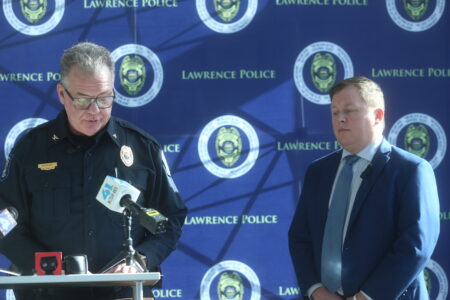
photo by: Chad Lawhorn/Journal-World
Lawrence Police Chief Rich Lockhart and Douglas County District Attorney Dakota Loomis are pictured at a Dec. 30, 2025 press conference.
Story updated at 5:05 p.m. Tuesday, Dec. 30:
The cigarette butt was still warm when Lawrence Police Department Detective Mike McAtee picked it off the ground of the crime scene in Naismith Valley Park.
But more importantly, it was still covered with DNA.
The detective was on the scene Aug. 25, 2000, to investigate a sexual assault against a child. The victim, a 7-year-old girl, said her attacker had been smoking a cigarette. Detectives found spent cigarettes near the scene, and more than a year later, a lab had produced DNA evidence from the cigarettes to enter into a national database. There was reason to believe this case was on a path to being solved.
Then, for more than 25 years, the path led nowhere.
On Tuesday, though, the Lawrence Police Department and the Douglas County District Attorney’s Office announced a Raytown, Missouri, man was arrested and charged on Monday in connection with that 2000 sexual assault and one other sexual assault against a child that was committed in the same park in 2003.
DNA evidence from that cigarette butt — enhanced by new technology employed by another detective who had been on the case since the beginning — helped lead to the arrest.
“Don’t give up hope,” Lawrence Police Chief Rich Lockhart said during a Tuesday press conference when asked what he hoped other victims of sexual assaults would take away from this recent arrest. “We’re not going to give up hope.”
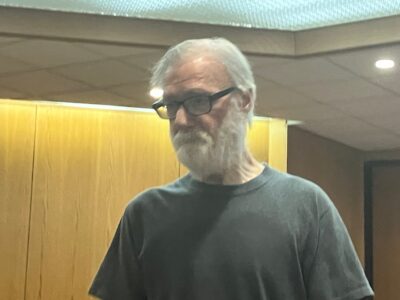
David James Zimbrick, 58, was arrested Monday by U.S. Marshals in Raytown after detectives with the Lawrence Police Department earlier this month received confirmation from the Kansas Bureau of Investigations that the DNA from Zimbrick — who had been interviewed and swabbed weeks earlier — was a match to DNA found at the crime scenes.
As it stands now, a warm cigarette may indeed have been critical to raising the temperature of a pair of cold cases.
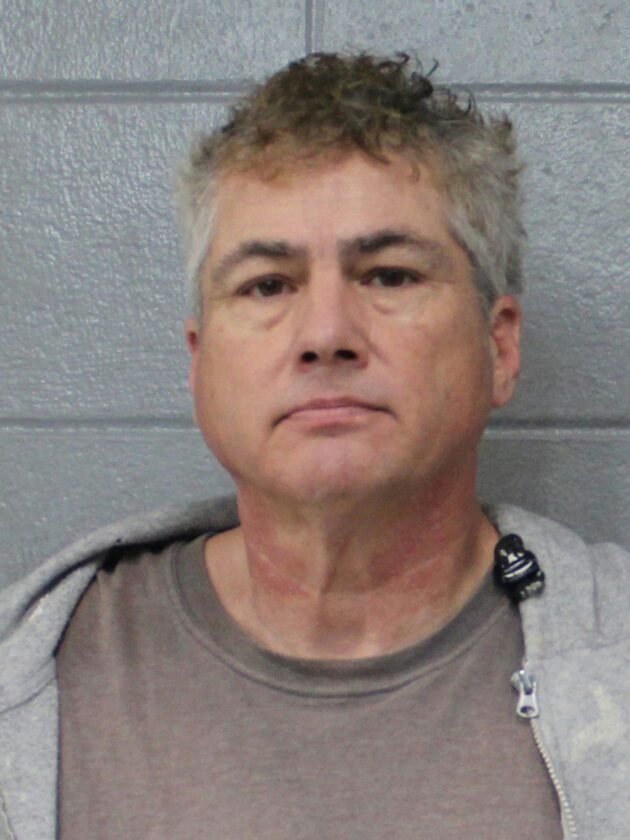
photo by: Lawrence Police Department/Jackson Co. Mo.
David J. Zimbrick
Zimbrick is in custody in the Jackson County, Missouri, jail, and is awaiting extradition to Douglas County. Zimbrick already has been charged with one count of aggravated criminal sodomy and one count of rape in the 2000 and 2003 cases, Douglas County District Attorney Dakota Loomis said at Tuesday’s press conference.
Upon extradition, Zimbrick will undergo an arraignment and the criminal proceedings will begin to unfold, Loomis said.
Additional investigative work will continue, including searches of other similar incidents to determine if Zimbrick might be a suspect in other crimes. But on Tuesday, Lockhart and other LPD leaders were taking a moment to highlight the more than two decades of police work that had led to Monday’s arrest.
“I’ve worked in big departments, I’ve worked in small departments, and this is kind of my mid-size department, and I would put these two up against any detectives I’ve known in 35 years,” Lockhart said of LPD Detectives Amy Price and Megan Bardwell — who were present at Tuesday’s press conference — for their longtime work on the case.
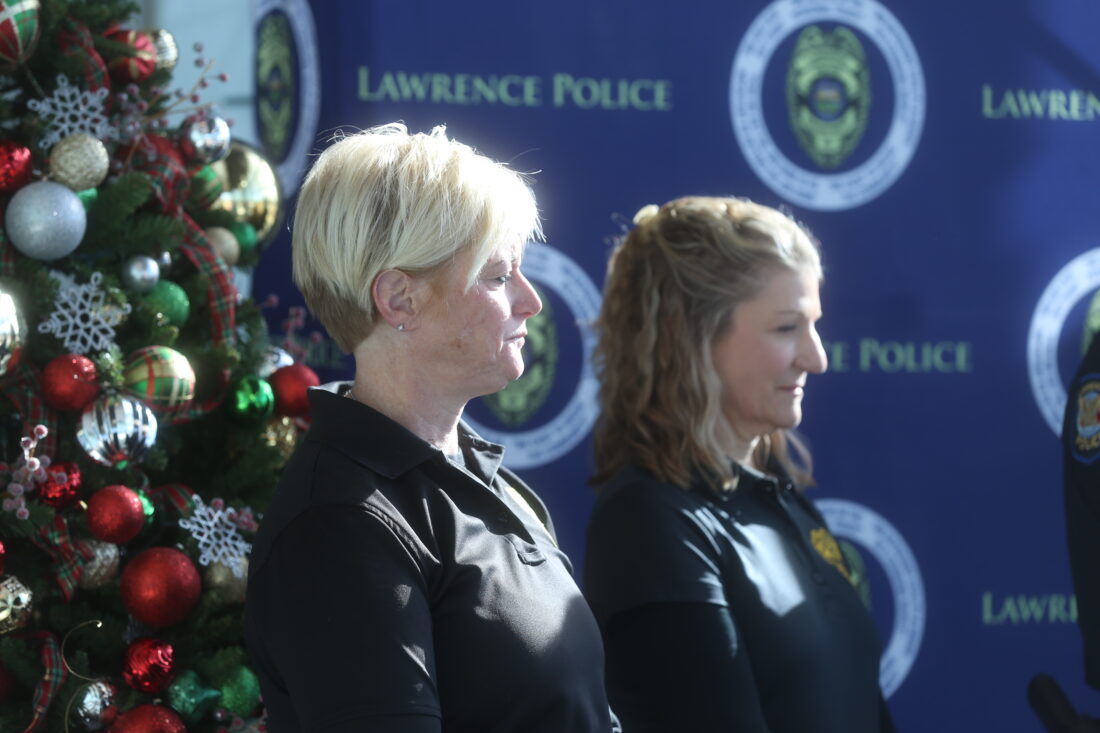
photo by: Chad Lawhorn/Journal-World
Detectives Meghan Bardwell and Amy Price of the Lawrence Police Department are pictured at a Dec. 30, 2025 press conference.
McAtee, who is now retired from the LPD, also was on hand for the press conference and was recognized for his work on the original crime scene. While McAtee found a cigarette butt, the key finding by Price might best be described as a nugget in a news article.
In 2018 and 2019, national headlines included news of the arrest and conviction of a California serial killer and rapist known as the “Golden State Killer.” The news reports highlighted how investigators hadn’t just used typical DNA analysis to identify that killer, but rather had used a more advanced form that tapped into public, consumer-oriented databases. Hundreds of thousands of ordinary citizens voluntarily upload their DNA to public databases used by people who are looking to fill in the blanks of their family trees.
In California, investigators began using that sort of DNA data to not only see if their killer happened to be a match in one of those public databases — he was not — but also to see if any of the DNA in those public databases came back as being a relative of the killer. That is what investigators found. With that type of match, investigators at least had a reasonable pool of suspects to investigate, which led to the 2018 arrest of Joseph James DeAngelo in California more than 40 years after his first crime.
When Price heard about that investigative technique — often called forensic genetic genealogy — her thoughts turned to the Naismith Valley Park cases. She began reaching out to law enforcement officials about what steps would need to be taken to use the method in the Lawrence cases. On Tuesday, she told the Journal-World that the technique gave her some reason for hope as soon as she began studying it.
“I was fairly hopeful, hoping there was some sort of relative or family tree that we could build off of,” Price said on Tuesday.
Price said she also needed a reason to feel some hope. She had responded to the 2000 crime scene, and had remained attached to the case ever since. On Tuesday, she said that in 2019 — when she began digging into the new DNA techniques — the cases were very cold.
“Definitely not,” Price said when asked if they had any other leads to follow had the DNA evidence not been fruitful.
But by 2020, there was a lot of reason to believe the DNA evidence was going to bear fruit. Price arranged for a specialized lab to take a new extraction from the DNA evidence, and by mid-2020 the lab had provided Price with a “hypothesis” about the ancestry of the suspect. In other words, the detectives now had a list of people who perhaps were grandparents, or even parents of the suspect who could be questioned.
Diving deeper in the suspected family tree, Price and Bardwell found that one of the individuals on the family tree had put a male child up for adoption upon the boy’s birth. Thus, that person’s name wasn’t on the family tree, but investigators were intent on finding out more.
So much so that Price and Bardwell traveled to Santa Fe, New Mexico to interview the woman who had put the child up for adoption. She told the duo that the child had done his own investigative work years ago to find his birth mother. She said the child, now grown, had reached out to her in 2005 to introduce himself. His name was David Zimbrick.
Price and Bardwell used that information to subpoena the adoption records, and learned through them that Zimbrick had previously lived in Lawrence.
The cold cases became very active at that point, and with the help of area law enforcement, Zimbrick was brought in for questioning on Nov. 20 at the Raytown Police Department.
Lockhart said Zimbrick said very little of value during that interview, but he was swabbed for DNA, and that ended up saying quite a lot. On Dec. 18, the KBI said it could match his DNA to the 2003 crime scene. Previous analysis had already matched the DNA from the 2003 crime scene to the DNA on the cigarette butt from the 2000 scene.
With that news, an arrest was made 11 days later, which Bardwell said was a big moment, but definitely not an ending.
“The arrest is half of it,” Bardwell said. “The conviction is really the end goal for us.”
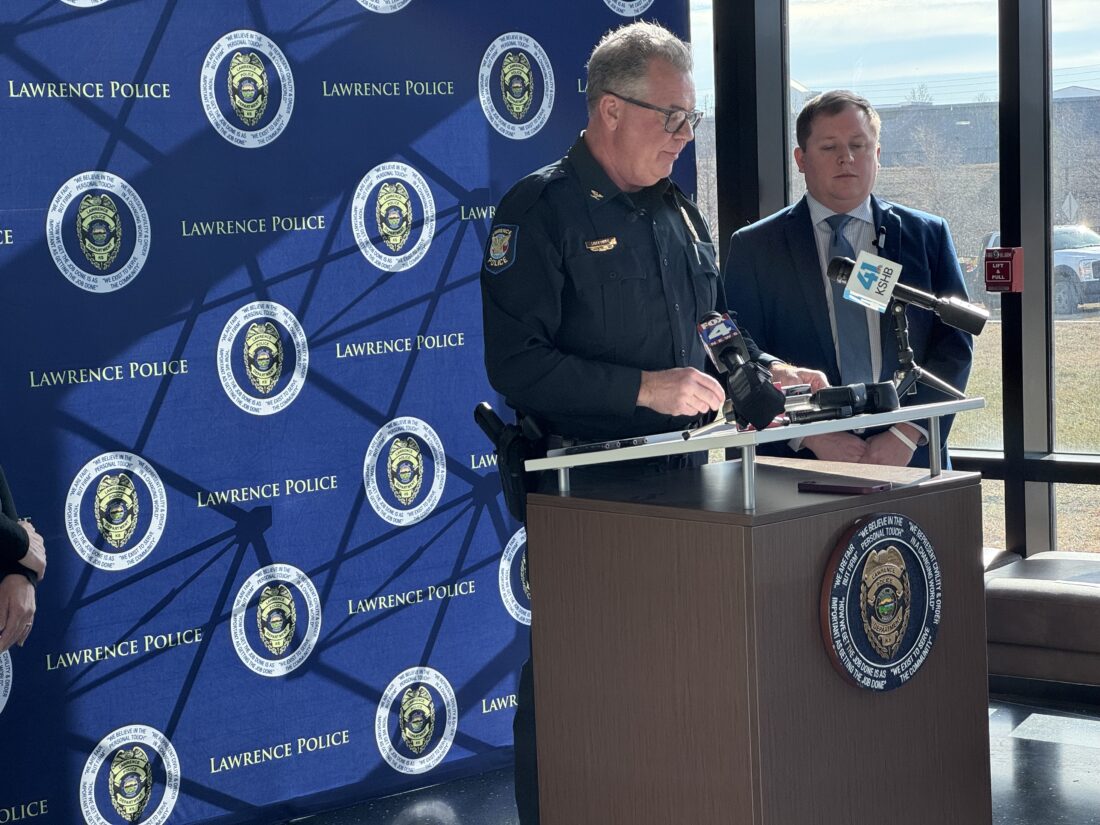
photo by: Chad Lawhorn/Journal-World
Lawrence Police Chief Rich Lockhart and Douglas County District Attorney Dakota Loomis announce an arrest in a 25-year old Lawrence sexual assault case on Dec. 30, 2025.
In terms of whether there may be other crimes that can be tied to Zimbrick, Lockhart said police don’t have definitive evidence to say that’s the case. There are three other sexual assaults that have occurred with similar elements to the 2000 and 2003 crimes, but Lockhart said those crime scenes didn’t produce DNA evidence that could be used, and the statute of limitations has expired on those crimes. Cases in Kansas that do not have DNA evidence have a shorter statute of limitations than those that do have DNA evidence, which is why the 2000 and 2003 cases can still be charged, Lockhart said.
But Lockhart said the police are interested in any information about incidents that anyone believes may be connected to Zimbrick. Lockhart said there were several common details between the 2000 and 2003 sexual assaults. Both occurred in Naismith Valley Park, which runs along a creek in southeast Lawrence, with its centerpoint being near the intersection of 27th and Arkansas streets.
In both cases, victims reported that the perpetrator approached them and offered $20 in cash if they could help him find a lost item. In both cases, the perpetrator approached a group of children in the park. He would send the children in different directions to look for the item, ensuring that the children were isolated, and then would attack and sexually assault them.
In the 2000 case, the children in the group ranged in age from 7 to 8 years old, while in the 2003 case, the group consisted of two 10-year old boys.
On Tuesday, Lockhart — a 35-year veteran of police forces — said it was extremely rare for a case that had been cold for 20-plus years to be solved. But he said new technology and dedicated police work should make criminals believe that they are never truly out of reach from being caught.
“Somebody probably thought they got away with it,” Lockhart said of these cases. “We just want to let you know that if you’ve committed crimes like this, eventually we are going to catch up to you.”

photo by: Chad Lawhorn/Journal-World
Members of the Lawrence Police Department and the office of the Douglas County District Attorney participated in a press conference on Dec. 30, 2025 announcing the arrest and charges in a 25-year old sexual assault case. Pictured from left: Det. Meghan Bardwell, Det. Amy Price, Police Chief Rich Lockhart, and District Attorney Dakota Loomis.
Public Safety
Crash on South Lawrence Trafficway closes highway temporarily, sends 2 to hospital with minor injuries
Lawrence man pleads not guilty to molesting young girls at sleepovers; trial scheduled for July
Officers save man who overdosed at convenience store, Lawrence police say
Man pleads no contest in connection with stabbing outside Lawrence restaurant
Former Lawrence landlord accused of sexually abusing kids faces new charges of interference and witness intimidation
