The DA’s office says prison is the best place for repeat offender; his attorney says the Marine Corps is

photo by: Kim Callahan/Journal-World
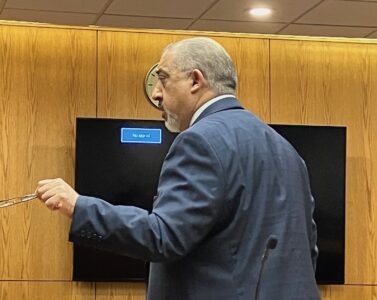
The Douglas County Judicial and Law Enforcement Center is pictured on Nov. 25, 2025.
The state wants him to go to prison, but the defense says he should go to the U.S. Marine Corps instead.
The fate of 21-year-old Joshua Mayo — prison or probation — will soon be decided by Judge Stacey Donovan, who recently convicted Mayo of felony criminal threat and misdemeanor criminal damage to property and a second DUI. Donovan was set to sentence him on Wednesday, but delayed doing so until Dec. 23 due to an incomplete assessment.

photo by: Douglas County Sheriff’s Office
Joshua Mayo
“Is the Marine Corps an actual possibility with his criminal history?” Donovan asked Mayo’s attorney, Michael Clarke. The question was prompted by Mayo’s criminal history score of “A,” which is the worst possible score under the Kansas Sentencing Guidelines.
Clarke — who blamed Mayo’s convictions on alcohol, and on a “lack of structure” in his life that he argued the military could provide — said that he could indeed become a Marine, based on his understanding of what a recruiter for the Corps told him. Clarke made the comment as part of his bid to persuade Donovan to depart from the presumptive prison term Mayo is facing for his most recent conviction of criminal threat.
Clarke said he had run Mayo’s most recent plea agreement by a Marine recruiter and understood that it would be possible for Mayo to enlist. A statement provided by the recruiter was referenced in court Wednesday but was not publicly available.
The U.S. Department of Defense, though, in “Qualification Standards for Enlistment, Appointment, and Induction,” states that the “Military Services are responsible for the defense of the Nation and should not be viewed as a source of rehabilitation for those who have not subscribed to the legal and moral standards of society at-large.”
Under Kansas law, a judge can depart from a presumptive prison sentence to probation if she finds substantial and compelling reasons to do so — for example, a finding that a person’s criminal behavior stems from an untreated substance abuse problem or a finding that public safety is better served through community-based supervision rather than prison.
“Mr. Mayo’s path forward is to complete treatment, maintain sobriety, complete probation successfully, and ultimately enter active duty in the United States Marine Corps,” Clarke said in his motion for probation.
Mayo, who has been in custody the past six months, has a string of convictions over recent years, leading to an extreme criminal history profile, prosecutor Cody Allen Smith told Donovan, and he currently has a pending DUI case involving an accident in another jurisdiction when he was on bond. Smith expressed concern that Mayo had racked up so many convictions in a relatively short time, and he urged Donovan to sentence Mayo to the 17 months in prison indicated by sentencing guidelines.
Court records indicate that Mayo has juvenile adjudications on his record related to theft, battery, sexual battery, criminal threat, criminal use of a financial card, trespass, assault on a law enforcement officer and various drug and liquor offenses.
As an adult, he’s “starting to pick up DUIs,” Smith said, “putting others at risk.”
The victim of Mayo’s criminal threat, a relative, declined to give a victim impact statement to the court, Smith said, noting that she “just wants to be left alone” by the defendant.
Even though he wasn’t sentenced Wednesday, Mayo briefly addressed the court.
“I do need structure,” he said.
To enlist as a Marine, a person must obtain a high school diploma and be a legal U.S. resident between 17 and 28 years old. The applicant must also pass a criminal background check and have no felony convictions, according to the Corps’ website.
People can obtain felony waivers, in some instances, to enter military services, but such waivers are based on “meritorious” cases, according to the DOD’s Qualifications Standards, which note that if an applicant has “a conviction, or a finding of guilty in a juvenile adjudication, for a felony crime of rape, sexual abuse, sexual assault, incest, any other sexual offense, or when the disposition requires the person to register as a sex offender,” enlistment will be prohibited and no waivers are allowed.
According to the DOD, the underlying purpose of enlistment standards “is to minimize entrance of persons who are likely to become disciplinary cases, security risks, or who are likely to disrupt good order, morale, and discipline.”
Generally, people with felony convictions are not allowed to possess firearms under federal law, but that restriction is presumably nonbinding if someone obtains a waiver to enlist in the armed services.
Public Safety
‘Forfeited the right to look the other way’; lessons from a class teaching the next generation of police officers

Leader of Kansas’ law enforcement training center trusts juries to deliver justice in Minnesota shootings

Attorney wants judge to seal affidavit, saying disclosure would likely lead to ‘widespread republication’ of explicit allegations

Four suspects arrested after alleged retail scam reaches Lawrence

Judge sentences Lawrence man to more than 12 years in prison for rape, denies new trial, says ‘consent’ has common meaning