

Continued analysis of Douglas County law enforcement agencies’ traffic stop data still shows disparity between Black and white drivers during 2022
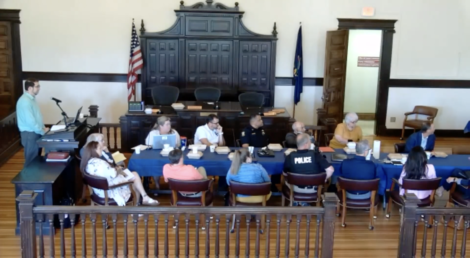
photo by: Douglas County screenshot
Douglas County senior data analyst Matt Cravens presents to the Criminal Justice Coordinating Council during its Tuesday, Aug. 8, 2023 meeting.
An analysis of data from Douglas County law enforcement agencies’ traffic stops in 2022 found that Black drivers were more likely than white drivers to be pulled over — a continuing trend from the same type of data collected for a study during 2020 and 2021.
Matt Cravens, a senior data analyst with the county, presented an update on that law enforcement contact data to the county’s Criminal Justice Coordinating Council at the group’s meeting on Tuesday. The data stems from a study commissioned by the CJCC back in 2019, which was completed about a year ago. Law enforcement leaders from around the county committed in November to continuing to collect traffic stop data.
The study, when first completed, found that Black drivers were nearly three times as likely as white drivers to be pulled over for a traffic stop in Douglas County in 2020 and 2021. That disparity hasn’t changed with the latest round of data collection, which included new data collected last year.
The study looked at a total of 18,371 stops of Douglas County residents between 2020 and 2022, and it estimated that 37% of Black residents in Douglas County who were old enough to drive were stopped by a law enforcement agency at least once during that time. Meanwhile, it estimated that only about 15% of white drivers were stopped during the same time period. That means Black people were 2.5 times as likely to be stopped, which Cravens said has not changed from 2020 to 2022. In data pertaining only to stops conducted during 2022, Black drivers were still 2.5 times as likely to be stopped.
“I think we can conclude here that a large share of Black drivers in the county have been stopped, but it is good to compare this number to other jurisdictions just to see how we measure up,” Cravens told the CJCC earlier this week.
And according to Cravens’ presentation, Douglas County has a bigger disparity than many cities across the country. He presented some statistics, compiled by the Stanford Open Policing Project, from 35 mid-size to large cities across the U.S. — some relatively nearby, like Wichita, and others much bigger and farther away, like Philadelphia and Los Angeles. Those 35 cities recorded data between 2015 and 2020 and had a total of about 2.3 million stops per year, and Cravens said that when you look at the aggregate of that data, Black drivers were 1.5 times more likely than white drivers to be stopped.
Cravens also pointed to a study of traffic stops across the state of North Carolina between 2015 and 2020. In that data, which included about 1.2 million stops per year, Black drivers were twice as likely as white drivers to be stopped.
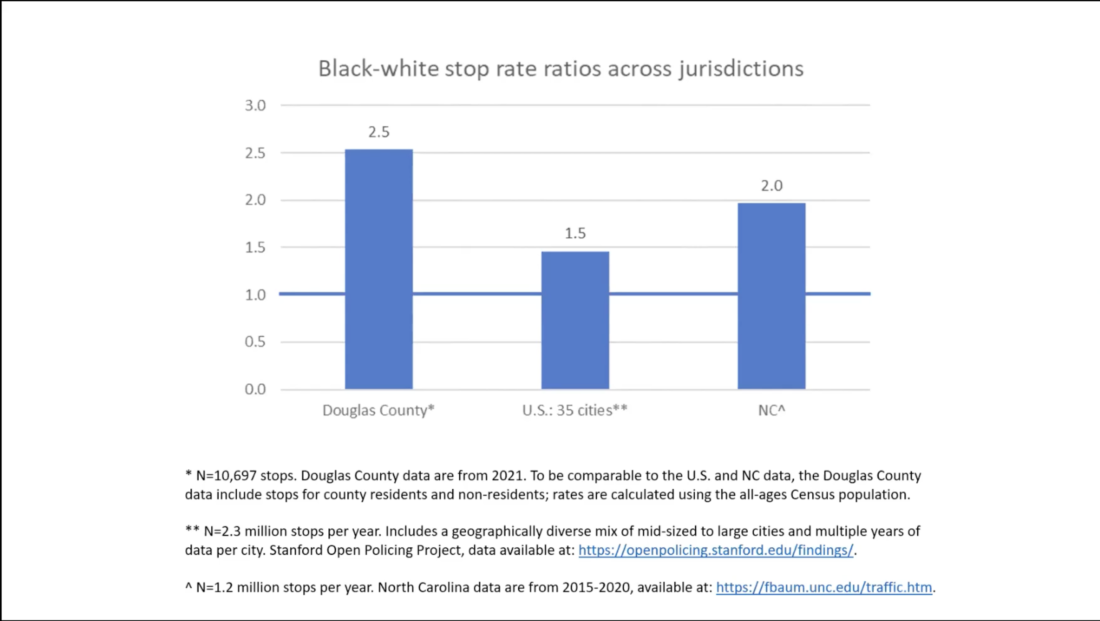
photo by: Douglas County screenshot
A chart shown during the Tuesday, Aug. 8, 2023 Criminal Justice Coordinating Council meeting illustrates how the disparity between the rates Black drivers and white drivers are stopped in Douglas County compares to other data from around the U.S.
There aren’t any similar disparities in Douglas County for any other racial or ethnic groups, but Cravens said recent research shows that law enforcement stop data does tend to underestimate racial disparities for Hispanic drivers as compared to white drivers, since Hispanic drivers may be erroneously reported as “white non-Hispanic.” He said it’s hard to tell what that discrepancy may actually be for Douglas County.
There were also racial disparities in the 2022 data for the likelihood of a driver being searched by law enforcement during a traffic stop, though Cravens said those ratios were lower compared to the rates from 2020 and 2021. In 2022, Black drivers were more than twice as likely as white drivers to be searched during a traffic stop, and people of color in general were 1.5 times as likely to be searched.

photo by: Douglas County screenshot
Another chart shown during the Tuesday, Aug. 8, 2023 Criminal Justice Coordinating Council meeting shows the racial disparities in Douglas County law enforcement agencies’ probability of a search during a traffic stop last year.
“From the figures, you can also see that the sheriff’s office, (Lawrence Police Department), KU and Baldwin’s discretionary search totals are lower in 2022 than they were in 2020 and 2021, so that’s a positive trend and I think that’s obviously something worth celebrating,” Cravens said. “We do see disparities above 1.5 still in 2022 though, regardless, and those are something to work on.”
Cravens made a handful of recommendations based on this data. One example was that agencies could prioritize stops for traffic safety issues and moving violations and limit their “high-discretion” investigatory stops, which are the kinds of stops that show disparities by race in Douglas County.
Another recommendation was for police chiefs and other supervisory staff to review individual officers’ stop statistics for signs of disparities. Cravens said that a supervisor simply pointing that out to an officer can often have an effect.
One member of the CJCC, criminal defense attorney Shaye Downing, said that while the information law enforcement agencies continue to provide about their traffic stops is beneficial, it’s important to recognize that the impact of racial disparities goes beyond just numbers.
“… I just want everybody to recognize what a lasting impact that has on brown children and their interactions with law enforcement,” Downing said. “So if we can do something to stop that, or at least try to limit that, the discretionary things — I tend to like to believe there are implicit things going on there and not explicit racism; I think it is going to be a lot more nuanced than that — but if we can maintain this as a focus as a community, I think it’s very important.”
Public Safety

Man who admitted stealing nearly $50K from Dillons signs diversion with DA’s Office; charge will be dropped if he completes its terms

Man accused of selling wristbands to enable minors to drink at time of Hawk shootings is sentenced to probation

36-year-old Lawrence man confessed to raping 13-year-old girl, affidavit says
Evacuation drill planned Tuesday at Lawrence City Hall
Douglas County’s newest pro tem judge sworn in
