
‘It’s pretty scary’: KU students, professors find a job market that has grown tougher for recent college grads
In a difficult labor market, students are increasingly looking at ways to get a leg up
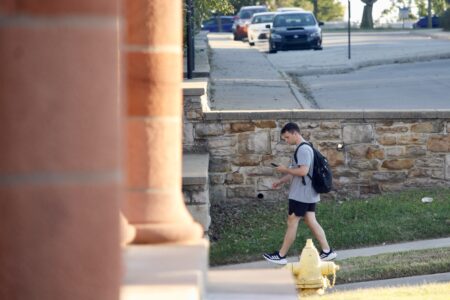
photo by: Dmitry Martirosov/Journal-World
A student walks past Spooner Hall at the University of Kansas on Wednesday, Oct. 21, 2026.
What should college students who are about to enter the workforce do in a tight labor market?
For some University of Kansas students, the answer lies in additional layers of support and outside-the-box thinking. That, they believe, will safeguard them from what one KU economist described as “a very unusual labor market.”
Preparation is key, according to Brett Cranor, an economics graduate student at KU. Cranor has been charting his path early on. He planned a lot of his coursework in advance and used his internship experience to land the position he sought.
It paid off. After he graduates in May, he’ll be heading east to join the Federal Reserve Bank of Boston as a research associate.
One of the secrets to his success was adopting a proactive mindset, he said. Cranor didn’t wait for recruiters to approach him; he knows he’s competing against top-tier schools from all over the country. And he didn’t limit himself either by only applying to a select few companies.
“If people’s views of the labor market are, ‘Oh well, I can’t get into Nvidia, Google or Apple’ or something, then they’re going to have a hard time,” he said.
Cranor recently read an article where over 100,000 people applied for a software engineering internship at Apple. His advice? Search locally. You may face steep competition, but your chances of landing something will likely increase, he said.
College graduates are entering a challenging job market, where artificial intelligence is changing many of the ways companies have traditionally thought about hiring. Employers have become more hesitant to onboard new talent, and college graduates are suffering the impacts.
An analysis by the Federal Reserve Bank of New York shows that, as of June, the unemployment rate among recent college graduates, ages 22 to 27, was 5.6%. That is substantially higher than pre-pandemic levels, when the rate was 3.6%. More than 40% of those who were employed worked in jobs that don’t typically require a college degree.
“This is a very unusual labor market,” said Donna Ginther, an economist at KU. “It’s kind of like stuck.”
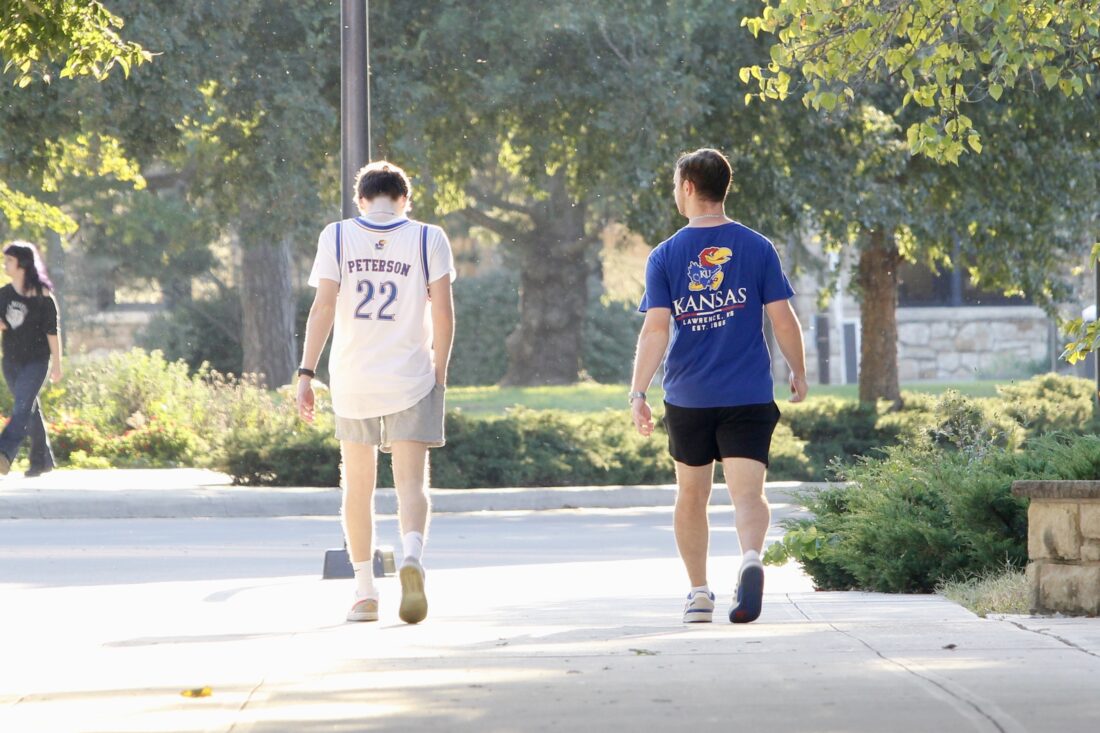
photo by: Dmitry Martirosov/Journal-World
Students walk on Jayhawk Boulevard at the University of Kansas on Wednesday, Oct. 21, 2026.
When AI was introduced, hiring slowed dramatically, Ginther said, particularly toward the end of last year. Employers, however, quickly realized that AI can’t fill every job and that it’s costly. That forced companies to adjust, leading many to view AI as a tool that could benefit them through their more experienced workers. The outcome is less demand for entry level jobs — exactly the types of jobs that recent graduates are seeking.
“This kind of creates a disconnect that is disproportionately affecting college graduates,” Ginther said.
Some students are responding by extending their college years and pursuing advanced degrees. The opportunity cost for staying in school when hiring slows is low, Ginther said, so many students are opting for master’s and doctorate degrees. Others are navigating it by making slight detours to their career paths within their industries.
Nora Schumaker studies psychology at KU. The sophomore said that getting a bachelor’s degree isn’t enough anymore, echoing a common belief among many who see advanced degrees as the new benchmark for entry level jobs. She enjoys psychology, but isn’t relying on it for a career path unless she obtains an advanced degree. The idea, she said, is to safeguard herself against unpredictable market forces.
Teddy Heffernan, a junior from Colorado, is looking at the job market through a political lens. With the midterm elections looming, Heffernan, who studies political science at KU, has been particularly attuned to people’s complaints about the economy. His peers have been sucked into the loop as well, he said.
“A lot of my friends who are engineering majors and business majors are applying to 30, 40, 50 internships for the summer and not hearing back from any of them,” Heffernan said.
A year ago, many of Heffernan’s friends were at least able to land interviews. “But now, a bunch of buddies of mine, particularly in the engineering field, they haven’t heard back from a single company.”
Like Schumaker, Heffernan believes that getting a bachelor’s degree is no longer enough. “It’s sort of like the old high school diploma,” he said, referring to a bygone era where a high school diploma was enough to land a solid middle-class job.
Heffernan plans to go to law school. But even then, he knows that a job is no guarantee. He remains optimistic.
“I think there’s a reality of AI that is going to continue to exist in the workplace, and it’s going to continue to maybe take people’s jobs, but also maybe create some new jobs,” he said. “But I also see a lot of change coming, you know, especially with political science. With an election coming up, there’s going to be a lot of need for new lawyers, and there’s going to be a lot of need for new engineers. We have a lot of problems to face right now as a country, and there’s a lot of jobs that if they don’t exist right now, (will) need to be created.”
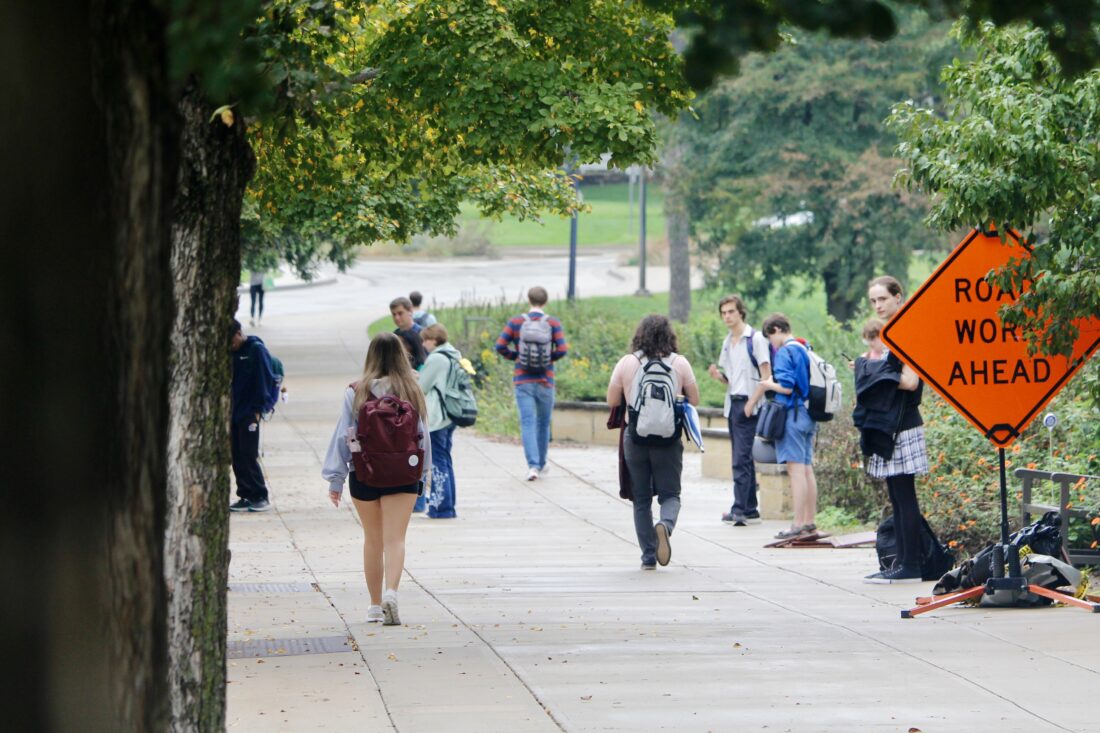
photo by: Dmitry Martirosov/Journal-World
Students walk on Jayhawk Boulevard at the University of Kansas on Wednesday, Sept. 30, 2026.
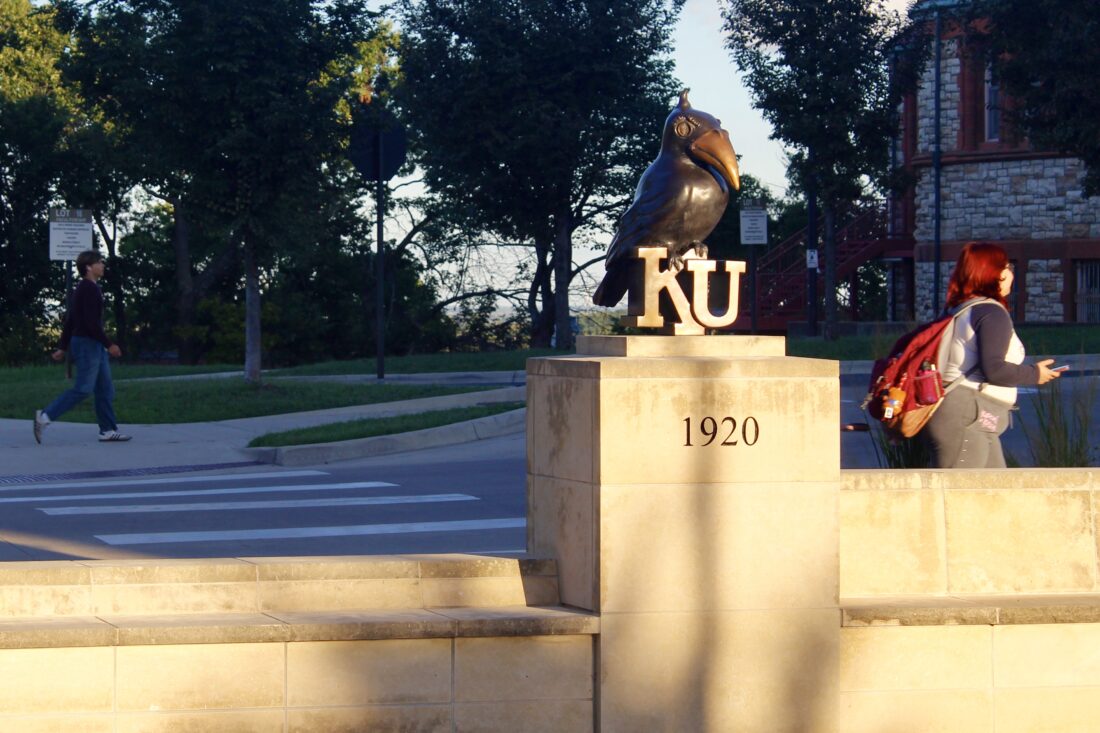
photo by: Dmitry Martirosov/Journal-World
A student walks past Ascher Plaza at the University of Kansas on Tuesday, Sept. 22, 2026.
In August, the Bureau of Labor Statistics released a report projecting employment over the next 10 years. It found that the private healthcare sector is expected to add the most jobs of any sector, accounting for 37% of all new jobs projected to be added through 2035. That aligns with recent employment trends, where nearly 372,000 workers were hired in healthcare over the last 12 months — far above any other sector.
Growth, however, doesn’t guarantee a job, according to Keysi Castellanos.
A pre-med biochemistry junior at KU, Castellanos works at a hospital and said she sometimes hears her manager saying that they may not be able to fill certain positions because people either aren’t applying or lack the qualifications for the role.
“I feel like at the hospital, they want people with experience. But people can’t get experience if they don’t get hired,” Castellanos said. Castellanos’ friends are looking for jobs, too, but are having a hard time landing any, she said.
Eric Faltermeier is in a similar predicament. As of last week, the computer science junior said he applied to more than 50 summer internships, mostly in Kansas. It took a strong effort, but Faltermeier was able to land a few interviews, he said.
“It’s pretty scary,” Faltermeier said. “AI has been growing in exponential rates, and you see every single week there is some new thing that it can do that it couldn’t do before. And it’s like ‘Well, if it can do that, then what is it going to do next week?'”
Computer science degrees used to be a hot commodity just a few years ago. Boosted by the pandemic, which kept many Americans in their homes, “learn to code” became the common phrase among workers struggling to land a job. Now, things are looking different, Faltermeier said.
“I started computer science in 2020, when it was booming. There were a billion jobs and you just had to, like, exist,” he said. Since then, “it’s gone down and down and down,” Faltermeier said.
AI is probably the main factor right now that is causing a hiring slowdown, said Clint Chadwick, professor of strategy and human resource management at KU’s School of Business. He called it “the big wild card.”
Not only is there uncertainty about what it will do to the jobs, Chadwick said, “but there’s a huge amount of uncertainty about how employers are going to react to it.”
Chadwick, however, isn’t pulling the fire alarm just yet. “The labor market waxes and wanes, and so there’s some natural ebb and flow in the labor market and you have to account for that,” he said. Even though AI has become so dominant, Chadwick said disruptions caused by technological innovations aren’t uncommon. “I don’t want to understate that it’s important. But it’s not like it’s a totally different phenomenon than anything else we’ve ever seen,” he said.
Chadwick likened AI to the Internet boom of the early 2000s. There was a lot of chatter at the time about it being “profound” and that it was going to change everything, he said. “But it also impacted things in some ways that could be kind of predictable in hindsight,” he said.
Faltermeier said it’s important to harness a positive attitude. “I don’t like to worry,” he said, “because I don’t think worrying is going to do me any good. I understand I have a lot to offer (and) I am doing everything I can in order to prepare myself for the difficult market.”
He also offered a word of advice for his peers: don’t get caught up in the doom and gloom. “Those are the people who are going to struggle to find jobs,” he said.

photo by: Dmitry Martirosov/Journal-World
A student walks past Watson Library at the University of Kansas on Wednesday, Oct. 21, 2026.
Amplifying students’ concerns is the seemingly unstoppable stream of online videos of people lamenting that they can’t land jobs, or the viral articles of recent graduates who are still out of the job market.
Cranor, the economics student, said many of those complaints are warranted. However, nuance is important, he added. Like Chadwick, he doesn’t subscribe to the notion that the current job market is some sort of a unique phenomenon.
“Obviously, AI is some type of new technology. But I personally haven’t seen enough to conclude that it is just some damning job market,” he said.
A factor that stood out among his peers who have heard back from employers, Cranor said, is prior internship experience. The difference was “night and day,” he said.
“I definitely think I had it easier than most, but I don’t think my story is unattainable or far out,” Cranor said. “It just requires a lot more planning and definitely some sacrifice in terms of the college experience.”
KU
‘It’s pretty scary’: KU students, professors find a job market that has grown tougher for recent college grads

Military aircraft to fly over Lawrence ahead of KU vs. Baylor game
‘This isn’t just childcare’: Hilltop closure brings community together to brainstorm solutions

KU researchers win $1.8M grant to study program designed to help parents who adopt children
KU’s homecoming parade returning to campus after hiatus