KU researcher excited to bring prestigious NASA fellowship to university as way to mentor students, expand research opportunities

photo by: Contributed
Hayley Beltz became the first ever KU researcher to earn NASA Hubble Prize Fellowship, the school announced Wednesday. Beltz hopes the expanded research opportunities available through the fellowship — which will expand her research into magnetic fields on exoplanets — will provide more opportunities for KU students, especially since she credited the importance of her own mentors in her career.
Hayley Beltz was the type of kid who grew up fascinated by space and “looking up at the night sky,” but a career that used that passion outside of being an astronaut seemed light years away.
Beltz went on to get a bachelor’s degree in math and physics at Kalamazoo College in Michigan, and found research experience through the National Science Foundation, where she was posted at the Maria Mitchell Observatory in Nantucket, Massachusetts, for a 10-week program focusing on astronomy research. That opportunity unlocked a pathway to explore the stars while staying on Earth.
“I realized, ‘Oh, astronomy is a job, and a job I can potentially do,'” Beltz recalled.
Flash forward from that research experience to now, where it was announced Wednesday that Beltz, now a postdoctoral researcher with the University of Kansas Department of Physics and Astronomy, received the coveted NASA Hubble Prize Fellowship — making her the first KU researcher to win the prize. The fellowship includes a monetary award, which online information about the program indicates is about $100,000 a year for up to three years, to enhance her research of far away planets and their magnetic fields.
Ian Crossfield, an associate professor with KU’s Physics and Astronomy Department and Beltz’s mentor, said that this fellowship is the “premier recognition” for young researchers like Beltz. Beyond her researcher, Crossfield said Beltz — who had only been at KU for about “two and a half months” — has been “a huge contributor” to the department in ways outside her research duties.
While the award is a huge step personally for Beltz, the impact can be felt for the whole department. At a time when there are national funding concerns and local pressure for the program, both Crossfield and Beltz are excited that this honor can provide a boost for not just Beltz’s research, but the whole department.
“I am really excited to be the first person to bring the fellowship to KU,” Beltz said.
THE STUDY OF EXOPLANETS
The field that Beltz studies is complex — as you might expect in a field closely connected to “rocket science.”
Beltz became interested in the study of exoplanets — planets that are beyond the Earth’s solar system — while working on her PhD at the University of Michigan. Along with the talks about the subject that “most excited her” when she got to visit astronomy conferences, her mentor and professor, Emily Rauscher, did research on exoplanets known as “hot Jupiters,” which are types of exoplanets unlike anything in our solar system.
“It was opening a whole new world,” Beltz said. “These are new planets I never considered with configurations I never considered.”
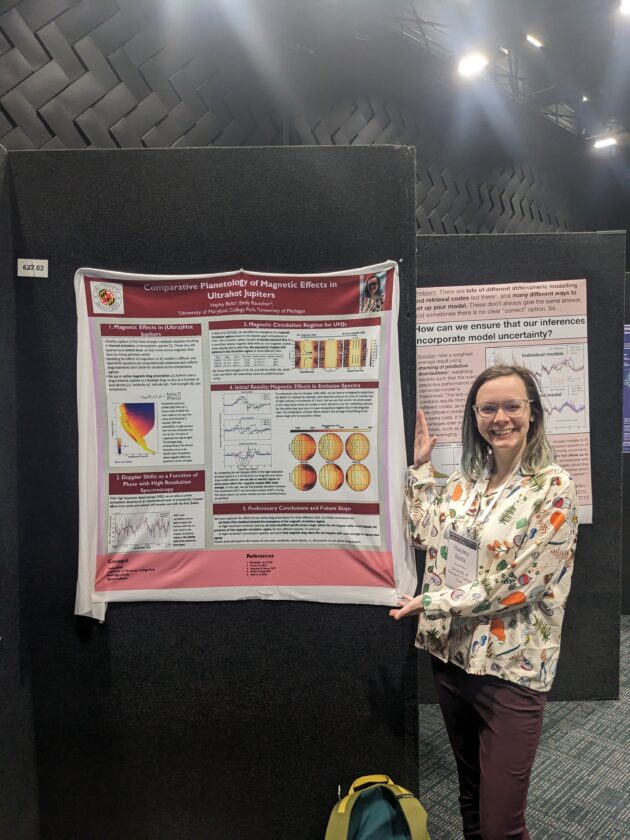
photo by: Contributed
Hayley Beltz presenting her research on the impact of magnetic fields on a type of exoplanets known as “Ultrahot Jupiters.” Beltz, who recently won the prestigious NASA Hubble Prize Fellowship, is a researcher at KU, and she will spend the next three years at the school expanding her research opportunities and aiming to mentor students.
Beltz said she fell in love with the theory of using numerical modeling to try and recreate the “extreme worlds” of distant planets. When she was talking with her adviser about what other things she should research next, she wanted to explore the effects of magnetic fields on exoplanets.
Beltz said there’s a joke in astronomy that most astronomers are “scared of magnetic fields” because they make everything “quite complicated.” But after going down the “rabbit hole” of thinking about magnetic fields, it became a big focus for her research. Beltz said while astronomers expect that magnetic fields would be present on exoplanets since they are on most planets in the solar system, they have not been fully detected yet. She hopes that some of her research can identify ways scientists could detect the presence of a magnetic field just by looking at its light.
Although it might seem counterintuitive to study the magnetic fields of far away planets, Beltz said studying exoplanets can add more scientific understanding about planets in our solar system, especially the magnetic fields. Learning about other planets can help understand the ways that different planets form instead of assuming there is just one way. Additionally, Beltz noted that magnetic fields are “really important to life on earth;” a magnetic field protects the atmosphere from the Sun’s radiation which could otherwise be really harmful to life while many species on Earth like migratory birds can detect magnetic field lines.
“Understanding the full range of different types of planets can help us understand more about Earth,” Beltz said.
GIVING BACK
While research is a big focus for many academics and professors across universities, Beltz always wanted to be able to be a teacher and give back to students.
Before she came to KU, Beltz said she was in her first postdoctoral appointment at the University of Maryland. Although she was progressing in her research, she was never able to teach classes. When she saw the opening at KU which included chipping in with classes, she was excited to apply to the role and find ways to help outside of just research.
Crossfield said she has already made some big contributions to the department. He said she is very active in department wide meetings that discuss latest discoveries, she has assisted in his research group that also studies exoplanets and has been at community outreach events.
Crossfield said there are lots of people in the field who could do the “work set out in front of them,” but nothing beyond that. He said that she’s already going above and beyond just doing her research duties.
“It’s clear she was someone who could bring a lot more to the table than (just research),” Crossfield said.
Beltz said that one reason she was so keen on being a mentor or helping out other students was her own journey in academia. When she was first looking to earn a PhD, she said “didn’t really know what I was getting myself into.” Without her mentors, she said she would not be where she is today, and she hopes she can answer questions and serve as a guide for students in a similar position at KU.
“I’ve been trying to make myself a resource for undergraduates… (and) answer the same questions I had a decade ago (in grad school),” Beltz said.
Beltz said she’s already been working to connect with students at KU, giving talks with undergraduate students and meeting with the Society of Physics students. She hopes to not just show students that there can be a viable career path in the field, but also highlight some of the “really cool research” going on right at their school.
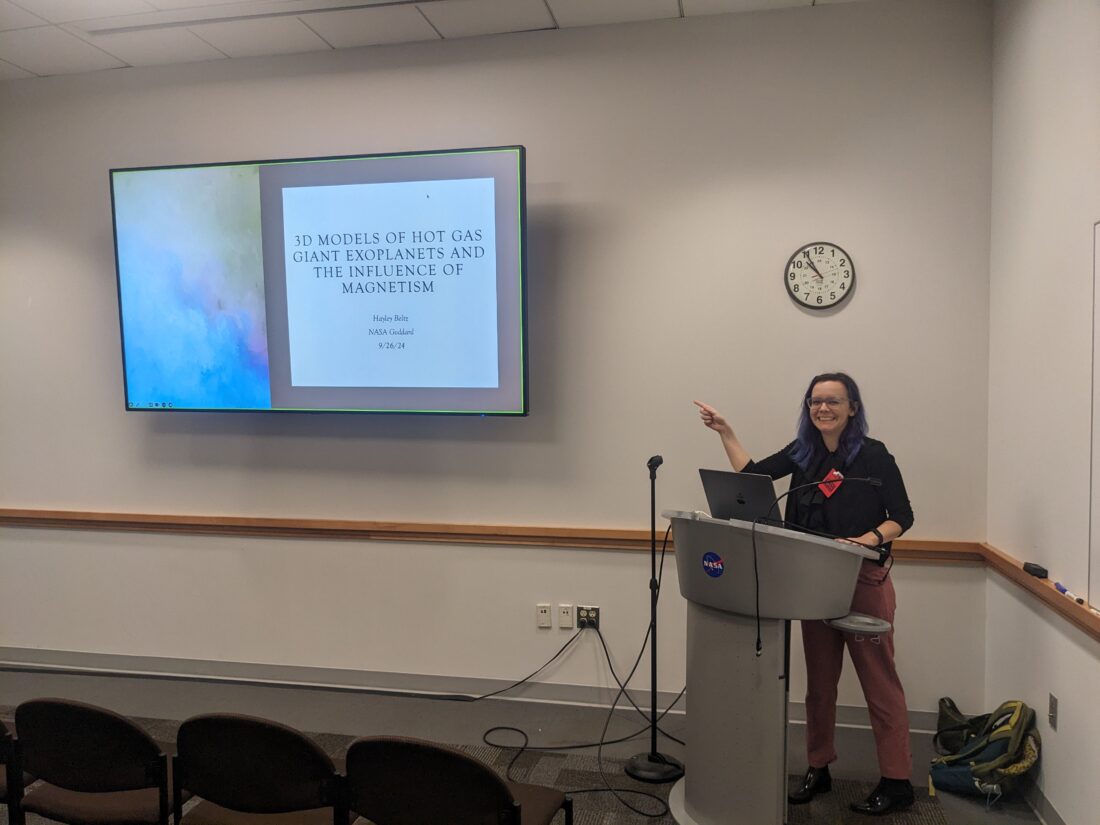
photo by: Contributed
Hayley Beltz giving a lecture in 2024 about her research that involved modeling exoplanets. Beltz, who recently won the prestigious NASA Hubble Prize Fellowship, is a researcher at KU, and she will spend the next three years at the school expanding her research opportunities and aiming to mentor students.
The award also will spotlight the work of the department — one that in recent years has been a focus of the Kansas Board of Regents. Astronomy and Engineering Physics were among the 11 KU programs that were under review by the Kansas Board of Regents in 2024 and placed on “improvement programs,” as the Journal-World reported. Crossfield said that in the past 10 years, the number of Astronomy majors at KU has nearly tripled from around 20 students in 2016 to around 60 students in 2025, and students minoring in both physics and astronomy have also seen steady increases in that time.
Crossfield hopes that the attention that Beltz’s award brings to the department helps the greater campus community — including key decision makers — become more “aware of all the increasingly great work the astronomy group here is doing and undertaking.”
Beltz said she’ll be at KU for the duration of the fellowship, and she’ll still get to teach throughout the three-year period. The funds from the fellowship will allow her to model new types of planets, hire a summer research student, mentor undergraduates and travel to research conferences, which can help her make key introductions to help with research and “raise (her) profile as an astronomer.”
But Beltz also said it will help lift up other people at KU. She said in the second-year of the fellowship specifically, she will be able to pay an undergraduate student to help with the research — those paid opportunities aren’t always the case.
Beltz said “it’s been a tough couple of years in astronomy funding wise,” so securing the money from the federal government through NASA is a huge game changer for her and KU as well. In a time when federal grants for research are becoming more scarce in the sciences due to massive budget cuts, Beltz said these kinds of opportunities can be “life-changing.” At a time when there is scrutiny for KU’s astronomy program and scarce funding, Beltz is excited to be able to bring some more opportunities to a passionate group of students.
“It’s nice to take this into an institution like KU where there are all these students that are excited about science, excited about space and astronomy,” Beltz said.
KU

University of Maine leader named as a finalist for KU journalism dean position

Self announces he will continue as KU coach

KU faculty union ratifies first-ever labor contract with 92% voting yes; contract now needs Regents approval
KU researcher excited to bring prestigious NASA fellowship to university as way to mentor students, expand research opportunities
Local vendors can apply now for KU’s new monthly on-campus market, Jayhawk Fridays