

Girod traveled to the White House to discuss future of college sports, but he thinks Congress holds the keys
K-State, Wichita State both plan to use more general funds to support athletics
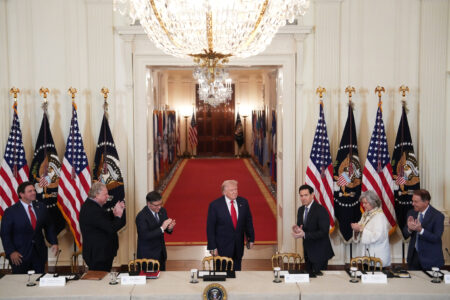
photo by: AP Photo/Julia Demaree Nikhinson
President Donald Trump arrives at a roundtable discussion on college sports in the East Room of the White House, Friday, March 6, 2026, in Washington.
The wild world of college athletics — think $20 million per year in revenue sharing with student-athletes — has leaders at Kansas State and Wichita State going to their universities’ checkbooks for help.
The top finance officers at K-State and Wichita State this week told a committee of the Kansas Board of Regents that they plan to transfer several million dollars out of their universities’ general funds into their athletic departments to help their teams remain competitive in recruiting top players.
K-State is likely to transfer $4 million to its athletic department during its next budget, while Wichita State plans to increase the size of its annual transfer to athletics by $1 million, the Regents’ Fiscal Affairs Committee was told. Thus far, University of Kansas Chancellor Doug Girod isn’t headed to the checkbook to give Kansas Athletics a similar boost.
Girod recently headed somewhere else — the White House.
Girod was part of a group of more than 50 people in the world of sports,politics and higher education who attended a future of college athletics summit with President Donald Trump at the White House on March 6.
“That was an eclectic gathering,” Girod said of the group that included everybody from former Alabama National Champion football coach Nick Saban to Secretary of State Marco Rubio, plus a handful of university presidents like Girod, who currently serves as the chair of the Big 12 Conference and is a member of the NCAA’s governing body.
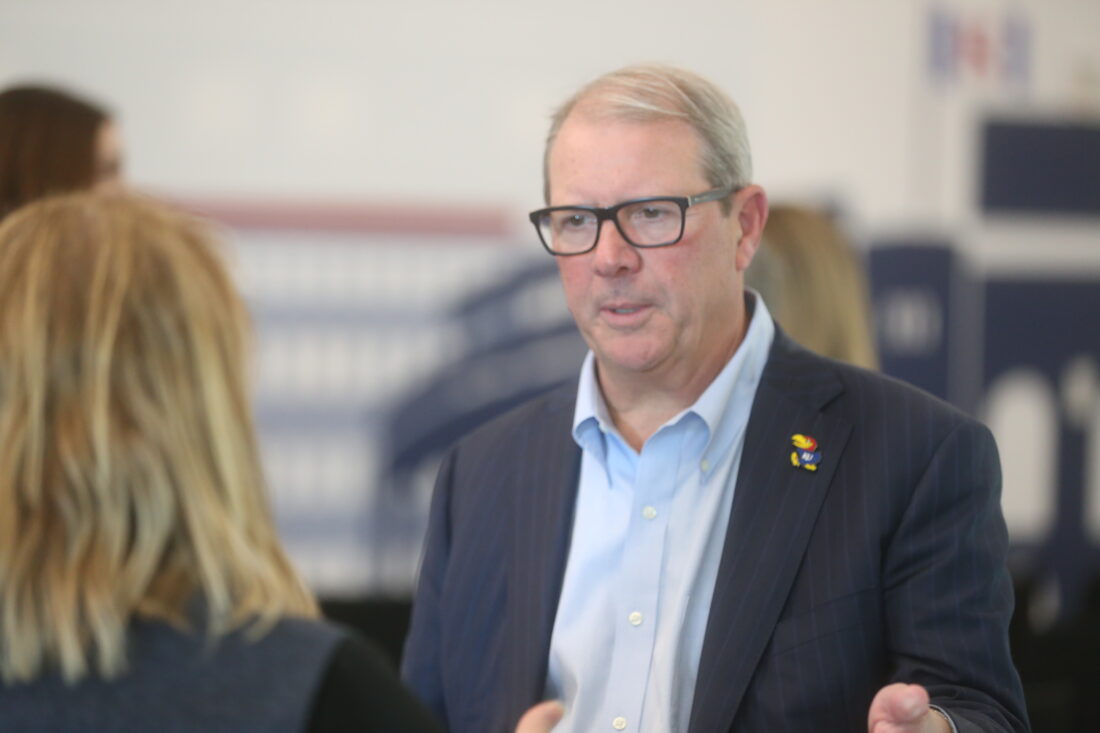
photo by: Chad Lawhorn/Journal-World
University of Kansas Chancellor Douglas Girod visits with a member of the crowd following his State of the University address on Oct. 16, 2025.
While eclectic, the group wasn’t exactly effective at finding a silver bullet for the ills of college athletics, which has a host of questions about what rules can be enforced and also how universities are going to feasibly fund their athletic departments.
President Trump told the group that he plans to soon issue an executive order to save college athletics, although he acknowledged the order likely will spark lawsuits. Girod left the event convinced that ultimately the NCAA is going to have to get help from Congress in the form of an antitrust exemption that will allow the NCAA to force member schools to follow an agreed upon set of rules.
“I think they know they need to help us,” Girod said of federal lawmakers. “How they help us, there’s not agreement on, obviously, or else it already would have happened.”
But in a brief interview with the Journal-World, Girod said it is clear that more than a presidential executive order is likely going to be needed. That is because federal courts have ruled that the NCAA is often operating in an illegal, monopolistic manner when it places limits on how long a student-athlete can compete for a school or how much they can be paid.
“We all know an executive order can not address antitrust rulings out of the courts,” Girod said. “So that is not a pathway to address that particular issue.”
As to whether KU will start heading down the pathway of pulling money out of its general fund to send to Kansas Athletics, KU leaders have not announced any such plans. Jeff DeWitt, KU’s chief financial officer, presented a financial update to the Regents committee this week. He did not mention any plans to provide Kansas Athletics with special funding. When the Journal-World asked DeWitt after the meeting whether KU would start making a special distribution from its general fund to the athletic department, he said the expectation was that KU would not need to do so in the next budget year.
However, there have been other changes that have benefited Kansas Athletics at the expense of KU’s general finances. As the Journal-World reported in September, KU agreed to relieve Kansas Athletics from the obligation of reimbursing KU’s general budget for certain expense.
Historically, when Kansas Athletics has given a scholarship to a student-athlete, the athletics department has made tuition, housing and dining payments to various KU funds to reimburse the university for those tuition, room and board costs.
KU is now forgiving about $10 million of those costs. However, KU officials have pushed back on characterizations that KU’s general budget is now subsidizing the athletic department. KU said a more accurate portrayal is that the athletics department is no longer as large of a revenue-provider to the general university.
No matter the nomenclature, the end result is that KU’s general use budgets are receiving about $10 million less than they would have received otherwise.
“Now we are covering expenses they (athletics) used to pay for,” DeWitt said this week of the change in policy.
Officials at K-State and Wichita State provided basic information to the Regents this week about how they plan to boost their athletic departments. Ethan Erickson, vice president for administration and finance at K-State, said K-State is planning to provide $4.2 million per year in general funding to its athletic department.
“Everything we do as an institution, our ability to recruit and retain students, athletics plays a key role,” said Erickson, who said the university has created a formula that looks at economic impact numbers to help determine how much funding the athletic department should receive.
At Wichita State, David Miller, senior vice president for administration, finance and operations, said the WSU athletic department already was facing financial challenges before the NCAA agreed to a lawsuit settlement that allows schools to provide approximately $20 million a year in revenue sharing monies to student athletes. Since that ruling, financial pressures have increased.
“We anticipate in 2027 we will have to put in an additional $1 million into athletics to shore up the entire operating deficit that we have been working through,” Miller told the committee.
From his perch on the NCAA board, Girod said he is seeing “across-the-board” financial pressure on athletic departments of all shapes and sizes.
“Nobody was built for this,” Girod said of the new revenue sharing model that has emerged from the settlement the NCAA reached with student-athletes.
But Girod said he thinks an anti-trust exemption from Congress could help with those pressures. A return to the days when student athletes received no payments is not likely, but Girod said an antitrust exemption could allow stricter transfer rules to be enforced, for example.
The ability of student-athletes to transfer at the end of every season is seen as a factor that is putting upward pressure on what student-athletes can demand universities pay them. It also is creating planning problems that are costly, as teams face uncertainty about how many players they must replace each year to field a team.
“It would allow us to create some stability,” Girod said of an antitrust exemption. “Part of what is feeding that machine is the ability to transfer every year throughout your entire career. That is creating a marketplace that is sort of artificial.”
Girod said it is realistic to think that Congress would grant an antitrust exemption to college athletics. Basically every major professional sports league has been granted such an exemption by Congress, which is how mechanisms like salary caps in the NBA and NFL are legal.
But Girod noted that a big difference between those pro sports leagues and college athletics is that the professional athletes are employees. That gives them the ability to form a union and collectively bargain with the leagues.
Thus far, the majority of college athletic leaders have resisted the idea of making student-athletes employees of the university. Girod said he believes most student-athletes also don’t want that outcome.
But exactly what status student-athletes should have is likely stopping many members of Congress from supporting legislation backed by the NCAA, including the SCORE Act, which is awaiting action in Congress.
“I don’t think that is the answer,” Girod said of making student-athletes employees, “but in fairness, there is no question that we have to figure out a way that student-athletes have a very strong voice in this conversation.”
State Government
Girod traveled to the White House to discuss future of college sports, but he thinks Congress holds the keys

Chiefs, key cities and state officials endorse sports authority ownership of $3B stadium

Board of Regents likely to maintain oversight of KU, other universities after legislative committee reworks bill
Lt. Gov. Toland tells higher education leaders they need to start having some ‘uncomfortable conversations’
Last-minute bill would strip Regents of many oversight powers regarding KU, K-State, Wichita State
