

Regents expected to take final vote on tightening tenure process for university professors
Latest proposal backs off from mandated dismissals
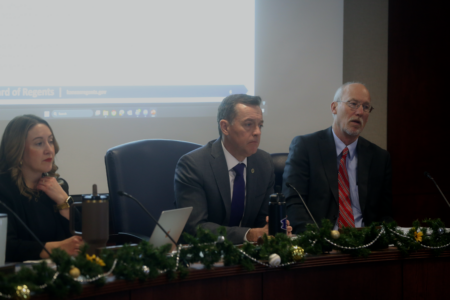
photo by: Chad Lawhorn/Journal-World
Leaders of the Kansas Board of Regents listen to proposed changes to the board's tenure policy for university faculty on Dec. 17, 2025. From left to right are: Vice Chair Diana Mendoza, Chair Blake Benson, and President and CEO Blake Flanders.
What university professors must do to keep their status of tenure — a rank that historically has provided a lot of job protection — is set for a key debate at Wednesday’s Kansas Board of Regents meeting.
Regents, in part, will have to decide how tough they want the new policy to be in regards to dismissing professors and other faculty members who do not meet expectations. A month ago, the Regents considered a proposal that essentially would mandate universities dismiss faculty members who have received two consecutive “unsatisfactory” annual reviews from their department chair or division head.
At Wednesday’s meeting, the Regents will consider a revised policy that no longer has the language saying that a faculty member “will be dismissed” for two poor performance reviews. Now, the proposed policy states such faculty members are “subject to dismissal, reassignment, an additional one-year improvement plan, or other personnel actions.”
The new language also gives faculty members a right to appeal the findings of their annual evaluations through a process to be determined by the university, as long as such process ultimately allows for the university’s chief academic officer — most often the provost — to make all final decisions.
The proposed changes are significant and come after Regents heard concerns from multiple faculty groups that last month’s proposal was unreasonable.
Now, Regents will have to consider whether this latest proposal is tough enough to meet the expectations of Republican lawmakers who have expressed concerns that university professors are not held to a high enough standard.
The Kansas Legislature could bypass the Kansas Board of Regents and create its own policy for tenure that all of the state’s public universities would be required to follow. Legislators have made it known to Regents that is a real possibility.
Rep. Steven Howe, a Salina Republican, who until recently was the chair of the House Committee on Education, sent written comments to the Regents last month urging them to keep in mind that the Legislature could act on the issue of tenure.
“I believe some additional changes are needed before this policy is ‘ready for prime-time,'” Howe wrote of last month’s proposal. “The last thing KBOR will want is the Legislature to get involved after the fact.”
How Republican legislators will react to the latest proposal is unclear. In the past, lawmakers have expressed concern that the universities’ tenure policies are too undefined, and give the schools too much latitude in deciding when a professor is no longer meeting expectations. The latest proposal provides more latitude for universities to make those decisions than last month’s proposed policy does, however, this month’s policy is still a significant tightening of what currently is on the books.
The proposed policy would be a tightening of the existing tenure policy in several ways, including:
• Professors who have received tenure would be required to undergo an extensive review by a committee every five years, instead of the current standard of every seven years. At least half of the review committee must be individuals who are not part of the professor’s department.
• Every faculty member — whether they have tenure or not — will have a written work plan that includes assigned teaching loads. The proposed policy stops short of mandating a minimum number of hours a professor much teach, but it does create an expectation. The policy states faculty members at research universities — such as KU, Kansas State and Wichita State — should typically teach six to nine credit hours per semester. In most instances, that equates to two to three classes per semester. At regional universities — which include Emporia State, Fort Hays State and Pittsburg State — faculty members should typically teach 12 hours, or the equivalent of four classes, per semester.
• Every faculty member would be required to go through an annual review with their department chair or division leader. While the current policy says such a review is a possibility, it is not technically a requirement. The proposed policy would mandate that each annual review specify how much time a faculty member will spend on teaching versus research versus other creative activities. Any faculty member who does not meet that workload expectation “will be placed on an improvement plan,” the proposed policy states.
University of Kansas Chancellor Douglas Girod has generally not taken a position on the proposed tenure changes, and Wednesday’s meeting will be the first time the latest proposal has been debated by the Board of Regents. However, Girod has said the topic of tenure is extremely important to the university’s future.
Tenure, which is an academic rank conferred upon faculty members who meet a certain level of scholarship, historically has been one of the most important components in attracting and retaining top professors. The tenure rank, through the job protections it has historically given to professors, has promoted the academic freedom that professors often desire.
In November, Girod said the proposed changes to tenure would make Kansas’ system “one of the most robust processes in the country.” Girod stopped short of saying that would be bad for the university, but has said Regents and others need to understand how changes to the tenure process may impact the ability of KU and the state’s other universities to compete for top academic talent.
The Board of Regents is scheduled to meet at 1:30 p.m. on Wednesday at its offices in Topeka. The tenure topic is listed on the board’s agenda as being up for a vote and final action.
State Government
Kansas lawmakers hold back bill on potty training requirement
TOPEKA — A Kansas bill that would have required kindergarteners to be potty trained before starting school ...

Budgets at KU, K-State, Wichita State would be cut by 2.5% under latest proposal; budget plan also calls for proof that DEI isn’t in classrooms

Moran secures another $20M in federal funding for KU Cancer Center, ER expansion at medical center
Kobach wants to force Kelly to hand over state SNAP data
Kansas Republican Attorney General Kris Kobach wants lawmakers to force state agencies to hand over personal ...
Lawmakers begin to work on bill that would place new limits on DEI at Kansas universities; KU estimates $1.8M cost to comply with bill
Bill would make clergy mandated reporters
TOPEKA — Kansas ordained clergy would be mandated reporters of child abuse under a bill proposed Monday in the ...