

KU to give raises to employees next week, but faculty members not included due to union negotiations
Wage increases to vary based on position and experience

photo by: University of Kansas
The skyline of the University of Kansas is pictured.
Most University of Kansas employees — but not professors — have a new date to circle on their calendars: Jan. 26.
That’s when they’ll find out how big of a raise they are receiving.
KU Chancellor Douglas Girod and other university administrators on Monday announced that the University of Kansas has a plan to give $15 million in wage increases to employees on the Lawrence and Edwards campuses.
However, in a departure from past practices, the wage increases won’t be an across-the-board adjustment. Instead, employees — even some in the same department — may receive significantly different percentage increases depending on factors such as years of experience and their starting wage.
Human resource administrators currently are entering the new wages into KU’s payroll system, and employees will be able to see their new wage by logging onto their employee account on or after Jan. 26, KU administrators said on Monday.
There’s also another big caveat to the announcement: One of KU’s largest employee groups — faculty members — largely won’t be eligible for the increases because the KU faculty is represented by a union that is currently in contract negotiations with KU. Union rules prohibit KU from making salary adjustments — even raises — without first winning approval from the union. However, those rules don’t prohibit the university from providing raises to non-union employees, and Girod said KU believes it is critical to do so now.
“As I’ve shared over the past year, employee pay is a top administrative priority,” Girod said in an email to university employees on Monday.
Here are the basics of the plan:
• KU has set a new minimum wage of $18 an hour for all non-faculty positions. The new minimum wage does not cover student employees, but essentially all other employees on campus should be making at least $18 an hour by next week.
• All eligible employees — essentially everyone but union faculty members, student employees and top administrators who report directly to Girod — will receive at least a 1% pay increase, effective next week.
• A significant number of employees — KU did not release a figure — will receive more than a 1% pay increase. How much of a pay increase will depend on where they fall within newly created wage ranges for their particular position. For each of the positions on campus, KU has created new wage ranges that are based on what similar positions are making either in the private sector or at comparable research universities.
In an email to the Lawrence campus, Provost Barbara Bichelmeyer said this latest plan will ensure that every staff member on the Lawrence campus is now at the 25th percentile or higher in terms of what similar positions are receiving elsewhere.
Being in the 25th percentile of a wage group means that 25% of peers in your profession earn less than you do, while 75% earn more. Any KU employees who are found to be below the 25th percentile — based on wage studies KU already has conducted — will receive a pay increase to ensure they are at that 25th percentile mark.
In his message to employees, Girod said he knows getting employees to the 25th percentile isn’t adequate for the long term.
“We still have work to do in this space, and getting all our faculty and staff to the appropriate benchmarks and aligning compensation practices and principles across all KU campuses will take another 4-5 years of investment into our compensation plan,” Girod said in the written message.
There is a path for employees who already have wages greater than the 25th percentile to receive a raise that is in excess of the 1% basic pay increase. Those employees could receive a larger raise if they are found to have been impacted by “wage compression.”
Wage compression occurs when employees with the same job but with different levels of experience are making nearly the same amount of money. KU wants to avoid that situation, so it has created a formula to reward employees based on their level of experience. All jobs at KU now will have a wage range attached to them. A new hire likely will make the minimum wage in the range. However, a person with one year of experience should make 2% more than the minimum, someone with two years of experience should make 4% more and so forth. KU plans to use that formula through the first five years of an employee’s employment, meaning a five-year employee should make 10% more than a new employee. Employees who have been with the university more than five years may be at risk of making roughly the same amount as a five-year employee, under the new system.
But employees who are in their first five years with the university may be in line for a raise larger than the basic 1% increase, due to the wage compression issue.
The new pay plan, however, leaves significant unanswered questions for the approximately 1,500 faculty members, which includes professors, researchers, librarians and other similar academic positions. Faculty members in April 2024 voted by a large margin to form a union to negotiate with administrators for better pay, benefits and working conditions.
The union — known as UAKU — has been negotiating with KU administrators since 2024, but has not yet reached agreement on a new contract. The issue of wages has been a particular sticking point. Union leadership released a statement last week on its website indicating that KU had offered the same basic 1% pay increase to the faculty. Union leadership called that offer inadequate and labeled it a “union-busting attack.”
“At this afternoon’s bargaining session, KU management said they refused to negotiate pay any further,” a Jan. 5 post on the UAKU website reads. “Their compensation proposal remains exactly the same as their first counter-proposal, offering only a 1% raise for one year, further disinvesting from the educational mission of KU and ignoring the serious impact on faculty, academic staff, and our students.”
In his Monday message to KU employees, Girod did not directly address the allegations made by UAKU, but did acknowledge that the university still had work to do to reach an agreement with the union.
In that same message, Girod said it was critical for KU to make what changes it could to employee pay as soon as possible.
“We remain grounded in the belief that the university must remain an employer of choice in an increasingly competitive environment,” Girod said. “We know that to deliver on our mission, and to build a stronger, more resilient university, we must recruit and retain talented faculty and staff who feel valued and supported in their work. This is a step forward in that direction, and it will not be the last.”
KU is paying for the wage increases through a series of budget cuts that university administrators ordered last year. KU leaders are expecting to book $16 million in departmental budget cuts by June 30, which is the end of the university’s fiscal year. Then, between July 1 and June 30, 2027, KU expects to accomplish $32 million in annual budget savings.
Girod and KU Chief Financial Officer Jeff DeWitt have been touting the budget cuts as a way to fund wage increases at the university. As the Journal-World reported in September, KU leaders anticipated that they would announce wage adjustments in January.
Indeed, the new pay plan will begin on Jan. 18, Girod said in Monday’s message. In addition to the wage increases at the Lawrence campus and the Edwards campus — located in Johnson County — KU announced a similar pay plan for the KU Medical Center in Kansas City.
State Government
KU to give raises to employees next week, but faculty members not included due to union negotiations
Kansas Senate minority leader challenges GOP House speaker for insurance commissioner
TOPEKA — Kansas Senate Minority Leader Dinah Sykes will run for state insurance commissioner, vowing to decline ...
GOP legislative leaders enlist former Emporia State president to slash Kansas university budgets
TOPEKA — Republican legislative leaders agreed to pay former Emporia State University president Ken Hush $50,000 ...
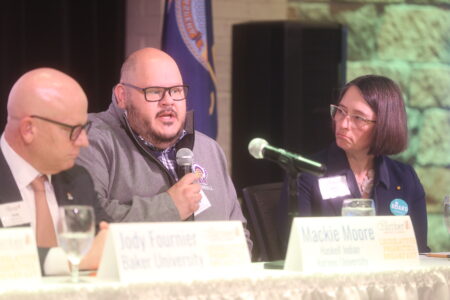
Haskell Indian Nations University still suffering from hiring freeze, interim president tells business leaders

Area legislators gather ahead of next week’s session with concerns of balancing money, human services
Bill seeks harsher penalties for child endangerment
TOPEKA — Jordan Chessher senses an urgency surrounding an effort to increase the criminal penalties in Kansas for ...