Pulitzer Prize-winning historian tells Lawrence crowd of what he’s learned about wars, both past and present
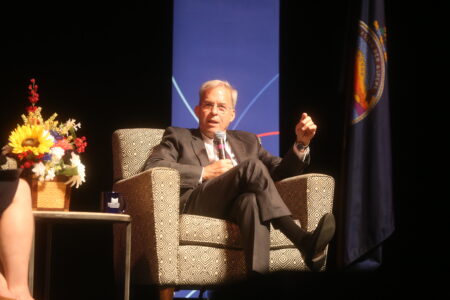
photo by: Chad Lawhorn/Journal-World
Pulitzer Prize-winning author Rick Atkinson speaks at the Lied Center on April 13, 2026 as part of the Dole Lecture hosted by the Dole Institute of Politics.
Rick Atkinson lived with Gen. Dwight D. Eisenhower for about 15 years and is currently living with Gen. George Washington, so, yes, he had thoughts to share on the nature of war with a Lawrence crowd Monday evening.
Atkinson — a best-selling military historian who said he has so studied his subjects that he feels like he’s living with them — told a Lied Center crowd that there is one rule of war to remember above all others.
“It never goes the way you think it is going to go,” Atkinson said. “Never.”
Atkinson was in Lawrence to give the 2026 Dole Lecture as part of the annual celebration of the life of former U.S. Sen. Bob Dole, hosted by the Dole Institute of Politics at the University of Kansas. Atkinson is best known as a Pulitzer Prize-winning author of historic narratives about World War II who is now writing about the American Revolution, but he told a crowd of several hundred on Monday that those wars of yesteryear have plenty of meaning for the current war the U.S. is waging in Iran.
“You think it is unfolding the way those guys in Washington thought it was going to unfold?” Atkinson asked.
The unpredictability of war is a primary reason that countries must be very deliberate about entering a war, argued Atkinson, who also is a former Pulitzer Prize-winning journalist for the now-defunct Kansas City Times and the Washington Post,
“You should be very careful about taking it on because it is going to go sideways at some point,” Atkinson said of war. “Whether you can recover from it going sideways is always a question.”
Atkinson also shared stories with the Lied Center crowd about his early days in Kansas, which came about because he was visiting his parents who were stationed at Fort Riley. With far more degrees than job prospects, Atkinson’s mother convinced him to talk to a family friend about a newspaper job.
He landed one with the Pittsburg Morning Sun in southeast Kansas, and even got the chance to cover the 1976 Republican National Convention in Kansas City. He covered it for the Pittsburg paper, but ended up leaving before favorite Kansas son Bob Dole was nominated to be Gerald Ford’s running mate.
A bit of a missed opportunity, he told the crowd, but he still ended up moving on to the Kansas City Times and a national reporting beat for the newspaper. His first Pulitzer came after he made a connection with the 1966 graduating class of West Point. The class of 579 cadets entered the U.S. Military Academy believing they were destined to be the next great, revered leaders of the U.S. Army.
Instead, they were destined for Vietnam, and 30 of them were killed in that war. Those who avoided that fate could not dodge the other casualties of that war, he said.
“They come back from the war and find they are no longer leaders of their generation. They are pariahs,” Atkinson said. “The country has confused the warriors with the war.”
The stories of that West Point class first became a series of articles in the Kansas City Times and then became Atkinson’s first book, “The Long Gray Line: The American Journey of West Point’s Class of 1966.”
Atkinson, after leaving newspaper journalism, went on to write multiple other books including “The Liberation Trilogy,” describing American efforts to liberate Europe in World War II. The first book of that trilogy won a Pulitzer Prize for history in 2003.
Atkinson last year released the second book in a trilogy on the U.S. Revolution, “The Fate of the Day: The War for America, Ticonderoga to Charleston, 1777-1780.” He said studying the Revolutionary War has led to observations about today’s times as well.
“We see it in the American Revolution,” Atkinson said of a lesson of war. “We certainly see it in World War II, and that is that the best team usually wins. Britain in 1775, and right through the end of the war in 1783, has zero friends. They have no allies.
“By their overbearing military and commercial behavior, they have alienated all of the other powers in Europe.”
The crowd let out a laugh and a smattering of applause after that line.
“You connected the dots,” he said.
KU
KU’s center for eating disorders invites public for open house

KU professors, middle school band director, radio personality among this year’s Phoenix Award honorees: ‘It’s a cool mix’

Hilltop childcare center has been losing money for at least two years, records show

Turnstile rocks KU campus as Day on the Hill returns after two-decade absence

UPDATE: Closure of Hilltop childcare center is final, but the building seems likely to stay