KU’s lesser known powerhouse: A look at how the debate team wins against the best of the best
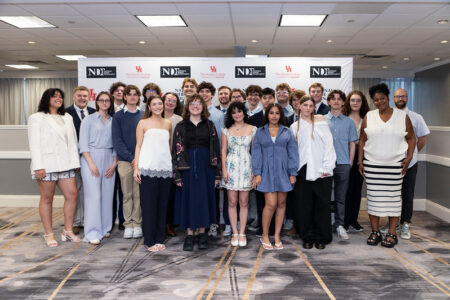
photo by: Contributed
Members of the KU debate team that competed in the National Debate Tournament this year. KU's team has won six national championships in its history and has had a team reach the Final Four of the NDT in six of the past seven tournaments.
Driving west into Lawrence on Interstate 70, you are greeted a few miles before one of the exits into town by a billboard featuring the University of Kansas Jayhawk logo that touts its men’s basketball program’s six championships.
Even a passing college hoops fan knows about the allure of Lawrence and the Jayhawks’ legendary coaches — from James Naismith himself to Bill Self. But that welcome sign to Lawrence includes another powerhouse program that might be lesser known on campus: the six-time national championship debate program.
Robert “Robin” Rowland, a KU professor and a national champion debater for KU in 1976, said that KU’s debate program has reached the Final Four of the National Debate Tournament 22 times, including reaching the final in 2025 and 2024. In those tournaments, KU students are going toe-to-toe with “the very best students from extremely strong universities” like Harvard, Dartmouth and Northwestern University — pretty strong company as Rowland noted.
“When you look at the history of debate, KU really has very few peers,” Rowland said.
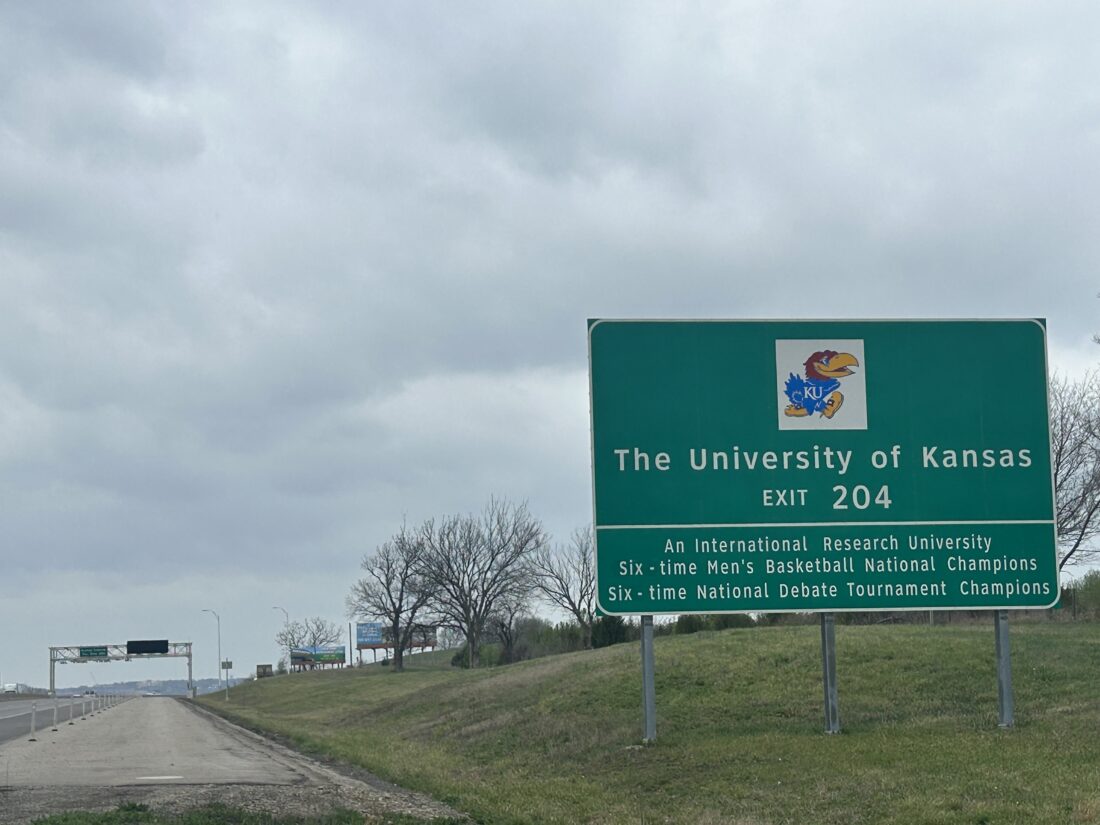
photo by: Bremen Keasey/Journal-World
A sign along I-70 near the Lawrence exit touting the University of Kansas and its six-time men’s basketball national championships and its six-time national debate tournament winning teams.
Rowland compared the run of success the school’s debate program has had to the men’s basketball program — especially in the way a great string of coaches in Donn Parson, Scott Harris and Brett Bricker has kept the school on top for decades.
Bricker, who won the National Debate Tournament as a debater with KU in 2009, now has the reins of the debate program, and he recently received the Ross K. Smith Debate Coach of the Year award during this year’s tournament. Bricker said he and the KU debate team take pride in the success of the program, and he hopes to continue a legacy of success built by Parson and Harris where “all types of students are welcome and bought in” on the program.
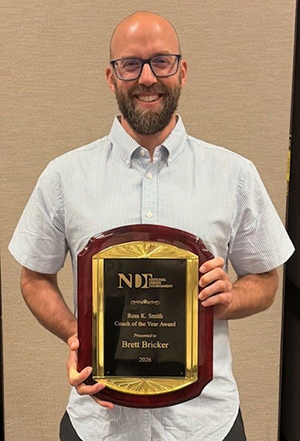
photo by: Contributed
Brett Bricker, the head coach for the University of Kansas’s debate team, was awarded the Ross K. Smith Debate Coach of the Year award at the 2026 National Debate Tournament.
DECADES OF SUCCESS
Much like KU’s men’s basketball program, the school’s debate team had some early success right at the start.
The Jayhawks had a national championship winning team in 1954 — just seven years after the first national tournament started in 1947. But their real run began in 1968 under Parson, which is when they started a streak of having at least one team qualify for the National Debate Tournament each year — a 58-year streak.
Rowland was a student at Lawrence High School alongside Frank Cross, his future debate partner at KU. As a local, he said he knew “there was a great university right up the hill” and he met Parson in August 1973 and joined the KU debate team. Rowland said he and Cross debated in over 500 tournaments during their time at KU, which included the 1976 title win — KU’s third ever national title. The work of competing in debate included “hundreds of hours” of preparation by Rowland’s estimation.
“We got better and better and better as the year went on,” Rowland said.
Rowland said in the semifinals that year, he and Cross faced a team from Augustana College in Rock Island, Ill. That team “did not lose” during the season until Rowland and Cross beat them 6-1 to advance to the final and win.
Rowland said one of his key takeaways from being on the debate team and competing with students from many elite schools was that he gained more confidence in his own abilities. He called it a “life-changing activity,” especially since it opened the doors for smart students willing to put in the hard work. Since his time debating, he has seen the team continue to excel in the national competitions and finds it exciting that the standard has continued through all of the school’s coaches.
“There are no down years for KU debate,” Rowland said.
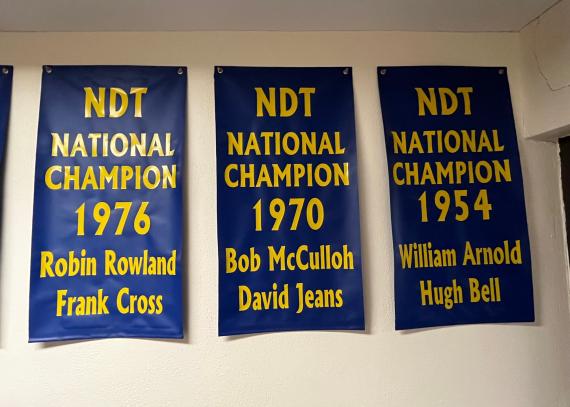
photo by: Contributed
Three banners representing the National Debate Tournament championship winners for the University of Kansas’s debate team. Robin Rowland, one of the winners for the 1976 championship, told the Journal-World participating with KU’s debate team was “life-changing.”
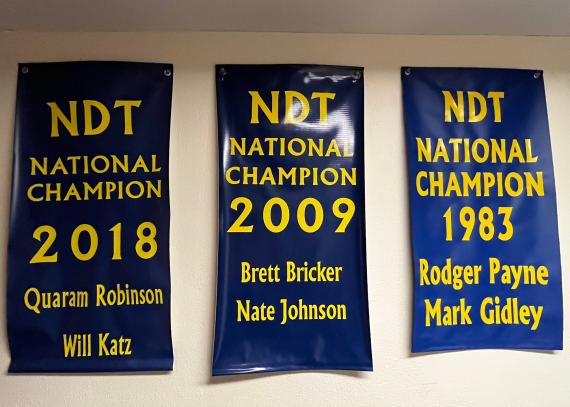
photo by: Contributed
Three banners representing the most recent National Debate Tournament championship winners for the University of Kansas’s debate team. Brett Bricker, currently the team’s head coach, won for KU in 2009, as the team has reached the invite-only tournament for the past 58 years.
PRACTICE AND PREPARATION INCLUDES A ‘MASTER’S THESIS’ OF NOTES
From July until April, Bricker said the best debaters spend countless hours outside of class preparing for the debate season.
Bricker, who became the KU debate team’s head coach in 2014, said that each July, the National Debate Tournament will release the debate topic that will be a part of each competition. Students will then spend “somewhere between a masters’ thesis and dissertation level of hours” in research and preparation by researching all possible angles that could be debated about the selected topic, according to Bricker.
If, for example, the topic was about energy production, then students would first develop introductory arguments that would touch on the most predictable topics, like climate change and the economy. Bricker said as the season unfolds, the team works to “perfect” both sides of the arguments and “innovate” them.
Knowing the topic forwards and backwards is important because the teams “won’t know what argument the other team is going to make” ahead of time, according to Rowland. One of the key tricks is to be able to be adaptable by knowing as much as possible to respond to the other team.
On that end, Bricker said the best debaters probably spend “around 30 hours a week” researching and crafting arguments. Those potential arguments are then run through practice debates — Bricker said they probably do “hundreds” in a season — where the teams refine all the arguments further. All of this is to ensure the arguments are “the best versions” they can be ahead of the national debate tournament.
“We spend basically all season building to that point,” Bricker said.
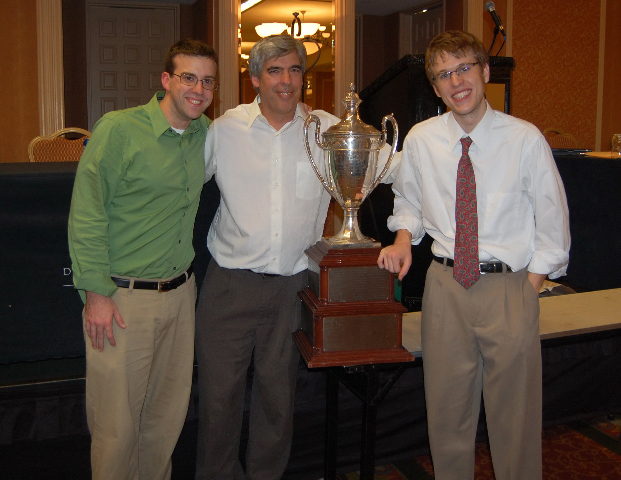
photo by: File Photo
Brett Bricker, from left, KU debate coach Scott Harris, and Nate Johnson surround the national championship trophy that Bricker and Johnson won in Texas in 2009.
That final National Debate Tournament is an invitation only event for the top 78 teams. The three-day tournament starts with eight preliminary rounds — which last two hours each — before going into single elimination where 28 to 32 teams qualify, according to Bricker.
In all those debates, the first few speeches are about providing evidence about the topic that the debaters plan to present and argue about. The last half of the debate is then the “rebuttals” stage, Bricker said, where the debaters synthesize their arguments and refute their opponents. Judges then decide who had the better argument and advances.
The hours of preparation and guidance of Bricker have led to a KU debate team reaching the Final Four in six out of the last seven years the NDT was hosted — there was no tournament held in 2020 because of the COVID-19 pandemic. In the heat of those elimination rounds, Bricker said the team has a motto that “every debater is in the tournament until the last KU team is out.” He feels that level of support and camaraderie is crucial for the success of the debate team.
“There is a small army of KU debaters helping that top team succeed,” Bricker said.
TEACHING SKILLS FOR LIFE
The success and prestige of the debate team at KU has caught the eye of many potential students, and the coaches say doing the activity itself adds a lot more to the college experience.
Bricker said that he has spoken with students who had opportunities to attend Harvard University or Stanford University but decided to come to Lawrence to be a part of KU’s debate team. Some of that is the fact the team aims to recruit the top students — just like Bill Self, Bricker said the debate team’s staff goes to high school events like the state debate tournament finals to identify potential talent — but he said many students feel like they can be “part of something bigger than themselves” with the KU debate team.
“It is kind of a beacon for bringing excellent students to campus,” Bricker said.
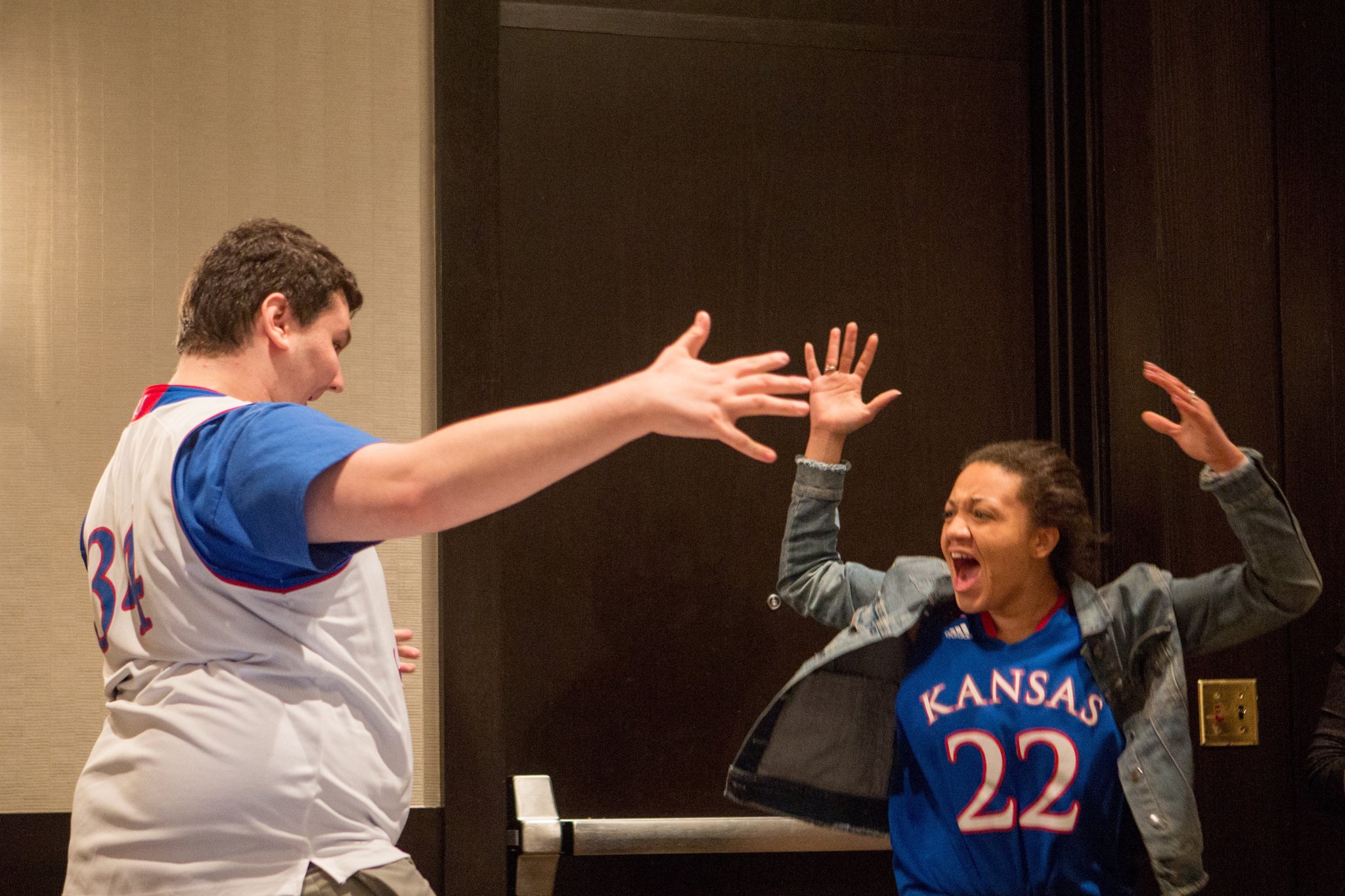
University of Kansas debaters Will Katz, left, and Quaram Robinson, right, are pictured at the National Debate Tournament, which ended early Tuesday, March 27, 2018, at Wichita State University. Katz and Robinson defeated a team from Georgetown University to win KU’s sixth debate national championship.
Once those students are on campus, they get a unique experience through KU debate’s competitive excellence and the preparation involved in the activity. Rowland said the skillsets from being a part of the debate team “opened doors” for his career. In preparing for competitions, he learned how to research any topic, how to think through the best way to approach the topic and how to take that information to create and respond to arguments.
Although there are fields like law or politics where it is obvious those skills would apply, Rowland said those skills can translate to a variety of fields. A scientist submitting a research paper to a journal would still need to respond to edits, and competing in debate is one way to learn skills outside the classroom.
“Debate doesn’t teach you how to do biomedical research, but it gives you a skill set that you need in the field,” Rowland said.
Bricker said one trait debate students learn is getting better at listening to and accepting feedback — something “integral” for most fields. During competitions, judges will vote for or against each team and usually give a “15-20 minute reason” outlining their decisions that gives advice for improving arguments. Bricker said while that is similar for students getting feedback on an essay, it happens so often in one weekend in a competitive environment that students learn to listen to it instead of potentially “taking it personally.”
The team aspect of competition is something that Bricker sees as critical for the success of the program, but also a key skill that his students learn. Instead of dreading group work, debate helps students “thrive” in that environment — and they often learn to be more selfless. Bricker said that one of the team’s top debaters, Rose Larson, chose to travel with the team to a tournament despite the fact she is not competing. Bricker said that’s because the rest of the group gave her so much help in the competitions, so she felt this is the time to give that support back.
More than anything, people involved with KU debate said that being a part of the team helps boost the students for the future. Rowland said competing in the 1970s proved to him success in debate was open to any student regardless of their background. It was all about hard work and critical thinking, not the credential of the school you went to, and it gave him “the confidence to achieve and go forward.”
50 years later, reflecting on the win for himself and KU, Rowland said winning the debate tournament felt like an ultimate example of the “democratic idea.” It was the words and the arguments that mattered in those competitions, not who was saying them. Seeing the program have continued success and seeing it launch the futures of many other fellow Jayhawks, Rowland said the debate team’s staying power proves to him just how far the students at KU can go.
“I believe the best KU students are every bit as good as the best students everywhere,” Rowland said.
KU
KU’s lesser known powerhouse: A look at how the debate team wins against the best of the best

University of Maine leader named as a finalist for KU journalism dean position
Self announces he will continue as KU coach

KU faculty union ratifies first-ever labor contract with 92% voting yes; contract now needs Regents approval

KU researcher excited to bring prestigious NASA fellowship to university as way to mentor students, expand research opportunities