

KU’s Religious Studies department wins grant to form new connections with health care providers
Other state universities also looking to expand breadth of religious education
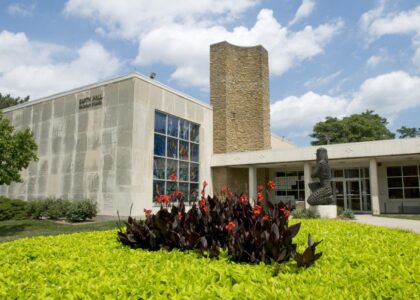
photo by: University of Kansas
Smith Hall, which houses religious studies at the University of Kansas is shown in this file photo.
The University of Kansas has won a $60,000 grant that may help create a new set of classes that combine religion and health care.
The two-year grant from the nonprofit group Interfaith America will help KU’s Department of Religious Studies form new relationships with health care providers, which in turn could inform a new academic program that KU hopes to create.
“We’re hoping to start a religion, spirituality and health care minor,” Jacquelene Brinton, associate professor and chair of KU’s Department of Religious Studies, said in a press release. “The grant will help us incorporate classes on faith and health into the curriculum, reach out to other departments that might participate in the minor and connect with community partners to offer student internships.”
As part of the grant, KU will host several public talks on and off campus that discuss how religion plays a role in many public health topics. KU already has agreed to partner with Lawrence-based DCCCA, which provides addiction recovery treatment and other services. Programs with DCCCA would address the importance of spirituality and religion in the addiction recovery process, Brinton said.
The department also plans to partner with LMH Health to discuss the importance of religion and spirituality in hospital settings, and also work with Lawrence-based Justice Matters, an interfaith group that has shown how religious organizations can address public health issues.
Brinton said the new minor that KU hopes to create likely would be valuable for students who are planning to enter medical school, nursing school or other parts of the health care industry.
“There is growing recognition that training health care providers to understand the religious and spiritual beliefs of their patients improves health outcomes,” Brinton said. “There’s substantial data supporting this, so people are paying more attention to teaching health care providers how to communicate with people about their religious and spiritual beliefs.
“What people believe about life, death, the body and medicine — many things at the center of health care — are often informed by their religion or spirituality. Understanding that and being able to communicate about it is essential. I think there has been a disconnect between patients and their needs in this area and the medical profession, and this program is designed to address that.”
The new program also comes at a time when KU’s Religious Studies department is seeking new ways to broaden its enrollment. As the Journal-World has reported, the Religious Studies Department is one of several low enrollment programs that have been put on a review list by KU and the Kansas Board of Regents. Unless enrollment and other metrics improve, KU has said the department could be merged with other academic programs.
Brinton said creating academic programs that examine the connections between religion and other parts of society is an important strategy for the department.
“Since religion plays an important role in society, connecting religion and health care helps demonstrate the importance of religious education across multiple disciplines at KU,” Brinton said.
Other universities in the state also are contemplating whether religious studies should have a different place in their academic offerings. The Kansas Board of Regents this week approved a new four-year Religious Education and Community Engagement bachelor’s degree for Fort Hays State University.
Fort Hays’ philosophy department will begin offering the degree in the Spring 2027 semester. The degree program would help students obtain careers in designing and leading religious education activities and programs for denominational groups. Those could include counseling and guidance programs that address marital, health, financial and religious problems, according to information Fort Hays State provided to the Regents.
Fort Hays leaders told the Regents the new degree program would be significantly different than traditional religious studies degrees, which have a heavy focus on developing academic knowledge of different religious traditions, ceremonies, communities and practices.
Fort Hays State leaders said in a memo to Regents that its new degree program would include some of that work but would primarily focus on “preparing students to apply this knowledge in professional careers with religious and nonprofit organizations.”
“This program would be focused on providing leaders for local communities in Kansas,” Fort Hays leaders said in their memo.
State Government
Property tax protest bill would let a few dozen voters block tax increases in some parts of Douglas County

Lawmakers pass bill to create sports authority to oversee new Chiefs stadium in Kansas
Kansas Legislature passes a bill that would give 10% of voters the power to stop some property tax increases
Kansas Senate, House pass budget bill that pegs raises at 1% for most state employees
U.S. Supreme Court Justice Sonia Sotomayor to visit KU next month; will speak to students, select guests
