Dinosaur that has resided at KU’s Natural History Museum is now the official state land fossil; middle school students lobbied for the designation

The Silvisaurus exhibit at the KU Natural History Museum is shown. (Credit: University of Kansas)
Indeed, Kansas once had a dinosaur that roamed its lands, standing about three feet tall, stretching about 12-feet long and coming equipped with protective plates and spikes.
Visitors to the KU Natural History Museum in Lawrence may already have known that, seeing the dinosaur’s fossil remains on display there.
But now that dinosaur — known as Silvisaurus condrayi — has an additional home inside the official record books of the state, thanks to some south-central middle school students and their teacher.
State lawmakers last week approved a bill that makes Silvisaurus condrayi the “official state land fossil” of Kansas.
The bill came about because students at Challenger Intermediate School in Goddard, just outside of Wichita, began pushing for the bill. Those students knew just who to enlist for help in the effort. Their teacher, Joel Condray, is the grandson of the Kansas rancher who found the dinosaur’s fossil skeleton in Ottawa County in 1955.
Condray’s students worked together to research the history of the fossil, visit lawmakers and provide testimony in support of the bill. In early March they visited the museum at KU to see the fossil and meet with the museum’s vertebrate paleontology staff.
“It has been an amazing experience both working with my students to be a part of history, but also to help carry on my grandfather’s incredible story and legacy,” Condray said. “The students and I share tremendous gratitude for the opportunity,” Condray said.
Kansas has several “official state fossils” of various types. For instance, the official state flying fossil — a Pteranodon — is also on display at the KU History Museum. Ditto for the official state marine fossil, a Tylosaurus proriger, a 45-foot-long mosasaur that is on exhibit in the museum’s lobby.
But despite being a part of the museum’s collections for decades, Kansas’ dinosaur had never received such a designation, despite being the only known dinosaur to have actually resided on the land now known as Kansas.
Megan Sims, KU vertebrate paleontology collection manager, said it was special to know that the Condray family helped make that designation happen.
“We are very thankful that in 1955, Warren Condray wanted to work closely with the University of Kansas and allowed this unique and important specimen to be available to the public in perpetuity,” Sims said. “Those connections are sometimes rare. We’re also thankful that Joel and his family have remained interested in the specimen and have taken an active role in advocating for the dinosaur’s state fossil designation.”
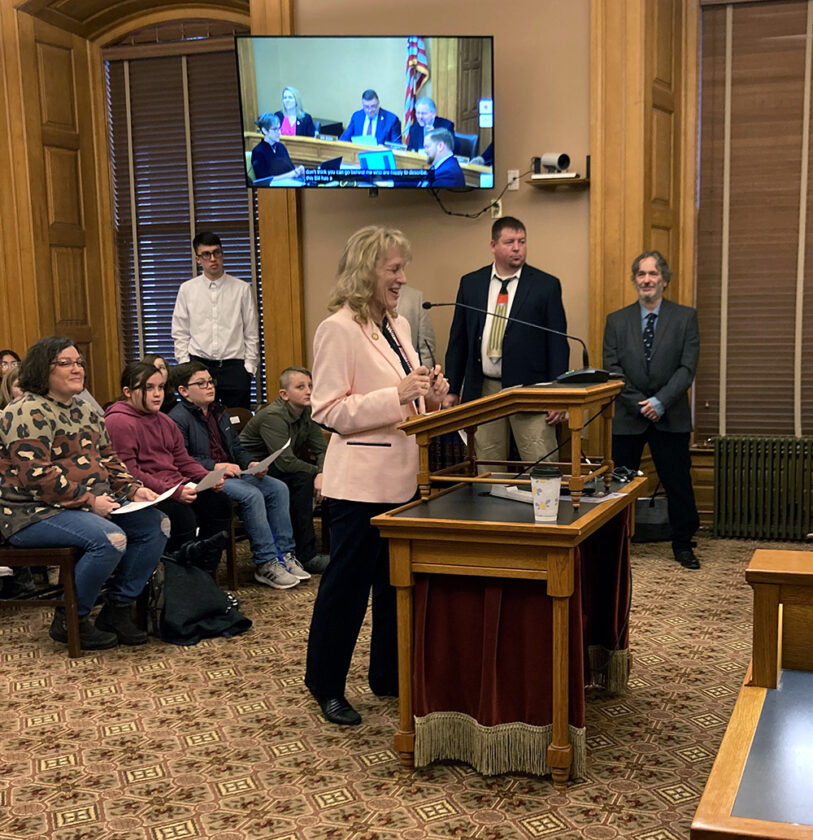
State Sen. Elaine Bowers, sponsor of the fossil bill is pictured. In back, center, schoolteacher Joel Condray; at right, David Burnham, KU fossil preparator, a pictured. (Credit: Megan Sims, KU Biodiversity Institute.)
Some of you paleontology buffs may be thinking that Kansas certainly had other dinosaurs, based on other skeletal remains that you have seen displayed in the state. Indeed there have been other dinosaur fossils found in the state, but experts at KU and elsewhere believe they likely did not reside on Kansas lands. Instead, they were found in deposits that were under the sea during the Cretaceous period. Because they were discovered in areas that were far from land at that time, they presumably washed into the area from other regions, KU said in a release.
As for Silvisaurus, the true Kansas dinosaur, it is a a species of ankylosaur, an armored dinosaur, which lived during the Cretaceous period 145.5-65.5 million years ago. At the time, Kansas was partially covered by the Western Interior Seaway; however, Silvisaurus lived in a forested area, indicated by an abundance of fossil leaves that were discovered with its skeletal remains. The presence of those leaves helped lead to the name of the dinosaur. Silvisaurus means “woodland lizard,” and was given that name in 1960 by KU paleontology researcher Theodore Eaton, who was a top researcher of the find.
The dinosaur’s fossil remains include the skull, lower jaw, backbone, ribs, limb bones, armor-like plates and a large shoulder spike, and they have been studied by researchers around the globe. Several years ago, new technologies emerged that helped KU paleontologists obtain more of the specimen from the rock in which it was embedded, and a new museum display was created for it in 2018. The exhibition can be seen at the museum, along with a large scientific illustration depicting a Silvisaurus walking.
The dinosaur is on the third floor of the museum, which is open Tuesday through Sunday on KU’s Lawrence campus.
— Anne Tangeman of the University of Kansas News Service contributed to this report.
State Government

In debate, Marshall says the Ukraine war, not the Iran war, has caused high diesel prices
Candidates lean on their prominent supporters in District 2 race
TOPEKA — Democrat Don Coover and Republican Derek Schmidt stood with partisan allies as their congressional race ...
Funding for new Chiefs stadium moves forward, setting sales tax revenue district
TOPEKA — State officials answered a key question this week underpinning the complex financing of the Kansas City ...
Voters Guide: A look at the candidates seeking to become Kansas Insurance Commissioner
The Kansas Department of Insurance regulates insurance companies that sell policies in Kansas. Voters will decide ...
Voters Guide: A look at the candidates seeking the job of Kansas State Treasurer
In the Nov. 3 election, Republican Kansas Treasurer Steven Johnson faces two challengers for his job as the chief ...