Regents approve giving in-state tuition rates to select out-of-state students at Wichita State; program may not work as well at KU
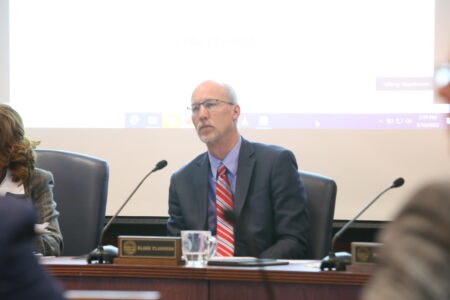
photo by: Chad Lawhorn/Journal-World
Blake Flanders, president and CEO of the Kansas Board of Regents, participates in a board meeting on March 17, 2022.
The Kansas Board of Regents had no problem in approving a new tuition plan for Wichita State University that will allow large numbers of out-of-state students to qualify for cheaper in-state tuition.
The reason was simple, Regents said.
“When we import a student in from another state, that is like creating a new job for the state,” Regent and Lawrence resident Wint Winter said. “It is similar from a standpoint of importing wealth.”
The Regents at their meeting on Wednesday unanimously approved a plan that will allow Wichita State to start charging students from select metro areas the in-state tuition rate.
Metro areas included in the tuition discount plan include: Chicago; Colorado Springs, Colorado; Pueblo, Colorado; Omaha, Nebraska; Grand Island, Nebraska; Lincoln, Nebraska; Ames, Iowa; Des Moines, Iowa; Fayetteville, Arkansas; Fort Smith, Arkansas; and Little Rock, Arkansas. WSU already charges in-state tuition for several other areas that previously were approved, including Denver, St. Louis, Dallas, Houston, Oklahoma City, Tulsa and Kansas City, Missouri, among others.
WSU estimates a student enrolled in 15 hours a semester saves more than $9,000 a year in tuition and fees due to the discount.
Regents, though, said the lost revenue may well be worth it. That’s because in a slow-growth state like Kansas, the higher education system needs out-of-state students to remain healthy, and the state needs young people inside its borders. The hope is that if they come for college, they’ll stay for their post-college careers.
“We have to message this properly,” Regent Mark Hutton said. “We’ve had some really good results that we aren’t touting enough because I’ve had people across the street (in the Statehouse) ask why are we giving away tuition?”
Wichita State indeed has seen enrollment growth during the time period it started the tuition discount program. From 2016 to 2021, the university’s student headcount was up 6.9%. During the same time period, KU’s overall enrollment fell by 3.2%. Wichita State’s growth in students from outside of Kansas is even starker. From 2016 to 2021, the number of out-of-state students has grown by 61%. At KU, during the same time period, it grew by about 8%.
But such a tuition discount strategy may not work as well at a university like KU, Regents were told. A complicating factor for KU is that it already has a large number of out-of-state students, with more than 40% of its enrollment coming from outside Kansas. If it started offering in-state tuition to certain metro areas — take Chicago, a longtime KU stronghold, as an example — it likely would have to do that for not just new students but also existing ones.
“If you have five of those students, that is not a big deal,” Blake Flanders, president and CEO of the Regents, said. “If you have 500 of them, it is a different deal.”
Regents in the past have expressed an interest in creating a tuition discount program that would apply to all Regents universities in the state. But factors like that have prevented such a policy from taking shape, Flanders said.
KU Chancellor Douglas Girod indicated KU likely wouldn’t move to a geographic-based discount program in the near future. He said KU does offer in-state tuition to a select group of out-of-state residents currently. They must be among the top achievers in high school, but they can come from any geographic location. Others that are high achievers but not in the very top tier receive a discounted tuition rate but one that is still higher than in-state tuition.
“We draw from all 50 states, so if we were going to do something, it probably would have to be for the entire country,” Girod said.
KU, however, as part of its strategic plan, is examining ways to create a “pricing/discount strategy,” but details of that strategy haven’t yet been developed.
KU
Haskell students hope for stability as Red Corn takes helm as permanent president

UPDATE: Closure of Hilltop childcare center is final, but the building seems likely to stay
KU to lead national effort to address special education needs and tackle industry’s pressing concerns
Opinion: KU faculty, staff should be nervous about the new spending rules proposed for college athletics
KU enrollment grows for third straight year, achieving a new record