Governor’s historic increases for higher ed budget may not survive; tuition increase may result
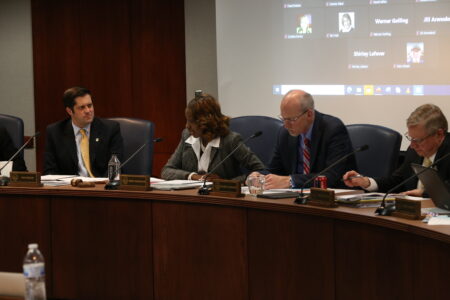
photo by: Chad Lawhorn/Journal-World
The Kansas Board of Regents meets on March 16, 2022 in Topeka.
A tuition increase for University of Kansas students next year may be in the cards after all.
The Kansas Board of Regents on Wednesday acknowledged that Gov. Laura Kelly’s recommended budget for higher education — which included a historic increase for the state’s universities — may not get fully funded by the Kansas Legislature.
Part of Kelly’s recommended budget called for a tuition freeze next year in exchange for an approximately $45 million increase in funding for state universities. Now, the Legislature is talking about a $25 million increase instead.
KU Chancellor Douglas Girod said anything less than the governor’s full $45 million allotment would bring a tuition increase back into play at KU.
“It will be on the table if they can’t fund us at that level,” Girod told the Journal-World in a brief interview. “For us, we will have to have that conversation.”
However, Girod said he believed KU would find a way to fund a 5% wage increase for university employees, even if the state Legislature doesn’t fully fund the governor’s budget. Kelly’s budget calls for a 5% wage increase for all state employees. That provision has remained in the budget as legislators have worked on the proposal. The 5% wage increase would be covered by new state funds.
But in the case of KU, that doesn’t mean it is getting new state money to give a 5% wage increase to all university employees. Only about 25% of KU employees fall under the state employee system that is targeted for a wage increase. KU would have to find funding to cover the wage increase for the other 75%.
Earlier this week, KU Chief Financial Officer Jeff DeWitt released a new five-year budget plan for KU that called for the 5% universitywide wage increase in fiscal year 2023, which begins in July. That budget, though, was based off an assumption that Kelly’s plan — or something very close to it — would be approved by the Legislature.
Girod on Wednesday said he doesn’t believe KU can let a derailment of Kelly’s budget plan in the Legislature knock the 5% pay raise off track at KU.
“I personally believe we need to figure out how to get it done,” Girod said of the pay raise in the event Kelly’s budget doesn’t get fully approved. “That’s why we have a CFO with a five-year plan. He needs to tweak the plan. It does create a bigger challenge down the road. It just means we have to work that much harder to make sure we have a plan to deal with it.”
Regents also were told that a majority of senators have largely backed away from the idea of the governor’s plan to provide $45 million in new funding for higher education in exchange for a tuition freeze. The Senate came up with the $25 million number instead. The $45 million amount was still in a House plan, but Regents were told some key House members also were having second thoughts about the number, expressing concern that the state may be extending itself too much.
The $25 million increase would be a much larger increase than the higher education system has seen in recent years. In many cases, state universities have experienced funding cuts. Girod acknowledged the various scenarios under discussion still would leave the university in a better place than in past years.
But Girod also told the Regents that legislators need to provide some significant increase in base funding to the universities, which is the type of funding that is renewed year after year. Girod said if legislators become tempted to provide only new, one-time money it will place the universities in a very difficult situation due to inflationary increases the schools are experiencing.
“Without putting money into the base, it is just another big budget cut to us,” Girod said.
Some one-time money that Kelly had recommended as part of her budget also is at risk in the Legislature. Kelly had recommended $190 million be put into the Kansas Department of Commerce’s budget to fund projects at state universities that could spur economic growth in the state.
Regents were told that legislators largely have decided not to include that money in the official budget bill that is expected to be approved by April 1. Instead, the amount may come up in the omnibus budget process in the final days of the legislative session, where items not included in the ordinary budget have one last chance to win approval before the Legislature adjourns.
It had never been determined how much of the $190 million KU would have been eligible to receive from the Department of Commerce. But Girod said it easily could be in the tens of millions of dollars. He said KU would look at ways to use the money for research initiatives, the build-out of Innovation Park on KU’s West Campus, cancer center expansion at KU Medical Center and maybe even a convention and hotel project, potentially in Lawrence, that ties into KU’s new strategic initiative to try to host more university-related conferences and conventions.
Regents were urged Wednesday to lobby legislators about getting that Commerce Department funding back into the state’s budget this session.
“It could be a game-changer not just for our campus, but for our community and the state,” Girod said.
KU
KU professors, middle school band director, radio personality among this year’s Phoenix Award honorees: ‘It’s a cool mix’
Hilltop childcare center has been losing money for at least two years, records show

Turnstile rocks KU campus as Day on the Hill returns after two-decade absence

UPDATE: Closure of Hilltop childcare center is final, but the building seems likely to stay
KU to lead national effort to address special education needs and tackle industry’s pressing concerns