KU budget cuts not planned for 2023; university confident it can fund 5% pay increase

photo by: Associated Press
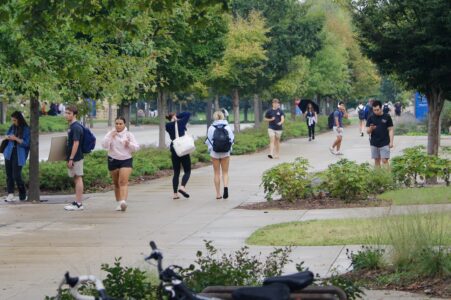
Students cross Jayhawk Boulevard in front of Strong Hall on the University of Kansas campus in Lawrence, Thursday, Oct. 24, 2019.
University of Kansas leaders plan to avoid budget cuts for the 2023 fiscal year that begins in July, and they are confident they’ll find a way to fund 5% pay raises, they said Tuesday.
But KU’s chief financial officer also said that the 2023 reprieve is a gamble that could lead to tens of millions of dollars in shortfalls if KU doesn’t become more efficient and start growing enrollment and other programs in the near future.
That’s because KU will be spending down cash reserves in 2023 to take a break from the cutting. If KU’s enrollment and financial performance don’t bounce back by 2024, the university will face a financial condundrum.
“Our checkbook, as I call it, is overdrawn,” KU Chief Financial Officer Jeff DeWitt said as part of a video message with Chancellor Douglas Girod and Provost Barbara Bichelmeyer.
DeWitt said he’s comfortable with KU drawing down cash reserves for the 2023 budget year to avoid cuts. Those cash reserves have accumulated largely due to about $25 million in budget cuts that the university has made during the current budget year.
But DeWitt detailed what will happen if KU doesn’t implement a new strategic plan that will help the university grow enrollment and improve its efficiency. KU’s budget would be $23.5 million out of balance, and KU’s cash reserves would be about $10 million short of covering the deficit, meaning cuts would be mandatory. By 2026, the budget would be $29 million out of balance, and KU’s reserves would be $62 million short of covering the deficit.
DeWitt said the looming deficits mean that it is critical that KU execute its Jayhawks Rising strategic plan, and “execute it hard.”
“They can’t be delayed,” DeWitt said of the plan’s initiatives.
DeWitt highlighted several initiatives that he believes will be key to improving the university’s finances. They include:
• A new strategic enrollment plan that grows programs most in demand by the market, and increases the amount of marketing and promotion that KU does to attract students. The initiative is expected to add about $7 million to KU’s revenues by 2025, but actually won’t be cash-flow positive in 2023 and 2024 due to start-up costs. DeWitt said KU plans to seek assistance from KU Endowment to fund the start-up costs of the program.
• A new focus on hosting university-related conventions, conferences and events, primarily in Lawrence. KU already has begun working with Explore Lawrence to develop plans to use university space to host conferences of approximately 150 people or less, with plans for larger events in the future. KU is projecting a $1.25 million impact in 2024, with it growing to $5 million in 2026.
• “Continuous improvement” in efficiency measures such as purchasing policies and other operational procedures. KU projects that this would improve KU’s finances by $2.5 million in 2023 and by $7.5 million by 2026.
• Universitywide cash management practices to ensure that money from a variety of different sources is being put to its broadest possible use. KU’s operations and budget are broken into many different units. KU is projecting that allowing more money to move across those units can improve KU’s finances by $10 million per year.
KU’s multiyear plan assumes some version of the governor’s recommended budget will be approved by the Legislature this year. If the Legislature doesn’t approve any higher education funding plan, KU’s deficits would increase by about $15 million per year.
The governor’s recommended budget would fund about 25% of the pay raises that KU intends to give in 2023. The university would have to use its cash reserves and other savings to fund the balance.
As part of the governor’s recommended budget, KU would be prohibited from raising tuition in 2023. However, KU’s plan calls for 3% increases in tuition in 2024 and beyond. Such increases would be subject to approval by the Kansas Board of Regents, which has been cool to tuition increases in recent years.
DeWitt said there are several issues that could arise that would throw KU’s plan off track. The biggest is that KU doesn’t execute on its strategic plan. A more immediate one would be a political derailment of the governor’s higher education budget.
“It is really important that budget passes,” he said. “It is critical to KU’s future.”
But DeWitt brought up another potential loss that sometimes shows up in the news: the dissolution of the Big 12 Conference. If KU were to lose membership in a Power Five athletic conference, DeWitt estimated it would cost the university at least $37 million in conference fees alone. At that point, KU would have tough decisions to make on whether to use general university funding to keep the athletic department functioning, he said.
“We need to stay in a Power Five conference,” he said.
Both Girod and Bichelmeyer endorsed DeWitt’s multiyear financial plan for the university. Bichelmeyer particularly highlighted the need to invest savings the plan creates into better wages and salaries for university employees.
Girod said it was “absolutely critical” that KU “takes better care of our people than we have been able to do in the last 10 years.”
He labeled the financial plan as “doable,” and one that can “enhance our university in many ways, not just financially.”
KU

Hilltop childcare center has been losing money for at least two years, records show

Turnstile rocks KU campus as Day on the Hill returns after two-decade absence

UPDATE: Closure of Hilltop childcare center is final, but the building seems likely to stay

KU to lead national effort to address special education needs and tackle industry’s pressing concerns
Opinion: KU faculty, staff should be nervous about the new spending rules proposed for college athletics