Provost says KU is ramping up online education program; questions develop over impact it will have on Lawrence campus

photo by: Mike Yoder
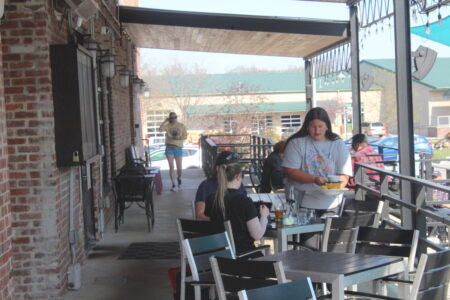
University of Kansas Provost and Executive Vice Chancellor Barbara Bichelmeyer speaks during an interview March 4, 2020.
A new initiative called Jayhawk Global – a program designed to greatly increase the University of Kansas’ online offerings — may give local Jayhawks some new issues to think about.
University of Kansas Provost Barbara Bichelmeyer told a group of university leaders Thursday that as KU places more emphasis on growing its online offerings, it likely will place less emphasis on growing the in-person enrollment totals on the Lawrence campus.
“As we grow ourselves into the future, we are not particularly looking to significantly increase the number of students that we have in the research/residential programs that we have on the Lawrence campus,” Bichelmeyer said at a recent meeting of KU’s University Senate.
In a Lawrence economy that relies heavily on student spending, KU’s undergraduate enrollment strategies have the potential to be felt far and wide. Bichelmeyer — who addressed the topic only briefly during her remarks to University Senate — didn’t provide any indication that KU was looking to see its undergraduate enrollment in Lawrence decline significantly. Rather, her comments created new questions about whether a return to past enrollment levels on the Lawrence campus will be feasible.
KU’s enrollment on the Lawrence campus has fallen for four consecutive years, hitting a new low this fall with 22,508 students. That’s down nearly 1,200 students from its recent high of 23,669 in 2017.
That decline comes at a time when universities across the country have struggled to grow or maintain enrollment levels. But the decline also comes at the same time that KU has increased enrollment for five consecutive years on its Edwards Campus in Johnson County. That campus caters more to students already in the workforce, and multiple online offerings are also based there.
Bichelmeyer mentioned the important role the Edwards Campus will play in KU’s future growth.
“We want these programs to be as full as they can be,” Bichelmeyer said of the classes and programs offered on the Lawrence campus. “But we also want to look at our opportunities for on-campus workforce development at Edwards. We want to make sure we are competitive with the online space with programs that should be online.”
Bichelmeyer said the university community should expect to hear more soon about how KU intends to become a larger player in the world of online education. University leaders some time ago agreed on the brand name Jayhawk Global to promote KU’s expanded online offerings. Now, Bichelmeyer said, the university will launch a search for a director to lead the Jayhawk Global program.
As part of the program, KU will reach out to deans and department chairs for ideas on what new offerings could be part of an online program. In some cases those may be full degrees that are offered online or just select classes. In other cases, the offerings may not be traditional college classes at all, but rather noncredit courses that professionals and others may need for certifications and other such programs.
That type of work could produce some new opportunities on the Lawrence campus. The idea of “competency-based education” for the business sector ultimately will lead to more work around the “areas of convention, conferences and events on campus because we know we have capacity in those spaces to generate significant revenue,” she said.
Bichelmeyer in her brief remarks didn’t address what KU’s strategy would be for bringing conferences and events to campus, and whether KU intended to use the Lawrence campus as the primary location for those events or whether it would look more often to the smaller Edwards Campus, which is closer to a major airport and surrounded by the Kansas City business community.
But Bichelmeyer did highlight how even when parts of KU other than the Lawrence campus grow, the Lawrence campus has an opportunity to benefit. That’s because the bulk of KU’s research efforts continue to be located in Lawrence, and student growth at Edwards or online could eventually feed those research efforts.
Recently, KU leaders have made growing KU’s research facilities in Lawrence a major focus of the university’s growth plan. The chancellor and other top leaders are touting a $400 million-plus master plan for KU Innovation Park on West Campus as a major economic development opportunity for the state of Kansas.
In other items from the University Senate meeting, Bichelmeyer said:
• Four finalists to serve as dean of KU’s School of Architecture & Design likely would be announced and come to campus in late February.
• The new timeline for hiring a dean of the College of Liberal Arts & Sciences is now Jan. 1. Bichelmeyer said the search process has taken longer than expected after she heard a multitude of comments from faculty and staff members of KU’s largest academic unit. She said many people advocated that the college was too broad to be served by one dean and should be split. Bichelmeyer said she was not pursuing a split of the college, but was considering a new structure that would better recognize the various academic divisions within the college. Doing so would allow a new dean to focus more on broader issues of the college while division leaders take more responsibility for some of the various academic units within the college.
Bichelmeyer said John Colombo has agreed to continue serving as interim dean of the College of Liberal Arts & Sciences during the extended search process.
• KU continues to study the possibility of providing a benefits package to university employees that includes tuition assistance. Bichelmeyer said staff and faculty raises remained the top priority to improve the KU workforce. But she said the lack of a robust tuition assistance program did put KU at a competitive disadvantage with other universities. She said her preliminary research indicated a program that would provide six credit hours per semester would be needed to make KU competitive. She didn’t provide details on how those credit hours would work or when KU might be able to implement such a program.
KU
Legislature overrides governor’s veto of KIRK Act, creating new free speech regulations for KU, other universities
University of Nebraska professor a finalist for KU journalism dean position

KU special education, paleontology graduate programs ranked No. 1 public programs by U.S. News & World Report
U.S. Supreme Court Justice Sonia Sotomayor reminds Lawrence crowd that people have the power to change bad laws
KU Religious Studies to host public talk with Justice Matters about the group’s role in promoting community health