As longtime Dole Institute leader retires, he says the center’s bipartisan mission is more important than ever
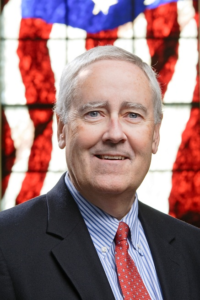
Bill Lacy
It is about the people, which, of course, people say with various levels of conviction all the time.
But when for the last 17 years you have run an institute named after a person, you may have a more sincere belief in the power of people than most.
That’s where Bill Lacy, the retiring director of the Robert J. Dole Institute of Politics at the University of Kansas, finds himself these days. As his tenure comes to a close at the end of the month. Lacy is convinced that America’s political system isn’t broken.
Just too many people within it are.
“The fact that Congress worked 20, 25 years ago and no longer works today is less an indictment of the system and more an indictment of the people we are electing,” Lacy said in a recent interview. “It is not all of them. There are some very well-meaning people going to Washington, D.C. Quite a few. But there are some who are not the least bit interested in reaching common ground with the other side.”
Prior to his leadership role at the Dole Institute, Lacy had an inside view of that system. He was a political director for President Ronald Reagan, worked as a campaign strategist on seven presidential campaigns, and served in multiple roles on Bob Dole’s staff.
It was at 40 years old — nearly 20 years into his political career — that a big change took place. Republicans won control of the U.S. House and Senate for the first time in his life.
What has happened since that big change is sometimes under-appreciated: Control of Congress has ping-ponged back and forth between the two parties, which has created little incentive for politicians to change their views or tactics. Now, it has left the country with entrenched partisans on both ends of the political spectrum who control the primary election process, making it difficult for people to work across the political divide and find common ground, Lacy said.
“The level of polarization is the highest I’ve seen in my lifetime, with perhaps the exception of the ’60s,” Lacy said. “In the ’60s it was over big, important issues. Now it is over owning the Republicans or owning the Democrats.
“It is kind of small potatoes today. The decisions being made are as big as ever, but the fights we are having are over the Republican and Democratic talking points that are being distributed every day. Everybody just wants to go out of their houses and shout their party’s talking points at the top of their lungs.”
The answers to those problems are tougher to find.
“We need to try to find a leader who transcends these things,” Lacy said. “I don’t see one on the horizon right now, but you never know what you will find.”
In the meantime, Lacy figures the Dole Institute can do its part.
“It seems more important than ever to hold up someone like Bob Dole as an example of someone who can work across the aisle and get things done,” Lacy said.
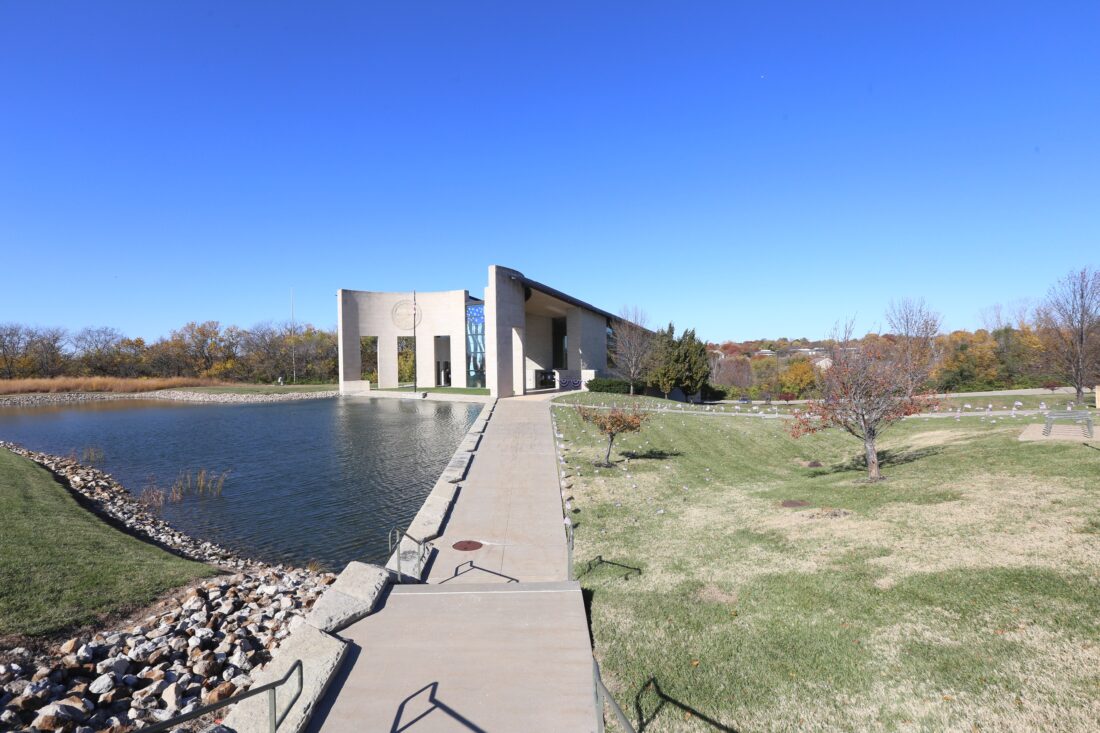
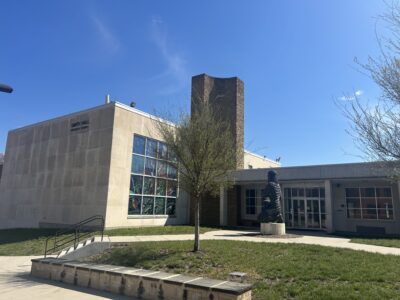
photo by: Chad Lawhorn/Journal-World photo
Dole Institute of Politics Nov. 11, 2021.
Institute’s impact
Dole, of course, was a Republican, U.S. senator from Kansas from 1969 to 1996, and for more than a decade was the senate majority or minority leader, depending on whether Republicans held control of the Senate.
You don’t get to be a leader of a major political party without being partisan, and Dole was on many occasions. Lacy said the public shouldn’t ever expect politicians to be nonpartisan, but should expect them to work across party lines for good ideas.
That’s a common theme of many of the more than 60 events a year that the institute hosts. At times, the institute has brought to Lawrence some of the biggest names on the political or international stage to promote that message.
Among former U.S. presidents who have spoken as part of the institute are Democrats Jimmy Carter and Bill Clinton and Republican George H.W. Bush. If you need further proof of the institute’s desire to live on both ends of the political spectrum, look no further than 2003 and 2004 when the institute awarded its first Dole Leadership Prizes. The 2003 prize went to Rudy Giuliani — then just the former Republican mayor of New York City who later would become a leader of Trumpism — while the 2004 prize went to George McGovern, the 1972 Democratic presidential nominee often cited as one of the most liberal major party candidates in U.S. history.
While director, Lacy, 67, oversaw or participated in the visits of multiple national and international leaders, including Nobel Prize winner and former Polish President Lech Walesa, former Ukrainian President Viktor Yushchenko, former Colombian President Juan Manuel Santos, former Secretary of State James Baker, U.S. Chief Justice John Roberts and others.
While the speakers and award winners have been varied in philosophy and background, Lacy said there has been a common theme to what the institute has tried to instill in students and others who use it as a resource.
“We are trying to give students examples — not just students, but anybody who walks through the front door or joins us through our virtual programming — examples of how it worked in the past and how it can work in the future,” Lacy said.
“We try to have a certain number of programs that harken back to when Congress worked and when they found common ground on issues,” Lacy continued. “People are really eager for that. I think at some point the country will turn back to that a bit.”
Navigating the future
That day, though, probably won’t be tomorrow. Lacy listed the hyper-partisan nature of politics currently as one of the challenges the institute faces in fulfilling its mission.
“Very carefully,” Lacy responded when asked how the institute goes about promoting bipartisanship. “You really have to be very cautious about what you present. If you present a person with a particular point of view on an issue, you try to balance that person off from a partisan or philosophical position. It also means we do a lot of history because history really isn’t left or right. It is just the way it happened.”
A challenge as old as history itself for almost any nonprofit institute is funding. When Lacy was hired in 2004 to become the institute’s second-ever director, there was talk by leaders of a need for a $20 million endowment for the Dole Institute.
Lacy said the endowment for the Dole Institute currently stands at about $10 million. While it hasn’t reached the heights once planned, Lacy said the institute has solid finances. Income from the endowment pays for most of the programming and other activities at the center, while the general university pays for the salaries of the institute’s staff.
Lacy said Chancellor Douglas Girod, like his predecessors, has been supportive of the institute, and Lacy hasn’t had to make a strong pitch to preserve the university’s funding as KU faces budget challenges. But, he said the institute could make a strong argument about its value, if it ever is required to.
“After KU basketball and the Medical Center, we are nationally one of the most visible parts of the university,” Lacy contended. “We are sucking up a part of the KU budget that is infinitesimal compared to many other parts of the campus, and what we do here is so important. We need it and can’t go without it.”
And Lacy thinks the institute will be able to argue that it is becoming important in new ways as Audrey Coleman takes over for Lacy in the coming days. Coleman, who served as the institute’s associate director, is an expert in the archives of the center.
The institute long has had the bulk of Bob Dole’s papers, and has worked hard to digitize them. But it has been more recently that Lacy led an effort to secure the papers of Elizabeth Dole, who is married to Bob Dole and served as U.S. senator herself for six years and was a secretary of transportation under Reagan and secretary of labor under George H.W. Bush.
Lacy said Elizabeth Dole’s papers “profoundly” add to what the institute offers researchers. That research component could become a larger part of the institute’s mission in years to come.
Not that the research component isn’t important today. It is, and sometimes in more ways than one. Lacy said that just a few weeks ago a researcher working on her doctorate at the University of California-Berkeley came to the institute to search through Dole’s records. Her dissertation involves cults in America, and she said Bob Dole in the 1970s and ’80s was one of the leading proponents for studying and understanding cults.
“I told her I had worked on and off for him for 35, 38 years, and that was the first I had heard of it,” Lacy said. “That’s pretty impressive.”
A small reminder that Bob Dole and his institute still have more to teach us.
KU
Legislature overrides governor’s veto of KIRK Act, creating new free speech regulations for KU, other universities
University of Nebraska professor a finalist for KU journalism dean position

KU special education, paleontology graduate programs ranked No. 1 public programs by U.S. News & World Report
U.S. Supreme Court Justice Sonia Sotomayor reminds Lawrence crowd that people have the power to change bad laws
KU Religious Studies to host public talk with Justice Matters about the group’s role in promoting community health