City advisory board backs Seventh, New Hampshire route to close Lawrence Loop downtown gap
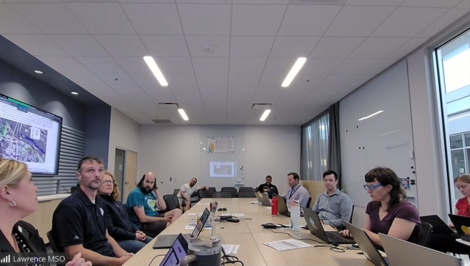
photo by: Zoom screenshot
The Connected City Advisory Board meets on Monday, Sept. 21, 2026.
A city advisory board is backing a plan to close the Lawrence Loop’s downtown gap with a route along Seventh and New Hampshire streets, though it might change in the future depending on what happens to the Riverfront Mall property.
On Monday, the Connected City Advisory Board reviewed a draft report from Trekk Design Group on how to close the downtown segment of the approximately 22-mile Lawrence Loop. The firm is recommending the trail network to be routed down Seventh and New Hampshire streets.
That’s a different route than what respondents to a city survey preferred. A majority said they wanted to keep the Loop out of the heart of downtown, as the Journal-World reported.
Most of the survey respondents actually favored the trail following the railroad tracks northwest, passing through the Riverfront Mall site and then behind City Hall.
However, according to the report, city management asked Trekk to not consider Riverfront for routing purposes after the city reached a lawsuit settlement with the owners of Riverfront. The city will take over the building next year, and city staff have proposed demolishing the structure and replacing it with new development, as the Journal-World reported.
At Monday’s meeting, the advisory board members unanimously voted in favor of the plan from Trekk and are recommending it to the Lawrence City Commission for approval. Several board members said they supported moving forward while wanting the city to consider safer or more separated bicycle infrastructure during the eventual design process.
Board member Hilary Carter said that Seventh Street is wide, and it could potentially be divided to create smaller travel lanes for cyclists and others using the trail system to separate them from downtown traffic.
“With shared use paths, it’s just like it creates a lot of conflicts between pedestrians and cars and cyclists,” Carter said. “I think because we have so much real estate on Seventh, if we can get separated facility for cyclists, … you are getting … road users right to more meaningful destinations, as well as recreational users.”
“I also understand the value of car-free spaces and having a place where you don’t have conflict with cars and being on the Loop,” Carter said. ” … I know staff are really amazing … so I’m really glad to hear that they want these specific safety interventions with it.”
While the proposed Lawrence Loop alignment wasn’t as favorable among the survey respondents, city staff said the alignment is – in part – a “temporary solution” to close the Loop. This is mainly because of the uncertainty of what will become of the Riverfront property.
City staff said infrastructure added along Seventh and New Hampshire streets would likely remain even if the Loop is later routed through the Riverfront property, helping keep the roads safer.
After going through Seventh and New Hampshire streets, the trail would go around City Hall to the north or south to create a loop around the building. It would then pass underneath the Kansas River bridges before reconnecting to Sixth Street and Constant Park.
“We’re saying this is a temporary solution to closing the Loop,” Jake Baldwin, an engineering program manager for the city, said. “And the ultimate solution would happen through the Riverfront property. So the temporary solution – at least what I’m envisioning – is this infrastructure that we build and continue to maintain in the future, even when something better comes along.”
The reason why city staff are trying to close the downtown section of the Lawrence Loop now is because they received a federal grant of $1.23 million from the Kansas Department of Transportation that can only go toward this project.
The route is not final, and the decision of which route the Lawrence Loop will take to complete the missing section of the trail will ultimately be up to the Lawrence City Commission.
Other News
Clinton State Park and other state parks will increase overnight camping, vehicle permit fees starting next month
‘No day is like the other here’: Students from Lawrence’s German sister city discover football, new foods and new friends on exchange
GCSAA celebrates 100 years with new plaza and statue honoring its founder and first president

Go, See, Do: Library book sale, candidate forum and more
Gas station at Lawrence’s new Costco will be open starting next Wednesday