
U.S. Army says cleanup at Sunflower Army Ammunition Plant is ‘slowing down’; PFAS investigation at site still needs funding

photo by: Chad Lawhorn/Journal-World
Aged water towers that are still left from the former Sunflower Army Ammunition Plant between De Soto and Eudora are shown on Aug. 2022.
While cleanup at the former Sunflower Army Ammunition Plant is “slowing down,” the U.S. Army is seeking additional funding to investigate contamination from a group of “forever chemicals” near a former fire station on the property.
The former ammunition plant is located in northwest Johnson County, approximately 3 miles southwest of De Soto. Most people now know it as the home of the Panasonic battery facility, but that plant takes up only part of the roughly 10,000-acre site, which has now been rebranded as a business park — Astra Enterprise Park.
Established in 1941, the plant was once the world’s largest power and propellant plant, but its manufacturing operations caused widespread contamination.
The Army has been cleaning up contamination at the site since 2005, and while much of the property has been remediated, several areas still require millions of dollars worth of cleanup.
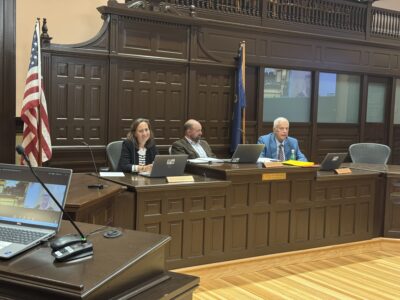
Scott Smith, environmental protection specialist and site manager for the U.S. Army, said at an advisory board meeting on Thursday that cleanup at the Sunflower site has been “slowing down” because much of the work has been completed. There are only a few areas of the Sunflower site still requiring remediation.
“As the work is slowing down, … the amount of information we have to bring you every three months will also be slowing down,” Smith told board members.
Meanwhile, Smith said the Army has detected the “forever chemicals” — more technically known as PFAS, or per- and polyfluoroalkyl substances — contamination in groundwater near a former fire station on the plant property. He said additional funding has been requested to investigate the area further.
PFAS contamination was found after an initial assessment was conducted to identify places where PFAS-containing materials may have been used historically. That assessment identified two areas for testing: the former fire station and fire-training area, and a sewage treatment area.
Testing found no PFAS in soil or groundwater samples from the sewage treatment area, but there were traces of PFAS detected in groundwater near the fire station area. Smith said the contamination could have resulted from the use of firefighting foam.
“(In) the fire station area, … some of the soil samples showed detections that were below the risk levels, so basically not cleanup levels,” Smith said. “But the groundwater in one location came up as having PFAS in it, and it was above the risk-based level.”
“It’s in the groundwater right there,” Smith said. “We didn’t find it anywhere else, but we have to delineate it still, and that’s what the remedial investigation will do — delineate the extent of it.”
Since the work is dependent on whether the Army receives federal funding, there is no timeline set for when it will begin.
Cleanup efforts
The entire Sunflower site is divided into multiple smaller sites since there were multiple different operations, waste-disposal areas and sources of contamination at the ammunition plant.
The Army has cleaned up 88 of the 97 tracked sites at Sunflower, Smith said, and they have submitted no-further-action requests to the Kansas Department of Health and Environment.
However, there are several stages of regulatory review. The Army’s completion of cleanup work does not necessarily mean a site has received final regulatory closure. The KDHE has to sign off on each of the requests, and many of the sites are at different stages of regulatory review.
Out of all the sites, only 24 sites have actually been removed from the “corrective action permit” – which is a federal-state environmental regulatory permit issued to oversee the cleanup of hazardous waste contamination. This means that the KDHE has determined that no further soil cleanup is required at these sites.
While the cleanup work is slowing down, as the Journal-World reported, the Army likely won’t have the cleanup “mostly” finished until 2028 or 2029. The reason why staff says “mostly” is because each fiscal year, Congress only gives the Army so much money for cleanup efforts.
There is no guarantee that federal funding will be available for the Sunflower site each year. In addition, Smith told the Journal-World on Thursday that much of the remaining cleanup – while in small areas – totals millions of dollars.
Other remaining work
The areas requiring further cleanup are primarily located in the northwest corner, as well as a few areas in the middle of the Sunflower property.
Near the middle of the Sunflower site, there are three ponds or sediment basins identified as Solid Waste Management Units 4, 5 and 6. The basins were previously used to manage water associated with the plant’s former nitrocellulose production area, where wastewater could be acidic.
The Army is planning to remove the sediment from the basins, test the soil underneath and clean up contaminated material along the bank of the largest basin. The work has not begun yet, as the Army is awaiting funding.
In addition, in the northwestern corner of the property, at a site known as Area of Concern 17, Smith said there are sumps that still need to be removed. While the Army has cleared sumps on the eastern half of the individual site, a contractor is expected to begin work on the western half soon.
“In the spring they’ll show up to the site and have removed the remaining sumps and a small area in one of the ditches that has some contamination in it,” Smith said.
There is also long-term monitoring for some sites and remediation underway for a site surrounding former laboratory buildings near the center of the Sunflower site.
Smith said once all of the remediation work is completed at Sunflower, the Army will no longer have a presence at the site and it will be turned over to private development.
The advisory board meets quarterly, and the next meeting is scheduled at 6 p.m. on Jan. 28, 2027, at the De Soto City Hall Senior Center, 32905 W. 84th St. in De Soto. The public is invited to attend.
Other News
U.S. Army says cleanup at Sunflower Army Ammunition Plant is ‘slowing down’; PFAS investigation at site still needs funding

‘One of a kind’: Sale at the Lawrence Arts Center will find new homes for late musician’s unique custom guitars

Go, See, Do: KU homecoming, Halloween happenings and other events

Student-run coffee shop opens at Community Connections at Pinckney, teacher receives surprise $1,000 award
‘This is for all of us’: Midco Prairie, an oasis of native plants in downtown Lawrence, opens to the public