

Data center company plans up to $1,000 a year in tax, utility credits for De Soto households
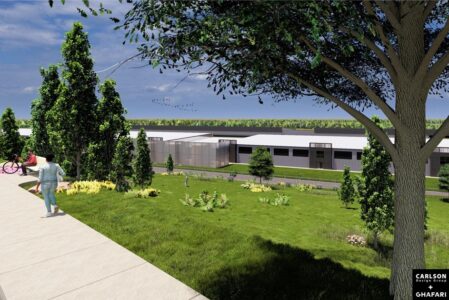
photo by: Carlson Design Group and Ghafari
A construction rendering looking towards one of the data center buildings of Digital Realty's proposed "Astra North" campus at Astra Enterprise Park. The view is from Lexington Ave. looking northeast. The design is not final.
A company proposing a data center campus in De Soto says it’s “committing” to provide households with up to $1,000 annually in property and utility tax credits for 10 years.
The total investment of $20 million from Digital Realty is to deliver economic relief, according to a press release from the company, and it is expected to award credits of up to $1,000 to every household in De Soto annually for 10 years. This decision was based on current population estimates.
The details between Digital Realty and the City of De Soto have not yet been finalized, the release said, and more information will be shared once details can be confirmed.
The company said the goal is to get credits to the residents “ahead of the recurring tax revenue and economic benefits the campus is expected to generate once operational.”
“Digital Realty builds critical infrastructure that enables the modern economy, and we believe we also have a responsibility to help strengthen the communities that make this growth possible,” Andy Power, president & CEO of Digital Realty, said in the release. “This commitment is designed to deliver tangible benefits for De Soto residents while we invest for the long term. We’re proud to partner with the City of De Soto and local leaders to ensure our presence contributes to community priorities, today and for years to come.”
According to the project’s website, Digital Realty is still working through the economic impact analysis, and they have not shared specific estimates yet.
“De Soto and the developers of Astra Enterprise Park have spent decades planning for the future of this historic site, with the City focused on ensuring its redevelopment creates tangible benefits and improves quality of life for our residents,” Rick Walker, mayor of the City of De Soto, said in the release. “Digital Realty’s commitment builds on that vision in a meaningful way by investing directly in the people who call De Soto home.”
As the Journal-World reported, Digital Realty proposed the data center project this past summer after it purchased land within De Soto’s Astra Enterprise Park, near West 103rd Street and Lexington Avenue, with the intention of developing one or more data center campuses.
The first phase of construction is known as “Astra North.” The site would cover approximately 280 acres and accommodate nine data center buildings, including administrative buildings, totaling approximately 3 million square feet, the project website said.
The second phase is “Astra South,” which is anticipated to be significantly larger than the first. While there is still little known about this phase of the project, both phases together would cover approximately 1,400 acres.
Digital Realty is not the first company to propose a data center project in De Soto. Another company Beale Infrastructure is working on a data center campus northeast of the intersection of 103rd Street and Evening Star Road in De Soto. While Beale and its utility partner, Evergy, have not publicly disclosed the exact total megawatt capacity or anticipated water use for the final four-building build-out, it is expected to utilize Evergy’s Large Load Tariff. This means it will use over 75 megawatts of power.
With De Soto neighbors being outspoken against the two data center developments – even launching a petition against further data projects, the city has decided to complete a study of its existing noise regulations.
The city wants to complete the study because of the industrial development growth in De Soto, especially with hyperscale data centers. At the city council’s meeting on Oct. 15, council members approved a contract with engineering firm Black & Veatch Corporation.
The final study is expected to be completed by March 2027, and based on those findings, the city council may make changes to its noise regulations.
Other News
Data center company plans up to $1,000 a year in tax, utility credits for De Soto households
Supernatural thriller filmed in Lawrence to have multiple showings at Liberty Hall
Eudora voters to decide sales tax election to fund increased fire protection in the city
Perry-Lecompton voters to weigh new joint recreation system funded by property tax levy

Theatre Lawrence’s ‘LIZZIE’ puts a Riot Grrrl edge on infamous ax murders