Advisory board recommends city reclaim over half a million dollars after Bert Nash steps away from housing project
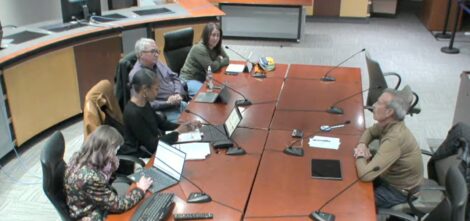
photo by: YouTube screenshot
The Affordable Housing Advisory Board met on Thursday, March 12, 2026.
After the Bert Nash Community Mental Health Center stepped away from a permanent supportive housing project, an advisory board is recommending the city claw back more than half a million in affordable housing funds — a first for the city.
As the Journal-World reported, Bert Nash said last week it would step away from the supportive housing project planned for the intersection of Sixth Street and Rockledge Road. With the project indefinitely paused and missing a Feb. 2, 2026 construction deadline, the Affordable Housing Advisory Board voted 4-1 on Thursday to recommend the City Commission claw back the funding, with board member Mark Buhler opposed.
The city has never clawed back Affordable Housing Trust Fund dollars from a project; if commissioners do so, it would be the first time. The fund is supported by a local sales tax to increase affordable housing options and support homelessness initiatives.
“We don’t have a future for this project at this moment,” Board member Mariel Ferreiro said, adding if the project comes forward again by another community organization in the future, she would be excited to discuss it.
The City entered into two separate Affordable Housing Trust Fund agreements with Bert Nash – one in 2023 and the other in 2024 – to help support the development of 24 permanent supportive housing units. Both the 2023 and 2024 agreements state that if construction has not begun within two years of signing, the city may have the right to require Bert Nash to repay the funds. The 2024 agreement was signed on Feb. 2, 2024.
In 2023, the city provided Bert Nash with $108,000 and $450,000 the following year, bringing the total allocation of Affordable Housing Trust Fund dollars to $558,000. The money will eventually end up back in the trust fund if the City Commission decides to claw back the funds.
Christina Gentry, chair of the Affordable Housing Advisory Board, said that while this is a project everyone wants to see happen, receiving money back helps the board do more of this work.
Matthew Herbert, chair of the Bert Nash governing board, told board members on Thursday that the organization is grateful for the opportunity that was given to them and the decision to not move forward with the permanent supportive housing project was a difficult one to make.
“In the last nine months, we faced some extreme financial difficulties,” Herbert said, referring to fiscal challenges from rising expenses, underfunded reimbursements and internal operations. “We have lost our CFO, we’ve lost our CEO, and we’ve had some extreme changes that have been made.”
Bert Nash was planning to build a 43,000-square-foot facility with an office hosting staff members like case managers and outreach coordinators with two dozen single-room units sitting on top of it. Those apartments would serve individuals with low or no income who are also experiencing serious mental illness.
Bert Nash has been discussing possible ways the project could still move forward, and one option that was on the table was to hand the project over to Douglas County. Shannon Reid, chair of the Douglas County Commission, said via email that Douglas County does not anticipate taking a leading role in the Rockledge supportive housing project, at this time.
“Douglas County may still play a role in the project’s future, as it has with many supportive housing projects developed in the last few years,” Reid said. “If it potentially transfers to a different community partner, we look forward to continued partnership opportunities and support for this critical community need.”
Ron Schneider, a member of the Bert Nash governing board, said that one of those potential community partners was the Lawrence-Douglas County Housing Authority – an organization that provides affordable housing, including rental assistance and public housing, for low-income residents, seniors, and people with disabilities in Douglas County.
“We’re in preliminary discussions with them, very preliminary, no commitments, no acceptance,” Schneider said. “They are very interested in doing this project … That doesn’t mean that’s the only one that’s a potential to take over the project.”
Mathew Faulk, director of housing at Bert Nash, said the organization has spent a little over 90% of the Affordable Housing Trust Fund dollars on the design of the project and an environmental review. He said those funds could transfer to a new entity taking on the project.
Herbert said Bert Nash remains focused on preserving the project’s initial vision.
“The fact that we are here right now is because we have approached the Housing Authority specifically because we believe that is an agency that can fulfill the original intent of the money that you gave us,” Herbert said. ” … We remain committed to finding a partner that can fulfill the original intention we had hoped to fill.”
Here’s where the Affordable Housing Trust Fund dollars have gone
Lea Roselyn, the city’s affordable housing administrator, told the Journal-World via email that since the Affordable Housing Trust Fund began awarding funds in 2019, $11,798,000 has been given to a variety of projects including new development, rehabilitation, repair, accessibility modifications, rental assistance and community engagement.
Of that total, $7,663,000 has been awarded for new affordable housing developments. The Affordable Housing Trust Fund has supported 21 projects — 14 completed, five under development and expected in 2026, one partially finished, and Bert Nash’s supportive housing project no longer moving forward.
The three organizations that have received the most funding from the Affordable Housing Trust Fund include Wheatland, receiving $2.55 million for three housing projects; Flint Hills granted $1.4 million for three housing projects; and Tenants to Homeowners acquiring $845,000 for five housing projects.
There are two new housing projects that have not yet begun construction, but both projects still have some time to get started.
Floret Hill is a proposed rental community for seniors and families featuring three-story multifamily buildings and two-story townhomes. The project includes 121 affordable one-, two- and three-bedroom units for households earning 30% to 60% of area median income and would be among the first and largest affordable housing developments on Lawrence’s west side. The project received $1.3 million in 2024 and $500,000 in 2026. The 2026 funding agreement was signed on Feb. 17, 2026.
The other that hasn’t started construction yet is 9 Del Lofts II. The project was originally scoped and awarded funding to construct 36 affordable housing units – then it changed to 29 units. At their meeting on Thursday, the Affordable Housing Advisory Board voted 3-2 to not recommend that number to be refined again to 26 units. The decision will be up to the City Commission.
According to a memo to city commissioners, the refinement of units is to ensure long-term affordability, financial feasibility and compliance with the city’s 30-year affordability requirements. The project reapplied for Low Income Housing Tax Credits through the Kansas Housing Resources Corporation in 2026 after a previous application was unsuccessful. This earlier setback caused project delays, and the new awards will be announced in July 2026.
The project has been awarded $450,000 in trust fund dollars in 2025, and the funding agreement was signed on Feb. 11, 2025.
City Government
Advisory board recommends city reclaim over half a million dollars after Bert Nash steps away from housing project
To help water customers ‘know what to expect,’ Lawrence will create a formal policy about shutoffs in cold weather

Lawrence city commissioners agree Fire Medical expansion is necessary, but opinions vary on tax increase to fund it
The Lawrence Community Shelter is an ‘iceberg,’ and its leader provides a glimpse beneath the surface
Lawrence city leaders to get first look at 2027 budget proposal with 3-mill increase for Fire Medical’s Station 6 expansion