This year’s point-in-time count shows increase in sheltered homelessness, but city official urges caution
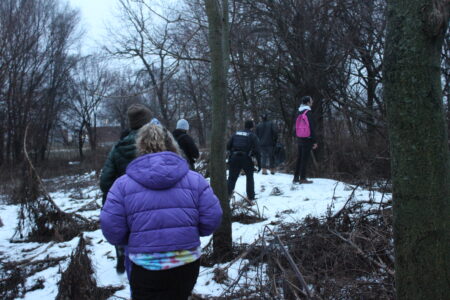
photo by: Austin Hornbostel/Journal-World
The point-in-time count team that the Journal-World accompanied in 2024 makes its way through a wooded area in East Lawrence in search of people sleeping outdoors.
Douglas County’s 2026 point-in-time count showed a 65-person increase in sheltered homelessness, but a city official cautions that the increase doesn’t reflect growth in the county’s homeless population.
The “point-in-time count” is an annual, one-night census that is required by the U.S. Department of Housing and Urban Development in order to track and measure sheltered and unsheltered homelessness. In previous years, the city has largely led the count, but instead, it was conducted by the Kansas Statewide Coalition – a Lawrence-based nonprofit that coordinates homelessness efforts statewide.
According to local data shared with the Journal-World, this year, 303 people in Lawrence and Douglas County experienced sheltered homelessness during one night in January, up from 238 people in 2025 — an increase of 65 people.
However, this doesn’t mean there’s an increase of people experiencing homelessness in the county.
Misty Bosch-Hastings, the city’s director of the Homeless Solutions Division, said she anticipated that there would be a large number of sheltered homelessness because the city suspended its residency framework – the city’s policy for serving unhoused individuals from other communities.
This would allow anyone to use emergency winter shelter services during the month of the point-in-time count, and would therefore, significantly increase the shelter bed utilization. The Kansas Statewide Homeless Coalition also noted in its data collection that there were very low wind chills documented in the days surrounding the count date.
“During periods when we suspend that framework because of life-threatening winter weather and open shelter to individuals regardless of residency, utilization increases to approximately 100% capacity,” Bosch-Hastings said via email. “And we have to add an overflow shelter to expand capacity to serve everyone. That distinction is important context when looking at the higher utilization reported during the winter months.”
But even then, Bosch-Hastings said the numbers surprised her. She thought they were a little too high – even the unsheltered homelessness count, which was still lower than last year’s.
Since the city wasn’t as involved in the point-in-time count as it was in previous years, Bosch-Hastings said she had concerns about the coalition potentially counting individuals twice by mistake, especially since the city’s Homeless Response Team works with people experiencing homelessness daily, and knows a lot of the individuals by name.
When the count was conducted Jan. 28, Bosch-Hastings said the HRT was focused on operating the winter emergency overflow shelter at First United Methodist Church, where it completed surveys with people staying there.
“We know who regularly lives outside and we know where they were,” Bosch-Hastings said. “And that night, they were in our (emergency overflow) shelter … There are ways to duplicate information but I’m not really sure because (there’s no) identifying information.”
As the Journal-World reported, the city didn’t partner with community sites for walk-in shelters last winter. Instead, all of the winter sheltering services were primarily consolidated at the Lawrence Community Shelter. While there was still an overflow shelter needed during some points last winter, it wasn’t nearly the amount of space that was utilized in the past at numerous local churches.
Bosch-Hastings said with current budget constraints, she doesn’t think the city can assume it will continue operating supplemental winter shelters in the same way it has in previous years.
What the numbers say
The increase to the sheltered homelessness count comes as the city’s role in conducting the annual count also changed this year.
In past years, the city’s HRT led the point-in-time count in partnership with the Kansas Statewide Homeless Coalition. This year, however, the coalition led the count instead.
HRT’s staffing declined from 17 members in 2025 to six in 2026, which limited the city’s capacity to participate. There were many factors that led to the decrease, some of which Bosch-Hastings said were a result of funding changes, and others were changes in operational needs since there are far less individuals experiencing unsheltered homelessness than when she first became a part of this work a few years ago.
The point-in-time count for 2026 identified 342 people experiencing homelessness on Jan. 28. A majority of those individuals counted were in an emergency shelter.
Despite an increase in the sheltered homelessness count, the number of people experiencing unsheltered homelessness decreased from last year’s number, which counted 52 people in 2025. This year, that total went down to 39 individuals who were counted that night.
However, Bosch-Hastings told the Journal-World she thought the actual number was less than 30. She said there are ways people utilize a shelter bed and don’t have to stay after they spend the night, and that there was some potential for double-counting.
“A lot of folks during the day do go outside, but they were staying in our shelter in the evenings,” Bosch-Hastings said.
The counted individuals were also asked to complete a participant survey. About 34% of those surveyed reported that this was their first time experiencing homelessness. Additionally, 18% reported being employed and 24% reported receiving benefits.
There was also data on the subpopulations represented in the county’s homelessness population, including almost half of the individuals experiencing homelessness were adults who reported having a serious mental illness; 36% reported to be chronically homeless; 35% were adults who reported to have substance use disorder; and 10% were adults who identified as domestic violence survivors.
Suspending the city’s residency framework
Bosch-Hastings said on the day the point-in-time count was conducted by the Kansas Statewide Homeless Coalition on Jan. 28, the city was going through a period where it had temporarily suspended its residency framework.
The framework states that in order to manage and prioritize the limited resources available for homeless services within Lawrence, its services are intended to prioritize Douglas County residents. As the Journal-World reported, this policy ultimately contributed to the city missing out on federal grant funding this year for services for people experiencing homelessness, despite Douglas County having one of the largest unhoused populations in the state.
According to the Kansas Statewide Homeless Coalition, it was during a “historic Arctic cold outbreak.” There were documented wind chills across the state reaching as low as -20 degrees to -30 degrees Fahrenheit in the days surrounding the count night. These conditions led to several communities – including Lawrence – to offer additional emergency overnight shelter capacity.
Bosch-Hastings said with the suspension of the framework, and individuals from outside Douglas County being sheltered during that period, it would be reflected in the point-in-time count totals – especially the sheltered homelessness figure.
On the night of the point-in-time count, Bosch-Hastings said approximately 40% of the individuals staying in the winter overflow shelter – First United Methodist Church – were not Douglas County residents. Additionally, approximately 15% of the people staying at the Lawrence Community Shelter that night were not county residents.
“That context is important when interpreting a one-night count,” Bosch-Hastings said in an email. “If the 2026 (point-in-time) count shows an increase, the data will need to be examined more closely before concluding that the increase represents growth in the number of Douglas County residents experiencing homelessness.”
Future winter shelter services
With the city consolidating emergency sheltering at the Lawrence Community Shelter, Bosch-Hastings said she is not concerned that the shelter lacks sufficient capacity to serve individuals from the community who need emergency shelter.
However, Bosch-Hastings said there is a question that still needs to be answered, regarding how the city will respond when individuals from outside Douglas County arrive during life-threatening weather.
“With current budget constraints, I don’t think we can assume that we will continue operating supplemental winter shelter in the same way we have in previous years,” Bosch-Hastings said via email. “That is ultimately a broader policy and community decision and not one I would make independently.”
She said one option worth exploring would be to partner with a community organization to operate a centralized location for individuals who are not county residents during periods of dangerous weather.
“That could provide immediate life-safety protection while also allowing our team to work intentionally with those individuals on returning to their community of origin or another community where they have housing, family or established supports,” Bosch-Hastings said via email.
The issue will become particularly important as the city prepares for the upcoming winter.
“We have gone more than two years without a weather-related death among the people we serve, and I am incredibly proud of that,” Bosch-Hastings said via email. “Whatever approach is ultimately selected for this winter, I believe we have to balance protecting people from life-threatening weather with maintaining sufficient capacity and resources to meet our responsibility to the people of our community.”
Other News
Clinton State Park and other state parks will increase overnight camping, vehicle permit fees starting next month
‘No day is like the other here’: Students from Lawrence’s German sister city discover football, new foods and new friends on exchange
GCSAA celebrates 100 years with new plaza and statue honoring its founder and first president

Go, See, Do: Library book sale, candidate forum and more

Gas station at Lawrence’s new Costco will be open starting next Wednesday