‘Illustrative’: Lawrence Arts Center’s new printmaker-in-residence loves to show her process
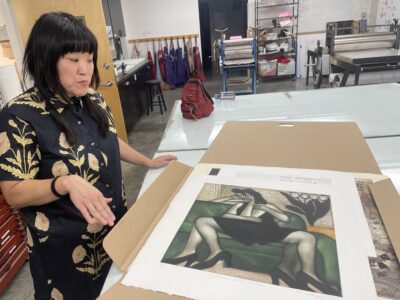
photo by: Sylas May/Journal-World
Printmaker Hibiki Miyazaki shows one of her works at the Lawrence Arts Center on Friday, Aug. 21, 2026.
It sometimes takes Hibiki Miyazaki most of a year to make a print, but it’s taken a fraction of that time for Lawrence to make its imprint on her.
Miyazaki is one of the Lawrence Arts Center’s two new artists in residence. She grew up in a small town of about 300 people in western Massachusetts, and just before coming here, she was based in Portland, Oregon.
“This is kind of like the sweet spot in the middle,” she says.
She now lives in a house that was built in the 1880s, and loves the old brick streets in her neighborhood. “Is that what’s underneath all the paving?” she asks. “Some areas I see the top paving coming off, and it looks like it’s the brick underneath.”
And, while the West Coast is cool, “there’s a sense of amnesia, because historically, there just isn’t the residue.”
Printmaking, like Lawrence, she says, is steeped in history and personality.
“The great thing about printmaking is there’s so many ways to do one thing, and there’s so many archaic processes, and everybody kind of latches onto one of them.”
Miyazaki and the Arts Center’s ceramics artist in residence, Reece Henderson of Little Rock, Arkansas, were selected from a national pool of applicants for the annual residency program, and through next summer they’ll be teaching classes and creating new work for exhibition.
For her part, Miyazaki has plans for a piece that blends all of her artistic skills – “Part print, part drawing, and I want elements of animation to occur in it.” She’s looking forward to teaching, something she hasn’t had much experience with.
And, from what she’s seen of Lawrence so far, she might even consider sticking around for longer.
“I might end up falling in love with it,” she said. “… At this point in my life, I could kind of be anywhere.”
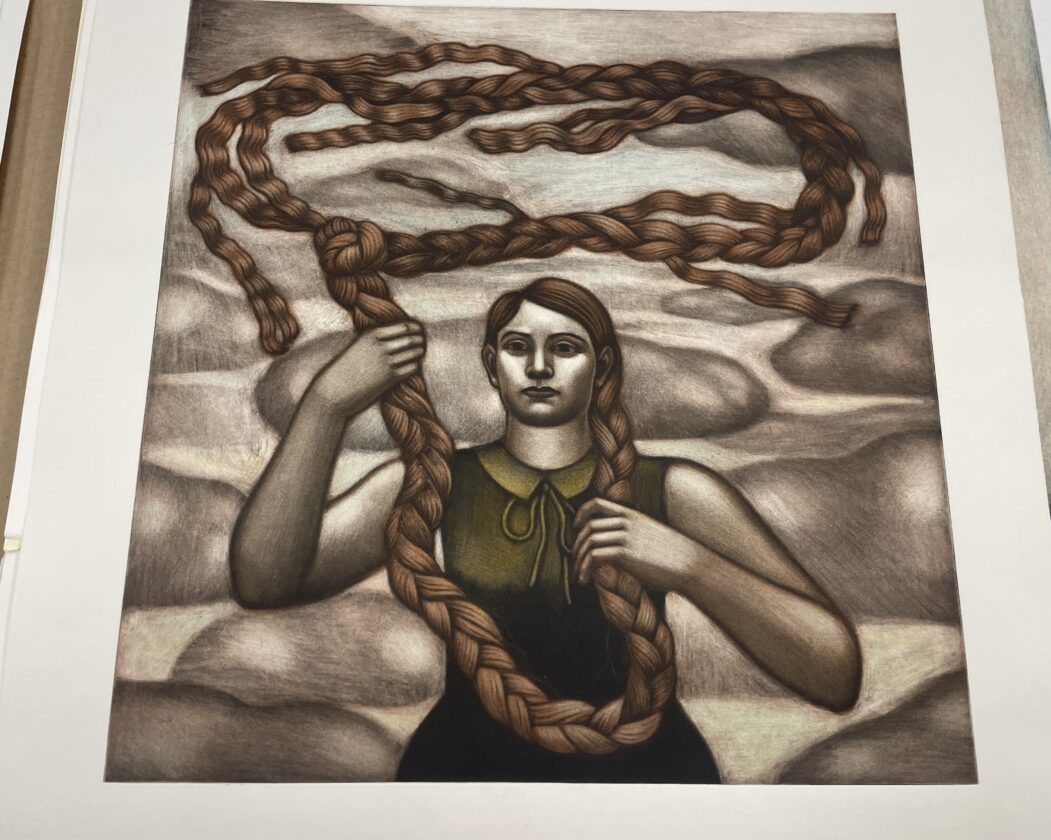
photo by: Sylas May/Journal-World
A print by Hibiki Miyazaki called “Lasso” is pictured on Friday, Aug. 21, 2026.
‘I love process’
Miyazaki’s parents were both artists. Her father was a woodworker who has a chair in the Smithsonian collection and worked with the acclaimed furniture designer Isamu Noguchi; her mother illustrated children’s books.
But Miyazaki doesn’t have a degree in art, and that makes her “kind of a weirdo” in art spaces, she thinks. While she’s been part of a printmaking studio before and has had her work shown in galleries, “I’ve been a working artist for the last 26 years.”
What she did for a day job in Oregon was graphic design for a headstone and memorial company. “I just would do, like, personalization, like a portrait of somebody’s mom, or their beloved Trans Am or whatever – like, I would be the one, any custom one-off thing.”
“I love process,” she continues. “You know, printmaking is so process-heavy. And putting images onto granite is so process-heavy, and I love that about it.”
When she draws, there’s a lot of process, too, adding and erasing marks, “trying to find my way, building an image through a series of trial and error. … There would be a lot of ghostly things that couldn’t be erased fully.”
“And I really found it to be kind of a shame,” she says, “that, like – that was the part that I loved, the journey to the end result, but nobody at the gallery or the show could see any of that.”
This is where the animation came in. She began scanning her works in progress and put the scans into iMovie to make an animated record, and her best friend, an experimental musician in Portland named Nik Viola, created a score for these animations.
What she hopes to accomplish next is a work like that that incorporates the processes unique to printmaking.
She loves what printmakers call “proofing” – basically, testing what’s on the plate to see how it will look when transferred to paper. A printmaker might imagine her piece one way, “but when it comes into the light of day, it’s like, ‘Oh, there’s a lot of feedback.'” It’s a “ping-pong” process, where a print goes through test after test, iteration after iteration.
And sometimes prints evolve in a whole new direction when Miyazaki does a test that turns out differently than she expected.
“You can let mistakes guide the image,” she says.
She shows the proof of one of her prints that looks sepia-toned, and another proof of the same one in a shocking hot pink.
“This is the fun stuff, where I was like, ‘Oh, let’s see what are the different colors, what are the different variations?'” She looks at some and thinks they’re cool enough to have been the final version. “I just wanted to proof endlessly,” she says.
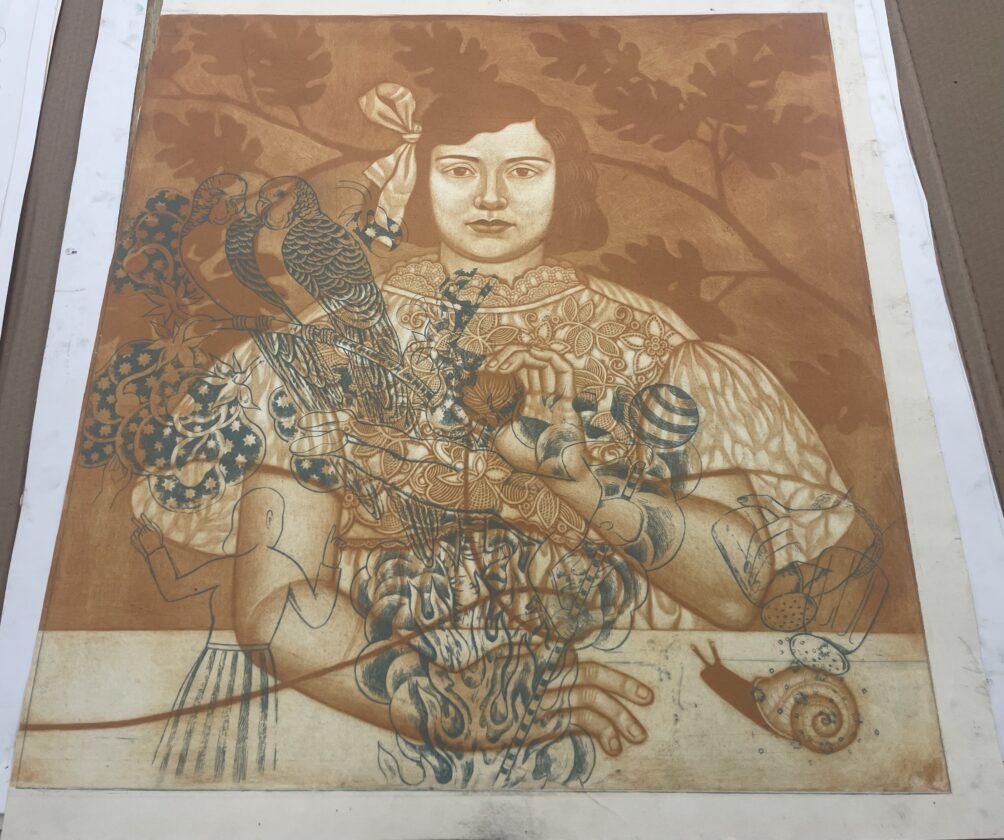
photo by: Sylas May/Journal-World
A sepia-looking proof by Hibiki Miyazaki is pictured on Friday, Aug. 21, 2026.
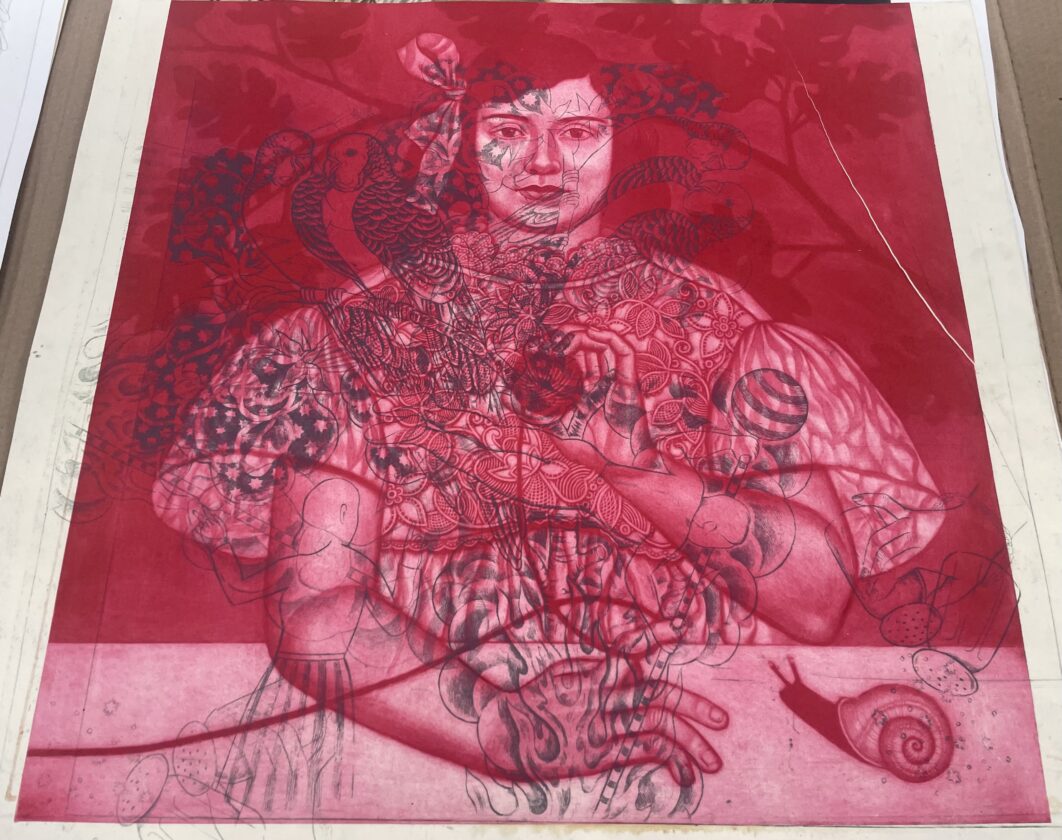
photo by: Sylas May/Journal-World
A hot-pink proof by Hibiki Miyazaki is pictured on Friday, Aug. 21, 2026.
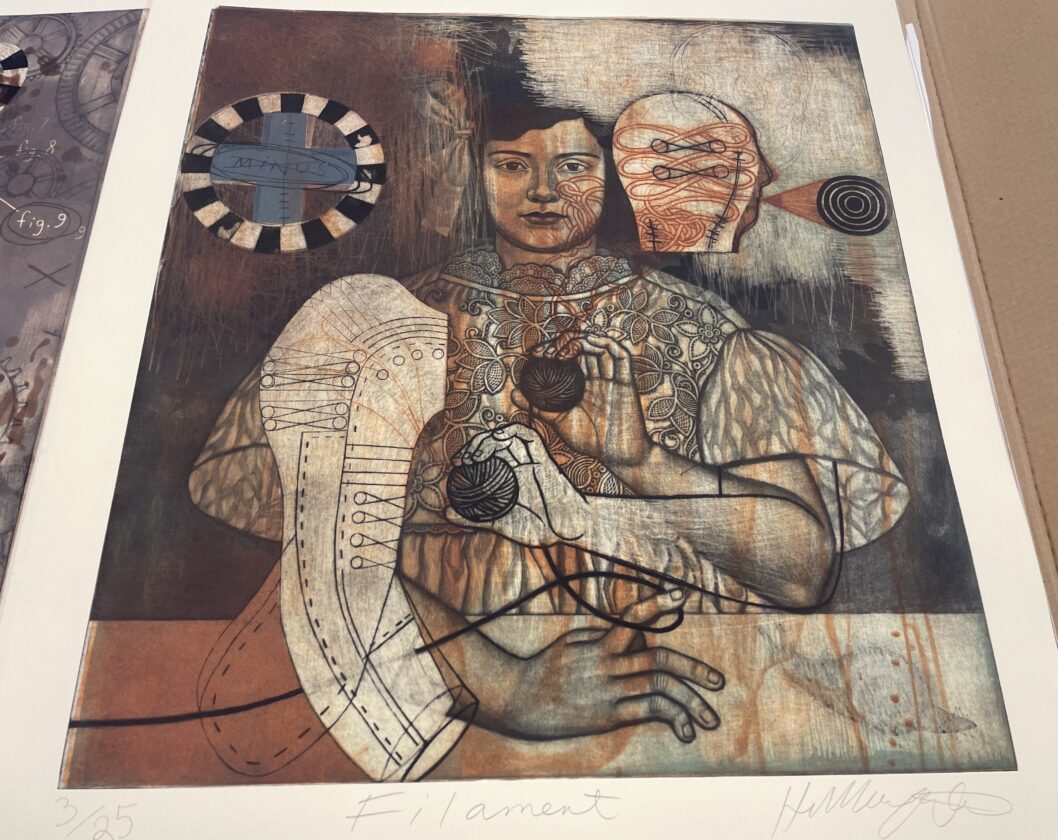
photo by: Sylas May/Journal-World
The finished version of a print by Hibiki Miyazaki is pictured on Friday, Aug. 21, 2026.
Dreams and opposites
It’s no surprise, then, that a print can take a while to come together.
“This process is extremely time-consuming,” Miyazaki says. A single print might take eight months to develop. When she started showing her work, galleries would ask when her next show was, “and I said, well, in this case, 10 years, I guess.”
In the Arts Center’s printmaking facilities, she shows some of her older works that she brought along with her. (She didn’t bring all of the proofs with her to Lawrence, but she wishes she had.)
Just like the strange things that show up in dreams, Miyazaki’s prints can crystallize around anything.
Commercial illustration from the ’40s and ’50s. Textures of hair and fur. Shoes made from toilet paper rolls. A drawing of a boy in an old Boy Scout manual. “It all starts from a little detail, and then it becomes something else,” Miyazaki said.
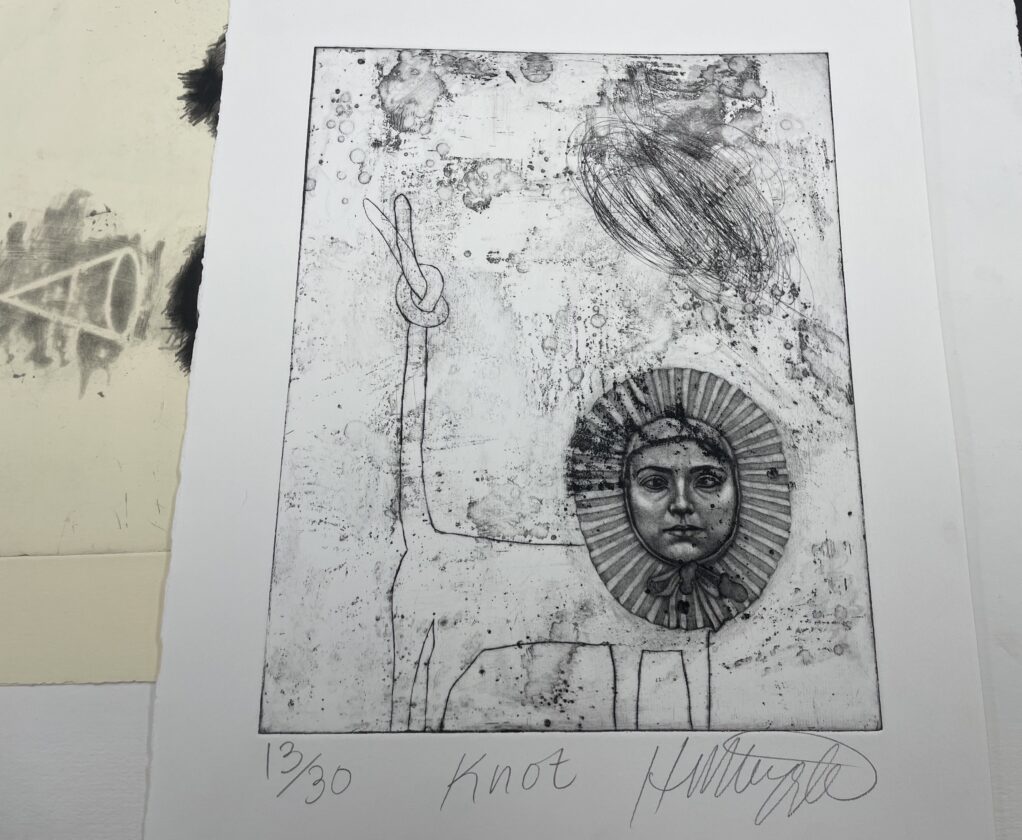
photo by: Sylas May/Journal-World
A print by Hibiki Miyazaki called “Knot” is pictured on Friday, Aug. 21, 2026.
Some parts are exquisitely detailed, others like a quick doodle. One print is inspired by “being frustrated and just getting yourself into a knot”; it features an animal with a realistic human face, but its tail, where the knot is tied, is little more than a sketch.
“It’s almost like this is kind of imagined,” Miyazaki says of the knot.
Some of them use special techniques, like a sandblasting technique that she developed while working as a headstone designer, bringing her copper plates to the shop and modifying them there. “That was kind of a way to integrate granite stuff with the printing stuff,” she says. The grit that gets stuck in the copper gives the print a “dreamy, atmospheric effect.”
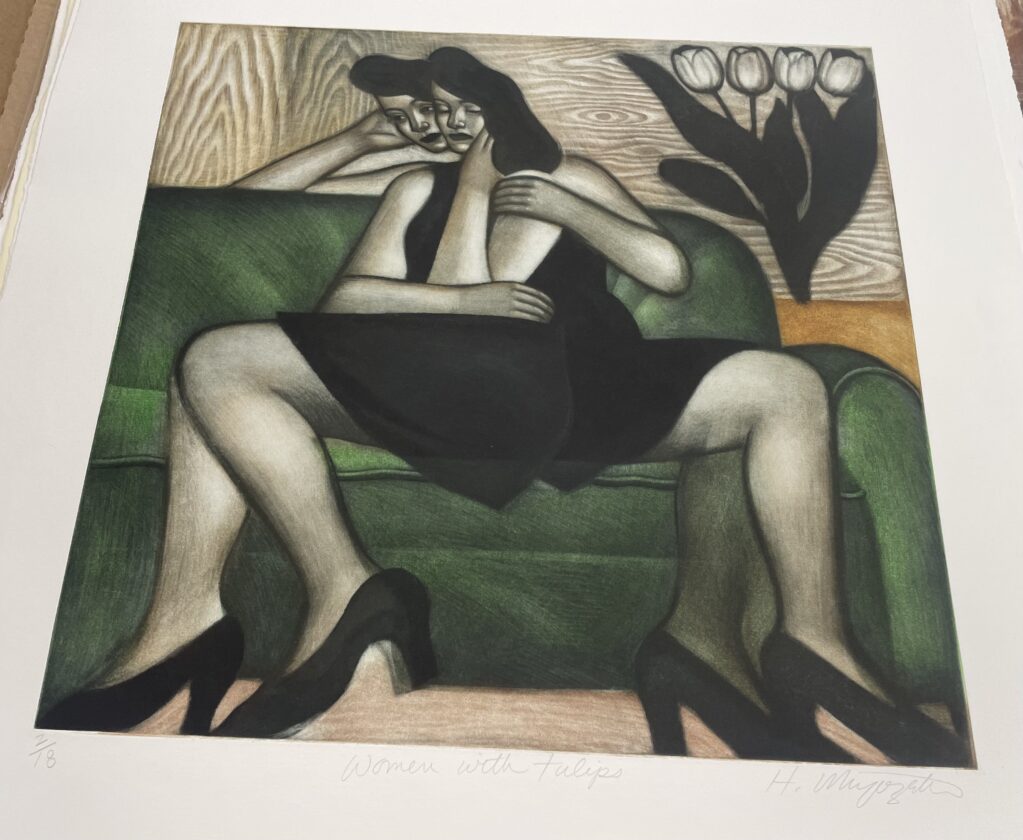
photo by: Sylas May/Journal-World
A print Hibiki Miyazaki made using her sandblasting technique is pictured on Friday, Aug. 21, 2026.
Printmakers don’t hoard their knowledge of their techniques, Miyazaki says.
“They love sharing. You’ll walk around and be like, ‘How did you get that mark?’ and they’ll be like, ‘Oh, I’ll tell you!’ It’s this really wonderful community cross-pollination of techniques that occurs.”
And, as an artist in residence, Miyazaki will get to do a lot of sharing: “I’m looking forward to teaching what I know and learning about what other people know.” She’s taught workshops over a weekend before, but never a class that spans weeks or months like she’s doing here.
“I would like to find my voice as a teacher,” she says.
She’ll be teaching classes on color printmaking and linoleum printmaking starting in September (you can find more on that at lawrenceartscenter.org/class-catalog), but she’s already had the chance to work with some younger students.
On Thursday, Miyazaki taught a class at Prairie Moon Waldorf School, which has a partnership with the Arts Center. The theme was “opposites,” which is something that speaks to her.
“I love the idea of duality, just as a concept.” It has a lot to do with printmaking, too. “The dark and the light; it’s so archaic but we’re doing it today … You could go endless places.”
The students will be learning about textures, solids, black and white. Miyazaki loved the experience of teaching so much that she was up late on Thursday night thinking of new exercises she and the class could do next time.
“It’s kind of an intuitive thing,” Miyazaki says. “I don’t have, like, this curriculum set out. I’m sort of freestyling it.”
‘Illustrative’
Freestyling is how she grew as an artist, too, after she found that the art-school track wasn’t for her.
Decades ago, she briefly went to Maryland Institute College of Art in Baltimore. She hadn’t done well in school, but she always loved to draw, and she thought art school was when she would “really come alive.”
“I was ready. I was excited to be an art student. And I’d always drawn images from my imagination. That was my thing.”
Her first drawing professor was looking for realism more than imagination, and would tell her things like, “You don’t really belong here. You belong in the illustration department. Nothing that comes out of your head will ever be as interesting as something observed from reality.”
“That just was kind of devastating to me,” she says. “And I thought, ‘Well, maybe I’m not a real artist.'”
“Illustrative,” she says, was “the worst thing that somebody in the fine art department at that time could call your work.” That word sounded like commercial or popular art, she said, and some artists just look down on certain kinds of work. (Even her father, who was one of her dearest mentors, warned her once, “Don’t draw manga. Nobody’s going to take you seriously.”)
She dropped out. For a while, she didn’t want to describe herself as an artist, just as a “person who likes to draw.” She got the headstone job and still told herself, “Well, I’m a graphic designer that works in manufacturing. But I’m not an artist, because I didn’t get the paper in art school.”
Getting to the point where she could take her art seriously again took some time and felt “a little weird, a little uncomfortable.” But little by little, she dared herself to get more “illustrative.”
It felt like she was rebelling against her old professor, she says. Now she could draw things “pure, out of my imagination.”
And, during COVID, when a friend told her, “If you had six months to live, what kind of art would you do?”, her art got more illustrative still.
“Time is limited,” she says. “And it always could be – I could get hit by a bus. And I just dared myself to go there, and I made really illustrative work, kind of about the pandemic. And that set a precedent for me, where I was like:
“‘OK, nobody gets to tell me what I’m going to draw.'”
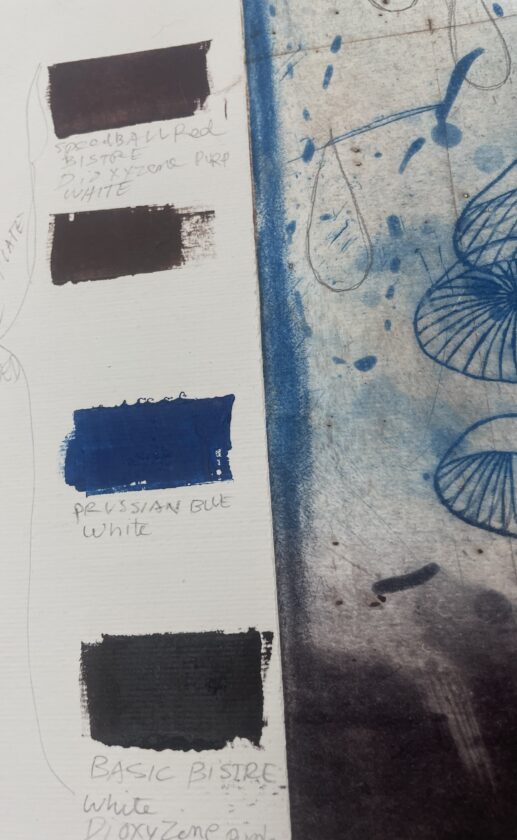
photo by: Sylas May/Journal-World
The color swatches used in a proof by printmaker Hibiki Miyazaki are pictured on Friday, Aug. 21, 2026.
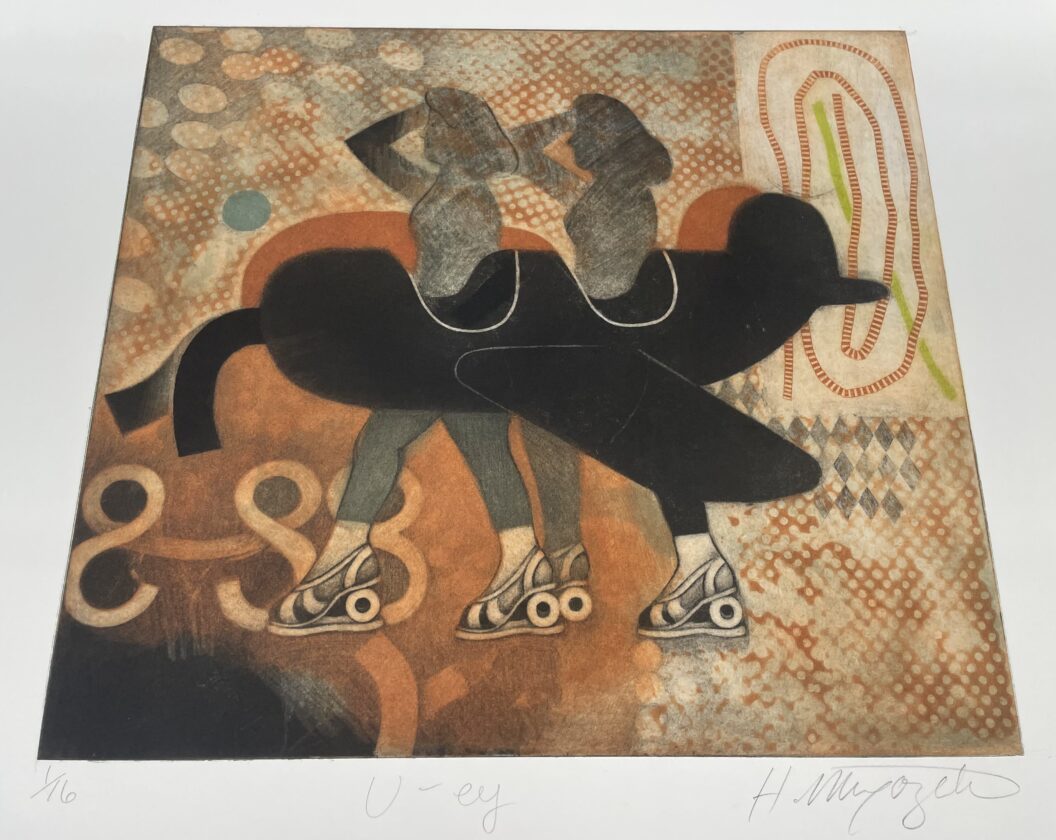
photo by: Sylas May/Journal-World
This print by Hibiki Miyazaki, pictured on Friday, Aug. 21, 2026, was inspired by a story about people making shoes out of toilet paper rolls.
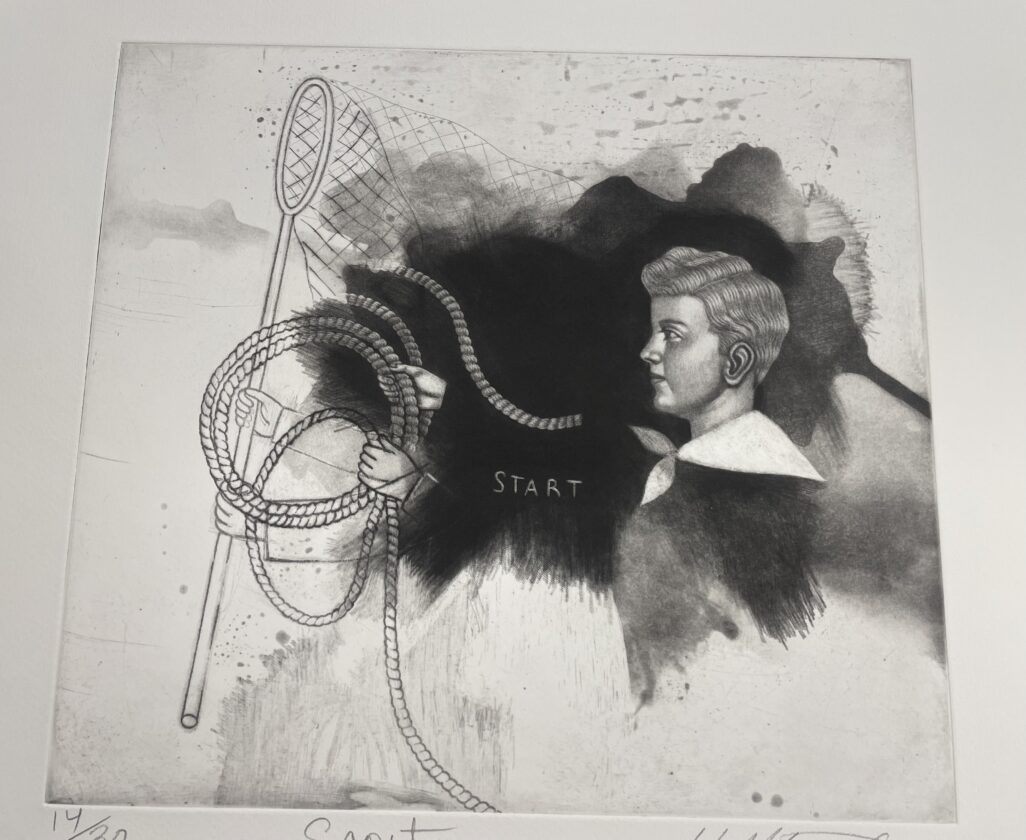
photo by: Sylas May/Journal-World
Hibiki Miyazaki used an image from a Boy Scout manual to create this print.
Arts and Entertainment
Growing up with famed Kansas fossil hunter, daughter returns with new book that goes beyond the digs
Duncan Sheik, Tony- and Grammy-winning ‘Spring Awakening’ composer and pop star, dies at 56
For this local artist and many others, Lawrence’s Art in the Park is the biggest event of the year
Go, See, Do: Haskell Arch celebration, Lawrence Beer Co. block party and more

Ed Sheeran’s tour in trouble after opening acts drop out in solidarity with Macklemore