Hear about the bizarre side of biology with acclaimed author Mary Roach at Liberty Hall
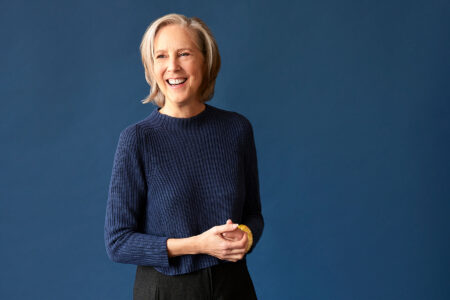
photo by: Contributed
Author Mary Roach will be at Liberty Hall on Thursday, April 23, 2026.
Mary Roach isn’t just a fan of science – she’s made of science, and you are, too.
“The whole world is science,” said Roach, a New York Times best-selling author who’s written about the science of cadavers, digestion, sex and a host of other topics. “Your body, your computer, your house, it’s all science.”
So she thinks it’s “kind of weird” that much of what she writes about grosses people out.
Take saliva, for instance. “It’s disgusting,” she said. “Spit. If somebody spits in your food, it’s the most disgusting thing in the world. But it’s like, people, it’s inside your mouth. It’s such a weird thing.
“We live with these things in us, produce this stuff, and yet it’s disgusting. I don’t know; that’s a fascinating thing for me, and I guess other people, too.”
She hopes to see a lot of those people when she comes to Liberty Hall on Thursday night for the Lawrence Public Library’s Ross and Marianna Beach Author Series. The annual series brings nationally acclaimed writers to Lawrence to discuss their work, and it’s free and open to the public – no registration required.
If you’re squeamish, don’t worry; Roach said she doesn’t expect it to be too “trying.” But do expect to dive into weird topics about the human body as she discusses and signs copies of her latest book, “Replaceable You: Adventures in Human Anatomy.” The book is about the many techniques that have been or are being developed to replace parts of the body, from prosthetics to transplanted animal organs to lab-grown tissues.
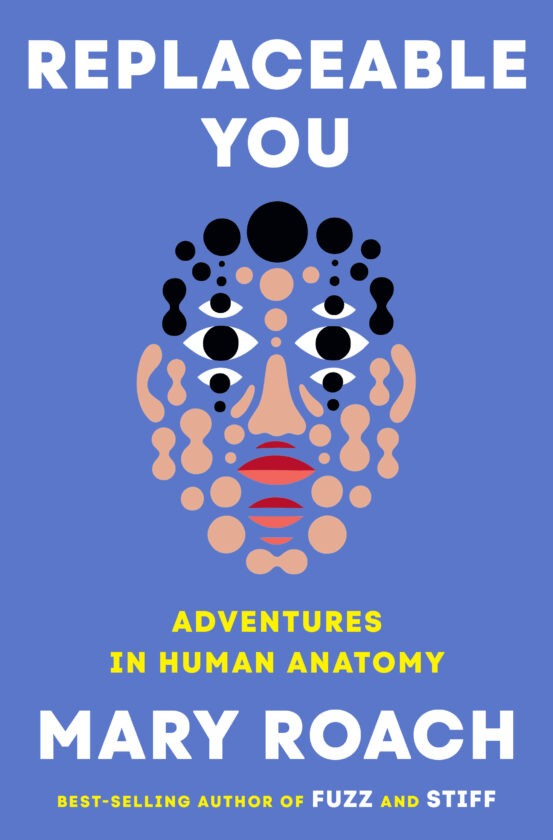
photo by: Contributed
“Replaceable You: Adventures in Human Anatomy” is the latest book by Mary Roach.
Roach says the topic of “crafting bits and pieces for a human body” is “something to wrap your mind around.” Sometimes, she said, modern medical technology looks almost like science fiction, such as new prosthetics that are attached by drilling into bone.
“When you’ve never seen that before, it’s very much like, here’s the thigh, and here’s this metal rod coming right out of the middle of it,” she said. “It’s so, kind of, cyborg-ey.”
“It’s very cool that this stuff is out there and helping people,” she said. “But it’s a weird thing to think about – an artificial valve, or a prosthetic, or even putting an intraocular lens in an eye. It’s pretty weird.”
Roach didn’t always have this fascination with science. When she was in school, she took just the bare minimum of science classes.
“I was operating on this misguided assumption that science is not creative,” she said. “I wanted to do creative things.”
But when she took on writing assignments about science for magazines, she got to see that science is very creative. It’s a field that’s all about solving complicated problems with outside-the-box thinking.
Roach prefers more down-to-earth kinds of science like anatomy and physiology over things like particle physics or quantum mechanics. Those are hard to understand and hard to explain, she said, and she prefers to write about things that are less abstract. “I like to be able to set a scene with people doing things in labs or in the field or whatever it is.”
She’s gotten to see scientific work happening in some truly bizarre places.
For a recent project, she went to Costa Rica, where a researcher is looking for new antibiotic compounds. To do that, he has to take hair samples from sloths, where bacteria and fungi are waging constant battles against each other that are invisible to the naked eye.
“He’s in a sloth enclosure with a pair of scissors snipping off bits of hair, because it’s a great repository of fungus and bacteria and moss,” Roach said. “There’s all kinds of stuff going on in sloth hair. That’s science, but that’s not what the average person thinks.”
Science can even involve people lying in bed and doing nothing.
While writing the book “Packing for Mars: The Curious Science of Life in the Void,” Roach learned about bed-rest facilities that are used to study how human bodies might change during long spaceflights. People there get paid to lie in bed for months without getting up – “not even to go to the bathroom; they have to use a bedpan” – so that scientists can watch what happens to their muscles and bones.
“So I was like, ‘who are these people who want to lie in bed?'” Roach said. “For the right person, you have a computer monitor right over your head, so if you’re really into gaming or online gambling or even shopping, it’s paradise for you!
“Except for the bedpan part,” she added.
That part is a lot tougher in space, too, and you may recall it made headlines during the Artemis II lunar mission. The spacecraft’s toilet had some problems that temporarily forced the crew to use plastic containers to relieve themselves.
Cut the engineers some slack – designing a space toilet isn’t easy, Roach said.
“Not only do you have to totally rethink how it works, because there’s no water coming down, no flushing, you have to completely rethink the system, but then you have to test it,” she said. “That means putting this giant thing on one of those weightless flights that do the parabolic curve, where you have like 22 seconds of simulated weightlessness while the plane goes over and down.
“So, you’ll be like, ‘How are you going to do that?’ You’re going to test it, somebody’s got to, like, take a shit in 20 seconds – nobody can do that.
“Now you have to create, in a laboratory, a simulated shit. And somebody did that at NASA Ames!” she says, laughing. “There’s this whole paper where they use like four different recipes, and it had to have enough E. coli in it, it had to be high fidelity, it had to be the right rheology and density, and that’s science going on!”
It may sound revolting. But she thinks it’s only natural to want to know how revolting things work.
“We tend to be kind of curious about things that are taboo,” she said. “I think a lot of us are kind of secretly curious.
“But that could be my own bias – maybe I’m just a little bit weird.”
Roach will be at Liberty Hall, 644 Massachusetts St., from 7 to 9 p.m. Thursday. Doors open at 6 p.m., and a book signing by The Raven will follow the talk.
Arts and Entertainment
Thanks to a nonprofit that pairs artists and landlords, the Lawrence Potters’ Guild gets a temporary space of its own

Go, See, Do: Library book sale, candidate forum and more
From a German pulpit to an indoor pool, old church building brings new visitors to downtown Eudora
Growing up with famed Kansas fossil hunter, daughter returns with new book that goes beyond the digs
Duncan Sheik, Tony- and Grammy-winning ‘Spring Awakening’ composer and pop star, dies at 56