Alvamar homeowners sue golf course ownership, seeking $26M in damages and restoration of defunct golf holes
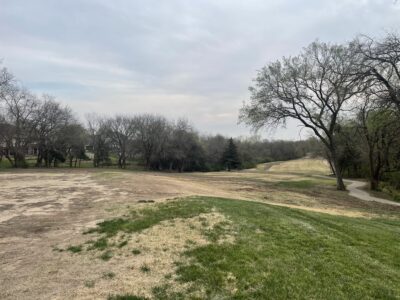
photo by: Sylas May/Journal-World
A bare patch of ground in the Alvamar neighborhood on Thursday, April 9, 2026.
When nine holes at the Jayhawk Club golf course stopped being maintained a few years ago, Scott Robinson said, it was “kind of subtle.”
“It was in early 2023,” he said. “You just noticed that the greens and areas weren’t being kept up. It was very subtle.”
But he couldn’t help but notice when the changes came to the greens behind his home.
“Behind my house, I watched a pond be destroyed and turned into not a pond,” Robinson said. “I used to have a pond behind my house with a fountain – gone. The grass that was behind my house on the golf course, the zoysia, was stripped away. And the whole area was just blighted.”
“And you’re thinking, ‘Who can I talk to? What’s the deal here?’ And there was no one.”
He and other homeowners in the Alvamar neighborhood think the owners of the golf course made a promise when they bought it 10 years ago – that everyone who had a golf hole behind their home would continue to have a golf hole. And now, after years of research and multiple attempts to resolve the situation, Robinson and the group of homeowners are going to court to try to bring the greens back.
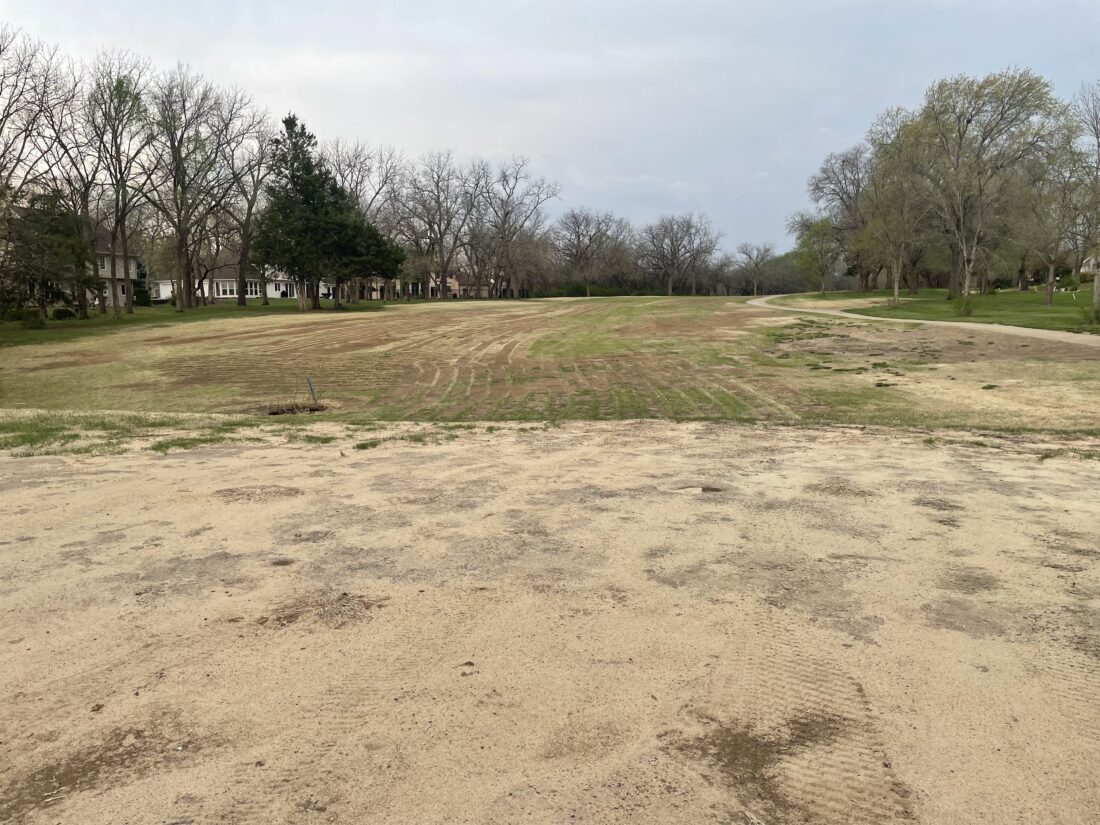
photo by: Sylas May/Journal-World
A bare patch of ground in the Alvamar neighborhood on Thursday, April 9, 2026.
Their petition was filed in Douglas County District Court at the end of March against course owner Eagle 1968 LC and its registered agent, Lawrence businessman Thomas Fritzel. In it, Robinson and the homeowners are seeking a court order that the defunct holes known as the Alvamar 9 be restored; that the property be permanently restricted from being used as anything other than a golf course; and a total of $26 million in damages for the decrease in property values as a result of the Alvamar 9’s deterioration.
A call from the Journal-World to Fritzel went to voicemail and had not been returned as of late Thursday afternoon.
In their filing, the homeowners are arguing that, while there was no explicit written commitment to maintain the property as a golf course, the way it was conceived and marketed and the statements the developers made constitute a kind of implied agreement that it would remain a golf course.
What it comes down to for Robinson is that he and other homeowners made their decisions based on those statements.
“All those promises … were they relied upon? No question,” Robinson said. “We’re just asking him to honor his word.”
• • •
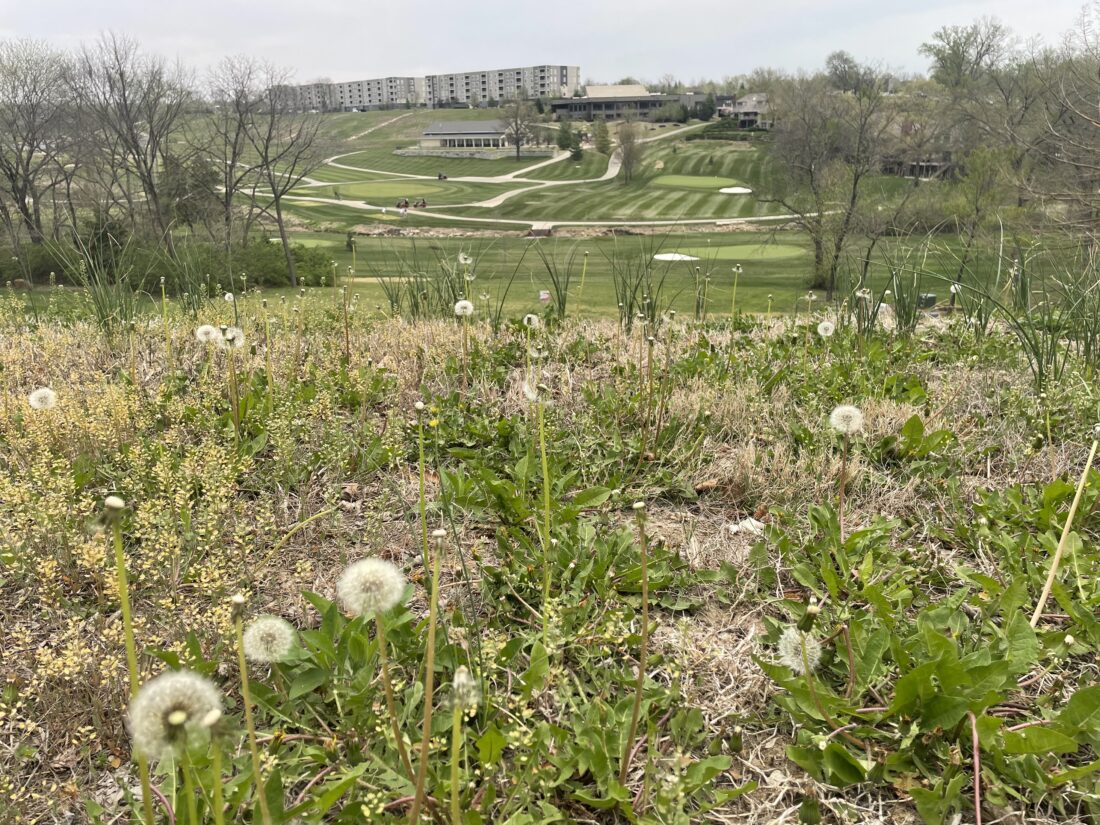
photo by: Sylas May/Journal-World
Maintained golf greens are seen from Nicklaus Drive in the Alvamar neighborhood on Thursday, April 9, 2026.
Robinson bought his lot in the Alvamar neighborhood in 1992, and he said Alvamar had been “a very well-planned community.” And he and his neighbors, he said, didn’t expect that to change when ownership of the course changed in the mid-2010s.
The Journal-World reported that the Fritzel family took over ownership of the Alvamar Golf and Country Club in January 2016 and proposed a variety of new developments. The new owners planned a 24,000-square-foot clubhouse, fitness and wellness center; new swimming pools; apartment buildings; and a space that could accommodate a business’ offices, among other things.
“As a homeowner, did I oppose the sale? No!” Robinson said. “All the things I heard by everybody that was saying anything was that this was going to be an improvement. Here’s a guy who’s a developer, he’s got capital, he wants to make this a crown jewel. And so we didn’t oppose it, I didn’t, my neighbors didn’t.”
Alvamar Golf and Country Club subsequently rebranded as the Jayhawk Club, went private and reduced its number of holes from 36 to 27. In May 2016, architect Paul Werner, representing the development team, showed the Lawrence City Commission a diagram of the new 27-hole design and said that with that design, every home adjacent to the course would keep its golf holes.
“I think it shows our earlier commitment when we started this that if you live on a golf course and you had a golf hole behind you, I think you have a golf hole behind you now,” Werner said.
City leaders back then wondered if the developers could make that commitment more binding.
“It seems like one of the issues is protecting the boundaries of the golf course,” then-City Commissioner Leslie Soden said. “And we talked about what could be possible, and there was the idea of a conservation easement.”
A conservation easement is a restriction that a landowner can voluntarily put on the future use of their property, one that can last even after the property has been sold to a new owner. In this case, Soden and some other city leaders, including then-City Manager Tom Markus, were wondering if the owners of the course would agree to retain its use as a golf course in this way, or at least preserve it as open space.
“To what degree are they willing to go to ensure that that happens?” Markus asked. “Would they voluntarily enter into an agreement that gets recorded against the property that gives the city the right to preclude (non-golf-course uses)?”
“I think that would certainly be an option,” Werner said. But at the same time, he said an easement would be a major commitment for the developers.
“The conservation easement’s a huge step,” Werner told Markus and the commission. “And certainly I couldn’t say that tonight.”
“The architect, Werner, backed away from that like crazy,” Robinson told the Journal-World when asked about that meeting. “Because he knew that, number one, I don’t think he could commit to that, being the architect and not the actual landowner, and, certainly, he was not thinking that the landowner would be agreeable to that.”
Robinson thinks Markus was right to suggest that the property owners put a restriction on the land.
“That was basically (Markus) very astutely saying, ‘Look, if we give you guys permission to do this, which is completely out of character with anything that has been done or proposed to be done on this golf course property, will you give us your word in writing that that’s all you’re going to do?’ That’s really, to me, the smart thing to do from the city’s standpoint.”
To his knowledge, no conservation easement was ever put on the golf course.
• • •
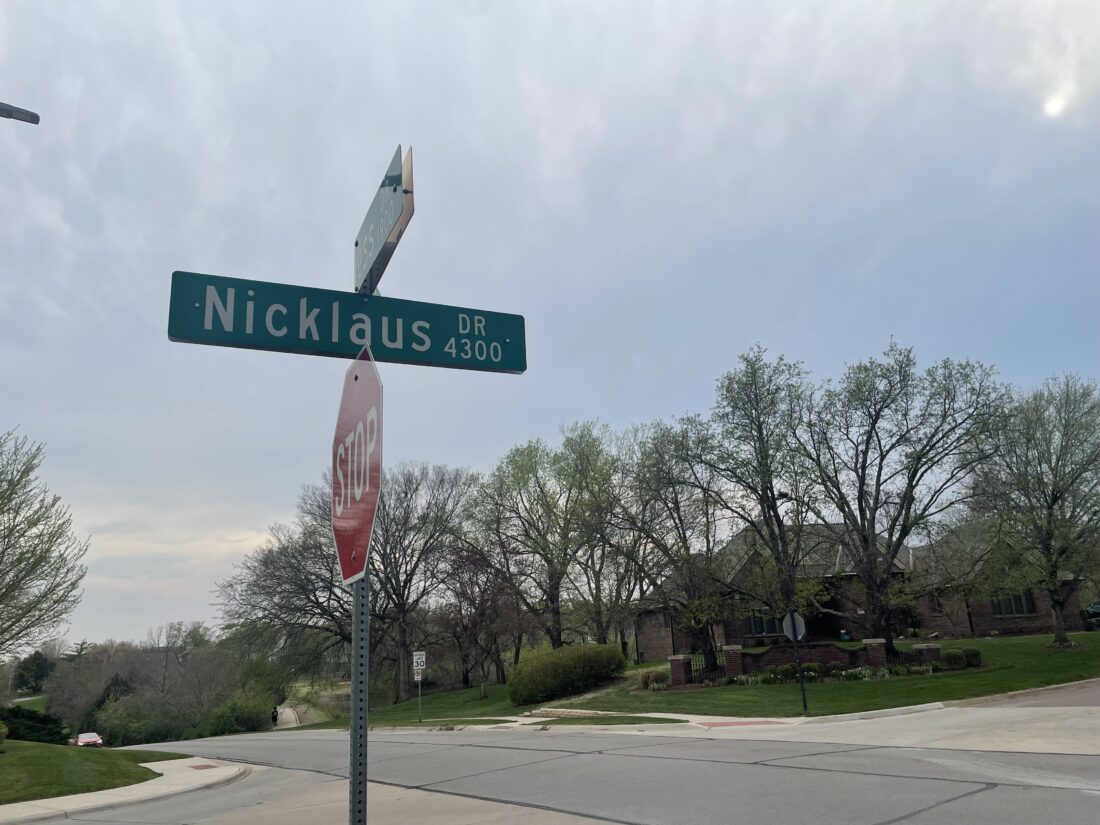
photo by: Sylas May/Journal-World
Some of the streets in the Alvamar neighborhood are named after famous golfers, such as Jack Nicklaus.
When the greens on the Alvamar 9 stopped being maintained in 2023, Robinson said it was a confusing time for the neighborhood.
“What’s going on here?” he said. “We haven’t heard anything, we don’t know anything. Somebody said the irrigation system was broken and they didn’t want to spend the money to fix it, so they were going to stop watering it.”
They came together for a neighborhood meeting in April 2023, he said, and decided to form a group of concerned property owners to research what was happening and what they could do about it. They hired an attorney and formed an LLC for their group, which they called “Bob’s Legacy LLC” after Bob Billings, the original developer of Alvamar.
The group made several attempts to try to communicate with the owners and resolve the situation short of legal action, Robinson said.
“We made multiple requests to the city and the landowner to talk about things. We actually had a couple meetings with the landowner, trying to come to a resolution. And, basically, it’s just crickets,” he said. “No word. No information.”
Not all homeowners in Alvamar were affected in the same way. The petition lists three classes of affected homeowners – one consisting of about 150 homeowners whose properties border the golf course, one with about 100 homeowners across the street from a golf hole, and one with the remaining 600 homeowners who don’t directly border the course. The petition claims that the first class has seen a 10% loss of its property values, the second one has lost 5%, and the third has lost 2%.
The reason all of the properties are affected, the filing says, is that the golf course was a central selling point of the Alvamar neighborhood. This identity as a “golf-course-centered community” also included details like special easements related to the flight of golf balls and the naming of streets after famed golfers like Jack Nicklaus and Arnold Palmer, it states.
“Alvamar was developed under a common plan or scheme in which the Golf Course Property was the central amenity and an integral part of the residential subdivisions built adjacent to and around it,” the petition states.
From the time lots became available at Alvamar up until the maintenance of the Alvamar 9 ceased, Robinson said, people were attracted to Alvamar specifically for the golf course.
He said one property owner bought a lot several years ago and, while the foundation of his new home was being poured, had a conversation with the country club manager about why his family was moving to Alvamar: “‘Oh yeah, this is great, the golf course is going to be here, we love it.’ This guy’s putting a million or more dollars into a home to build on the golf course specifically for that reason.
“And, a year after the house was finished, the golf course is closed behind his house,” Robinson said.
“In my opinion, that is really very inappropriate. To say one thing, and then a short time later do another – it drastically changed the reason he was building that house on that spot.”
• • •
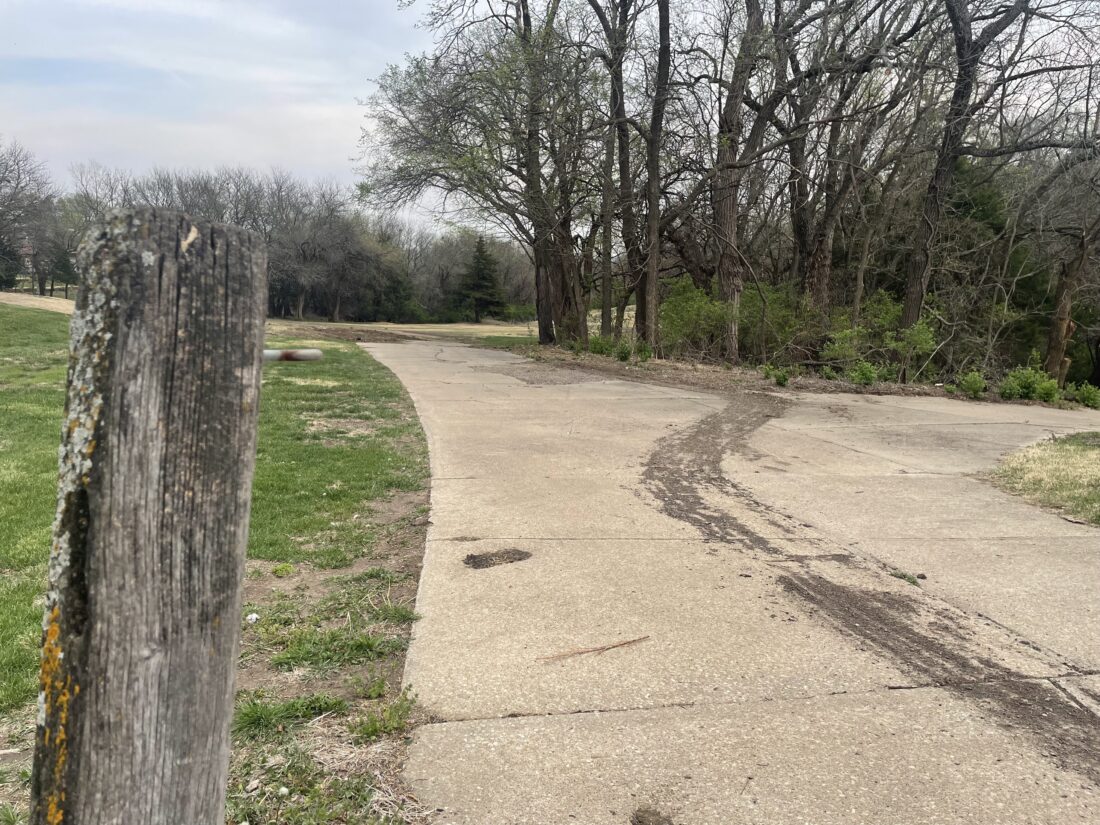
photo by: Sylas May/Journal-World
A golf cart path streaked with dirt in the Alvamar neighborhood on Thursday, April 9, 2026.
Robinson said that if Fritzel and the ownership group restored the course, it would give the property owners a lot of peace of mind.
“We’re just asking him to restore the golf course, as he promised, to a golf course, and a permanent covenant that it will only be used for a golf course,” Robinson said. “And if he does that, I think that the damages to homeowners and their property values will be less of an issue, because the real damage to our property value … is that when they go to sell their houses, and somebody says, ‘Well, what’s going on back there?’ We don’t know.”
There was a recent attempt to develop a 200-unit apartment complex along a portion of the Jayhawk Club golf course, which the City Commission denied a development plan for in December 2025. But the bigger issue for Robinson has to do with the possibility of things being built on top of the defunct parts of the course.
He told the Journal-World that when Bob’s Legacy researched the zoning at Alvamar, they found that the city’s new land development code had shifted the golf course property into a different kind of residential zoning, one that would permit a greater variety of uses than before. That could include certain multifamily housing uses like townhomes, he said.
And “we don’t know” what’s going to be built, he said, is “the worst thing you can say to a prospective buyer.”
It’s worse, he said, than if you actually know that some new project is happening behind your home.
“If somebody came to buy my house, and I say, ‘Oh, yeah, that’s going to become a park. It was a golf course but it’s going to become a park. Or it was a golf course but it’s going to become townhomes,'” he said. “That knowledge of that, even though townhomes would be a very devaluing thing to have behind my house in terms of trying to sell it, knowing that is less damaging than if you don’t know.
“It’s the ‘don’t know’ that’s the worst,” he went on, “and that’s what we’ve been dealing with since the golf course died.”
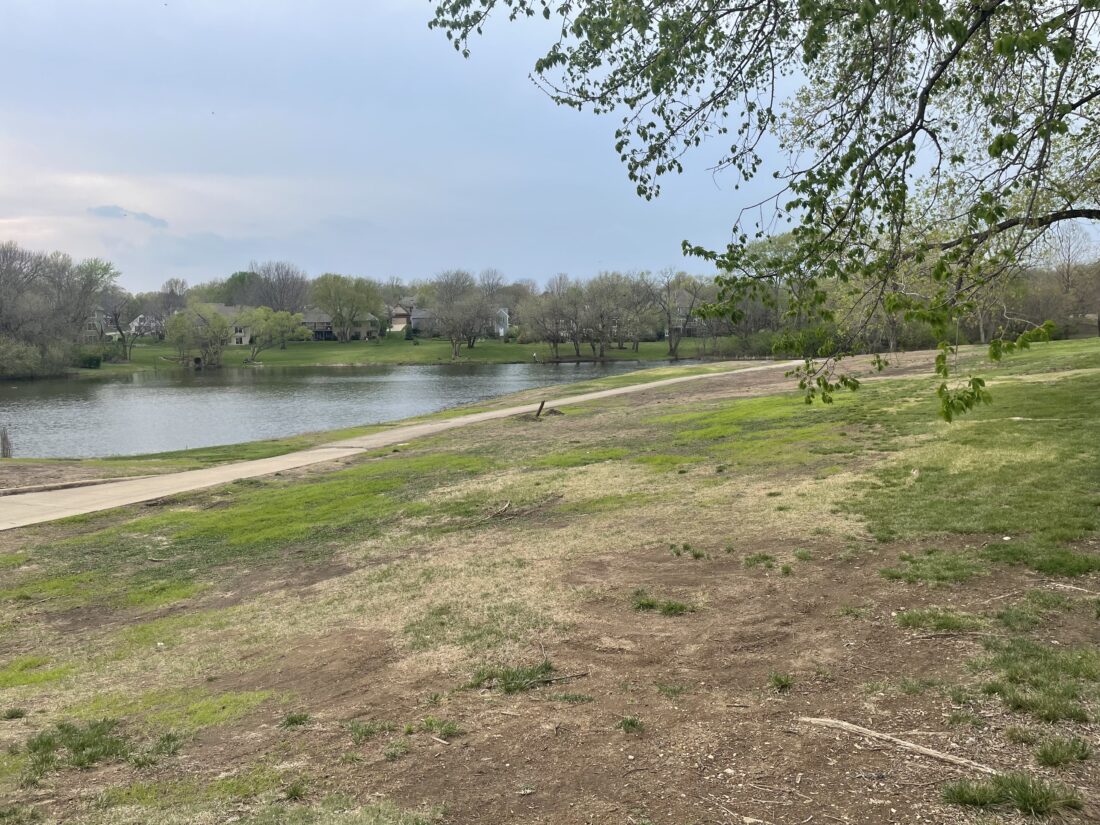
photo by: Sylas May/Journal-World
Dry grass and dirt alongside a golf cart path in the Alvamar neighborhood on Thursday, April 9, 2026.
City Government
Alvamar homeowners sue golf course ownership, seeking $26M in damages and restoration of defunct golf holes
Lawrence city commissioners might move general public comments to earlier in their meetings
With new murals, Junior Girl Scouts and Jewish congregation hope to turn bland buildings ‘into something beautiful’

60 people from 23 states have applied for Lawrence’s city manager position, mayor says
City of Lawrence will soon start application process for a construction manager for Fire Station 6