

Lawrence housing market strains residents as development fails to keep up, city’s affordable housing study finds

photo by: Shutterstock
A single-family home construction.
A new Lawrence Affordable Housing Study finds that over half of renters and many homebuyers cannot afford current prices, as housing construction lags well below pre-pandemic levels.
The city has been working on a new Affordable Housing Study to update its understanding of the local housing market and affordability needs, particularly in light of how conditions have changed since the last major analysis in 2018, as the Journal-World reported. Its purpose is to capture the economic and housing shifts that have occurred during and after the pandemic.
While many of these problems existed before the pandemic, it also intensified and brought affordability issues to the forefront for more residents. To gather data for the study, the city shared a survey for residents to complete at the beginning of the year.
One of the main findings in the study is that Lawrence faces a housing shortage across nearly all types of housing, and it is increasing home prices and rent as well as contributing to the displacement of long-term residents. According to data shared with the Affordable Housing Advisory Board, 76% of survey respondents reported having a difficulty in finding a home they could afford in Lawrence.
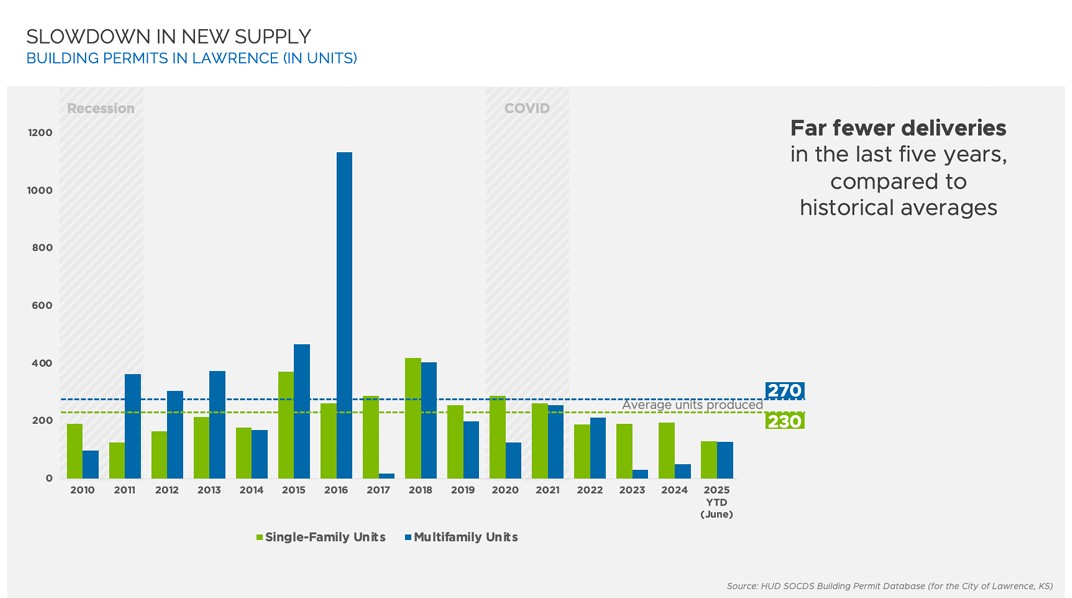
photo by: Screenshot
The number of building permits for housing units issued in Lawrence from 2010 to 2025.
According to the U.S. Department of Housing and Urban Development, if rent for a two-bedroom unit is set at $1,252 – which is based on 110% of the 2025 HUD Fair Market Rent for the Lawrence, Kansas area – 57% of renters in the city cannot afford this unit. This amount includes an estimate for tenant-paid utilities like heating, cooking, water heating, and electricity.
In addition, for home buyers, the median sale price for homes sold in the city the last two years is $323,000. About half of potential homebuyers cannot afford the median home price.
City officials have shared a strategic framework of the study with members of the AHAB – which outlines many of the causes of the city’s housing challenges and a structured plan for addressing them. The board will be taking a look at this data next week.
Another one of the challenges is a lack of supportive housing, particularly for vulnerable populations such as seniors, people with disabilities and those experiencing homelessness. About 11% – or approximately 10,500 of Lawrence residents – report having a disability, yet accessible housing options remain limited.
The conditions of existing housing in the city also raise concerns. In Lawrence, there’s a median home age of 1988, and many properties are requiring significant repairs. According to the data shared with the AHAB, 69% of survey respondents reported seeing or experiencing homes or apartments with significant repair needs in Lawrence.
Stakeholders emphasized the need for stronger code enforcement, better tenant protections, and more resources for maintenance and rehabilitation to preserve existing housing quality. As the Journal-World reported, Douglas County commissioners approved a tenant eviction defense pilot program at their last business meeting.
While the city and other municipalities have been attempting to address the housing shortage, the report highlights that the community’s opposition to a lot of projects has slowed progress.
Opposition to new development, especially higher-density or multifamily housing, has slowed or blocked projects that could help alleviate shortages. These misunderstandings surrounding housing needs and stigma around certain housing types contribute to delays, and it has made it harder to respond quickly to demand.
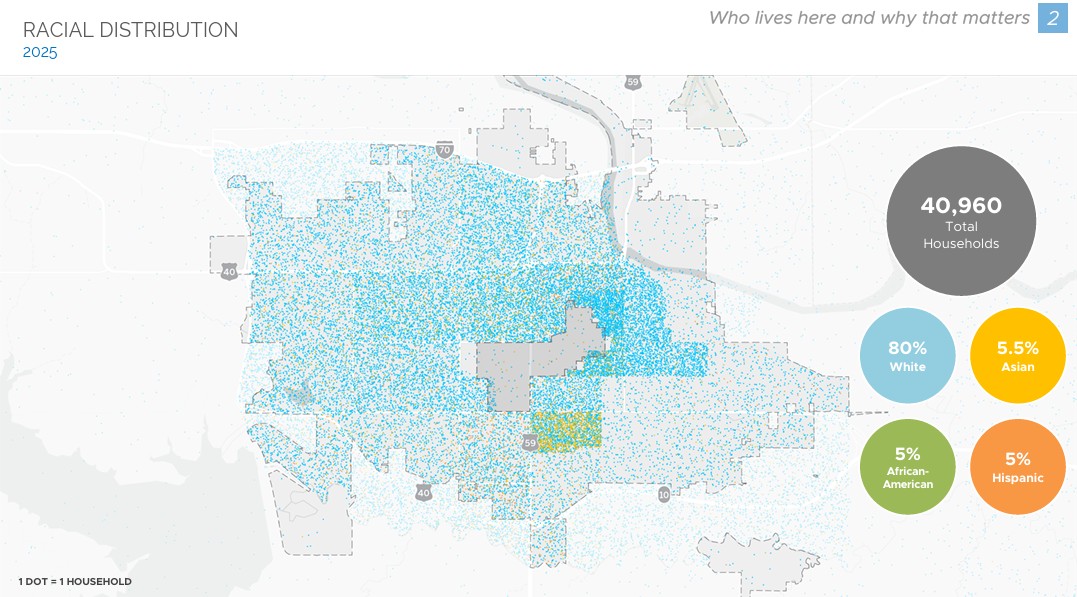
photo by: Screenshot
The racial distribution of households in Lawrence in 2025.
To address all of these housing challenges, the study’s framework proposes five overarching goals: increasing the housing supply, improving accessibility, enhancing housing conditions, fostering informed public dialogue, and better leveraging city programs and funding tools.
Another key purpose of the study is to update local housing strategies and plans, such as the joint city-county plan tackling chronic homelessness, ‘A Place for Everyone.’ With the new data, the city will be able to adapt its policies and programs to reflect the current situation of the housing market.
The AHAB will be meeting at 5:30 p.m. on Thursday, April 9 on the first floor of City Hall, 6 East Sixth Street., to review the data collected so far and help shape the city’s housing strategy before it is finalized in June. The meeting will also be available on Zoom.
The AHAB will provide feedback on the proposed goals and strategic framework. This includes evaluating whether the five main goals accurately reflect community needs and whether anything important is missing or should be prioritized differently. Another thing the AHAB will consider is helping define how progress will be measured. The board is expected to suggest metrics, benchmarks, or indicators that can show whether housing affordability is actually improving over time during the meeting.
City Government

Lawrence is charging water, sewer customers a special tax not required by state or city law
Lawrence housing market strains residents as development fails to keep up, city’s affordable housing study finds

Property tax protest bill would let a few dozen voters block tax increases in some parts of Douglas County
Portion of 19th Street to close during much of April for stormwater structure replacement

With water and sewer rates soaring, a city utility fund has had multiple financial discrepancies
