

Kaw Valley CrossFit expands with new adaptive fitness space to serve athletes with disabilities
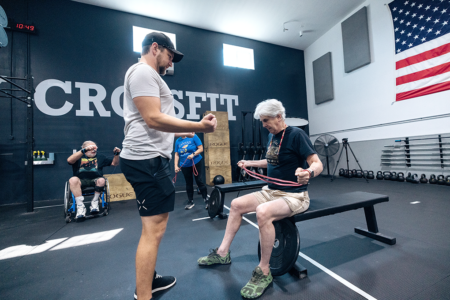
photo by: Contributed
An instructor at the Kaw Valley CrossFit in Lawrence leads an athlete in a routine of adaptive exercises.
To help more people with disabilities stay fit and active, Kaw Valley Crossfit needed more space for classes tailored specifically to them — and now it has just that.
A new 2,500-square-foot space was built adjacent to Kaw Valley’s main facility, 1204 East 24th St., and it’s intended to host functional fitness classes that can be adapted to the needs of athletes in wheelchairs and those with other disabilities, too. Owner Alec Barowka told the Journal-World that previously, a lot of these classes were only available during hours where athletes might be at work or school, and he needed more space in order to hold classes for them in the evening hours.
“The actual space is the first step,” Barowka said. “It was ‘how do we serve the people with disabilities in Lawrence that work or go to school?’ And the only way we could do that was more space.”
Barowka is also the development director for a nonprofit called Bloc Life Inc., which works to make adaptive classes in already existing fitness gyms like Kaw Valley CrossFit. Bloc Life Inc. has partnered with several gyms even outside of Kansas to offer these programs, and Barowka said these classes have continued to grow significantly.
At Kaw Valley CrossFit, there are three different types of adaptive training classes – Adaptive Athletes in Motion, Adaptive+ for people with intellectual disabilities and Masters CrossFit offering classes for people 65 years and older.
“We’ve been running our adaptive program for the last couple of years, and I came on with Bloc Life to help them grow and work alongside Dr. Lyndsie Koon,” Barowka said. Koon is the associate director of the Research and Training Center on Independent Living at the University of Kansas, and Barowka said they’d collaborated on several prior research projects.
“I just got bit by the bug,” Barowka said. “It’s just so much what I enjoy doing and the benefit it has to your community. So that’s when I decided that we would expand Kaw Valley to really allow like a full slate of adaptive classes.”
Kaw Valley CrossFit and KU have recently begun a new project for research showing the benefits of exercise for people with disabilities. The research is being funded with a three-year, $750,000 grant from the National Institute on Disability, Independent Living, and Rehabilitation Research, and the project will be led by Koon.
With the partnership, Koon will be recruiting individuals ages 18 to 74 years old who have mobility disabilities to participate in a functional fitness program. The project will recruit individuals to participate at CrossFit locations partnering with Bloc Life Inc. in North Kansas City, Missouri; Mission, Basehor and Lawrence in Kansas; and in Houston, Texas.
“We just continue to run our classes, and then KU operates around us,” Barowka said.
Barowka said the people who offer to participate in the research with KU will have their membership at the gym paid for by the university and Bloc Life Inc.
Barowka said not only does it cost money to have special equipment, many of the athletes have some kind of financial hardship and Bloc Life plays a role in helping mitigate those costs by providing scholarships for the athletes and some money for the coaches.
“They are sort of shoulder to shoulder with us, but they operate kind of in their own column,” Barowka said. “So they support us with grant money to help support the programs that we’re running. If an athlete’s in research, their membership is paid by research and that supports them. They don’t have to pay a single dollar.”
He said it becomes expensive for a good gym like his to run without the help of the Bloc Life Inc.
“Bloc Life also pays some part of the subsidy … of the coaches’ pay. So it makes a really cool opportunity for gyms … to run these programs because it benefits their community and is financially viable for them.”
Barowka said it’s also about building a network of gyms so no matter where people are in the Kansas City metro and beyond, people can access adaptive fitness programs.
“In the future, maybe we go to Dallas, or maybe we go to Oklahoma,” Barowka said. “We find a major city and we spread the web there, but everyone in that town, they can then find access. It’s just almost impossible to build a tower on the hill and let everyone come to you because there’s too much of a barrier there.”
The newly built space will also be home to Assistive Technology for Kansans, another project at the Life Span Institute. ATK helps people with mobility issues, limited vision or hearing, speech or cognitive disorders, and other disabilities find solutions to improve their daily living and independence.
The location will provide an off-campus community setting for ATK researchers and staff to meet with individuals about resources such as specialized equipment for people with disabilities.
“They’re a great mission aligned sub tenant for us,” Barowka said. ” … We’re just really excited to work with them, and so I don’t know quite what that will hold yet.”
Barowka said the ultimate goal is to build as much accessibility as possible and provide a number of options for seated and standing athletes in the adaptive fitness program.
“All of our equipment is wheelchair accessible,” Barowka said. “All of our cardio type machines, our rowers, our skiers, our bikes, they all either have wheelchair bases on them, which are just wider so you can fit the wheels and wheelchair on them. Our bikes, you can actually use without sitting on the seat with these auxiliary handles.”
Barowka said he always hopes people take away a sense of community while participating in the program and have somewhere they can go each day.
“But it’s usually just that it’s always more fun with other people,” Barowka said. “The community is almost everything and that and last but not least, they can do hard things in their life. Everyone is capable of something … We have athletes that are holding 10 pound weights and we have athletes that are holding 75 pound weights in each hand, and it’s all the same. We’re just meeting you where you’re at.”
Other News
Kaw Valley CrossFit expands with new adaptive fitness space to serve athletes with disabilities

Facing federal cuts, changes to training, Douglas County CASA appreciates donations and support from multiple KU organizations to continue growing
PHOTO: Downtown Lawrence’s holiday lights glow merry and bright

Light displays, kids’ clothing swap and more area events

Longtime Lawrence artist known for community murals to host art show opening for this month’s Final Fridays event
The latest legal notice filings in Douglas County
State law requires residents of a county to be notified of a lot of different legal matters that are underway at ...