Lawrence resident’s poetry spans themes of racism, activism and spirituality
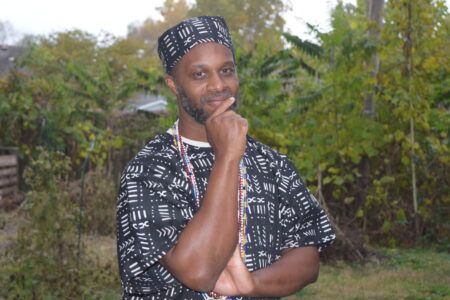
photo by: Chansi Long
Local poet Tai Amri Spann-Ryan is pictured recently in his backyard in North Lawrence wearing a mud cloth dashiki and initiatory African beads called ilekes.
There are certain topics Tai Amri Spann-Ryan is reluctant to broach with his now very young daughters: topics like no-knock warrants and sleeping Black women — references to Breonna Taylor, who was killed last year in Louisville, Ky., when police stormed her apartment in a botched overnight raid.
Channeling his desire to change the society in which he raises his daughters, Spann-Ryan, of Lawrence, wrote “Things I Can’t Tell My Daughter,” a poem that is a part of his new collection, “Beautiful Ashe: Memoirs of a Sweet Black Boy and Other Poems.”
A piece that made its way into “Beautiful Ashe” secured Spann-Ryan the Langston Hughes Creative Writing Award for Poetry in 2016.
“When I won the (Langston Hughes) award, it was kind of an indication that I can actually share my poetry and the more I share it, the more powerful it can be,” Spann-Ryan says.
While his wife was pregnant with their first child, Spann-Ryan came up with the grounding phrase “beautiful ashe” from a self-hypnosis C.D. Spann-Ryan says “ashe” is a Yoruba concept symbolizing the spiritual essence of a being.
The Yoruba are an ethnic group mainly living in Nigeria and other parts of Western Africa.
“Ashe is a word that means ‘so be it,’ and it is also the life force that is in everything,” Spann-Ryan says. “When I would feel anxiety around the birth I would chant that.”
“Beautiful Ashe” evolved into a seven-part poetry collection that spans themes of racism, activism and spirituality.
The section of the book that earned Spann-Ryan the Langston Hughes award is called “Sweet Black Boy.” In it, Spann-Ryan confronts his childhood struggle with toxic masculinity. Other boys called him “sweet,” meaning to shame him.
“When I grew up, boys would call me ‘sweet,’ but they would say it like a gay slur. I wanted to make it something strong and powerful,” Spann-Ryan says. “I wanted to use my experience to show what healthy masculinity would look like, and every time I tried to write it down, it came out as a poem.”
In the poem “Sweet Black Boy” Spann-Ryan uses the third-person voice to write about the dichotomy between himself and other boys:
“sweet tai amri wants to cry when other boys get teased and jumped. hates when the bully’s parents beat him. thinks it’s wack that his friend has a dad who never kisses him.”
“Beautiful Ashe” was a collaborative effort by four Black artists, with the others working on layout, photography and editing.
“What makes this work so precious and important is that it’s an all-hands-on-deck (project), and at the center of it all is a talented poet,” says Mercedes Lucero, who helped design the book’s cover. “I think there are so many harmful stereotypes rooted in a toxic masculinity that perpetuate harm and violence, and to get a counter narrative or exposure of that counter-narrative is vital.”
One section focuses on Spann-Ryan’s relationship with activism. Once a traditional activist for Black Lives Matter — attending meetings, speaking at rallies, organizing events — Spann-Ryan decided to support the BLM movement through his poetry.
“I felt like I couldn’t be on the picket line all the time,” Spann-Ryan says. “(With young kids) I had to stay at home, so I thought, how can I be part of the movement? Poetry became a way to do that.”
Spann-Ryan has a degree from the Jack Kerouac School of Disembodied Poetics in Boulder, Colo., where he discovered poetry could be a tool for social justice. Throughout his adult life, he has used poetry to both advocate for social change and to cope with some of the horrors of the world.
“Sometimes when I look at the news it’s just too much and the only way … that, say, I’ll read this article, is if I give myself the opportunity to write about it afterwards,” Spann-Ryan says. ” I have to get it out so I can function in the world. … What do I do with this pain? All I can do is write it down.”
Other News

Lawrence Humane Society’s Clear the Shelter event coming up; adoption fees will be waived for an entire weekend
Lawrence Jewish Community Congregation to celebrate its new mural with potluck dinner
Watkins Museum of History partnering with national nonprofit to bring famous painting of George Washington to Lawrence
Lawrence transgender woman gets her driver’s license back after the state invalidated it; judge says she’s likely to prevail on her due process claim

Lawrence and Eudora receive millions in federal funds for 3 ‘transportation alternative’ projects, including the Loop