For local beekeepers, honey hobby can be costly but sweet
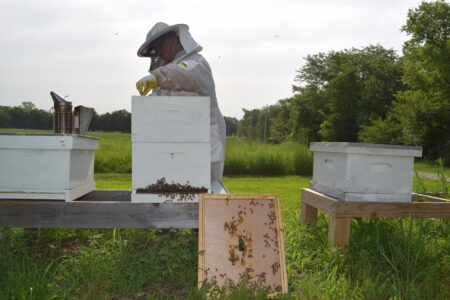
photo by: Chansi Long
Janelle Niemczyk-Pierson, of Moon on the Meadow Farm, works with her bee hive Tuesday, July 13, 2021, in rural Lawrence.
Ask Levi Lenard how much money he’s spent on bees and his answer might shock you. But to Lenard, the benefits outweigh the expense.
“I’ve spent thousands on beekeeping,” said Lenard, who is forthright about how costly and time consuming the hobby can be and how it requires a certain devotion.
Not only are bees expensive, but managing them when they’re moody can be a challenge. Nectar scarcity, humidity, hot weather, a felled queen, a clumsy beekeeper — the reasons that cause a bee to swiftly zip and cluster around a beekeeper’s head, mashing at the veil some beekeepers wear, to sting the face and neck, are many.
Janelle Niemczyk-Pierson, who sells her honey at Moon on the Meadow Farm, was terrified when she first started harvesting honey almost four years ago. Her fear response would jolt into action, even though she was fully covered with a protective bee suit.
“Early on I was always afraid,” Niemczyk-Pierson said. “My dad was allergic to bees and I was not sure if I was going to carry that on. But I felt like I wanted to do it, so I had to push myself.”
To cope with bee aggression, many beekeepers smoke their bees, a practice that prevents them from communicating and swarming. When afraid, bees emit a pheromone that signals an attack; the smoke masks the attack pheromone so other bees can’t smell it.
“I try to avoid smoking them,” Niemczyk-Pierson said. “This year I am doing a very hands-off strategy with the smoker, to see if I can keep them calmer without it.”
Instead of smoking her bees, Niemczyk-Pierson opts to move more slowly and carefully while wearing a full beekeeper suit.
Niemczyk-Pierson and Lenard want people pondering beekeeping as a hobby to have low honey expectations for the first and even second year.
“Generally, the first-year hive isn’t going to be strong enough to create honey for you,” Niemczyk-Pierson said.
But some beekeepers do have luck eking out honey sooner. Gayan Stanley, of Three Crow Farm, started beekeeping six years ago, and his hives yielded honey within the first year. He sells the honey locally, but because he approaches beekeeping as a hobby, he doesn’t carefully track profits. He estimates that he’s breaking even. But like Lenard, Stanley is more interested in the world of bees than money issues.
“Bees remain ever interesting to work with, observe and learn about,” Stanley said. “I’m still learning lots about how to keep hives healthy and productive, producing both honey and more bees. It’s animal husbandry and requires a keeper to keep an eye out for disease, parasites and toxins.”
While the bees do the work producing honey, beekeepers have to diligently watch and wait, watch and wait, in order to steal the honey from the bees — then keep it obscured so they can’t steal it back. In the meantime, things like mites and parasites are a constant threat to bee hives. Last year Niemczyk-Pierson entered winter with seven hives and emerged with two.
“The mites are really causing destruction in the bee population,” Niemczyk-Pierson said. “All (beekeepers) are struggling with it. In a way, it’s reassuring in the fact that I’m not missing some aspect, that I could be caring for the bees better.”
Ashton Hall got his first beehive two weeks ago.
“I try to get most of my information from other beekeepers, but they all tend to have different opinions. As a new beekeeper, it is hard to sort through all of the different opinions and decide how you are going to manage your hive,” Hall said. “When I open up the hive, I know kind of what I am supposed to be looking for, but sometimes I worry that I wouldn’t know if they weren’t doing well. I’m only into my second week of beekeeping, so even the basics of identifying the queen are still challenging for me.”
Despite all its challenges, local beekeepers who watch and harvest honey for little monetary reward continue to do it year after year. Lenard laughs as he acknowledges how much time and money he has invested in his hobby, then quickly notes the benefits, beyond the fascination of watching bees: the honey that he adds to his oatmeal, stirs into his tea and gives to his dog for an extra burst of energy in the winter.
If you are interested in learning about beekeeping, Lawrence has a store devoted to the hobby. The Bee Store, 711 W. 23rd St., is owned by Tony Schwager and his family. It specializes in supplying bees and equipment, as well as teaching beekeeping classes. The store is open from 3 to 6 p.m. Tuesday through Friday and from 11 a.m. to 5 p.m. Saturday.
Other News

PHOTOS: Demolition Derby and other Douglas County Fair happenings
‘Let’s meet again’: Near the end of their trip, Japanese students celebrate their sister city bond with Lawrence

Go, See, Do: Art shows, Douglas County Fair finale and more

After tense start, meeting ends with many agreeing that city, county homelessness plan deserves closer review

PHOTOS: Fun at the Douglas County Fair