Lawrence women’s searches for biological mothers have led to varying results but no regrets
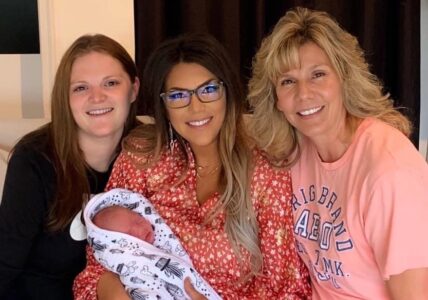
photo by: Contributed
Anna Varney, left, poses with her baby son Kendrick, her biological sister Ashley Carlson (holding Kendrick) and her biological mother, Wendy Anderson-Neyssen, in 2019, shortly after giving birth.
Anna Varney, 29, has spent very few actual days with her biological mother and sister, yet she feels an immeasurable love for them. Born at Lawrence Memorial Hospital, Varney was adopted by a local couple when she was an infant and was raised in Lawrence. Meanwhile Varney’s birth mother, Wendy Anderson-Neyssen, lived in Minnesota where she raised Varney’s older sister and a brother.
Growing up, Varney knew she was adopted. It was an open adoption, and her parents gave her an annual birthday card from her paternal grandparents — a tangible prompt connecting her to her biological family.
“My parents would give the (cards) to me, and that’s what got me wondering who they were,” Varney says. “Then one day I was going through photos and I found a photo of my (birth) mom. It said ‘Anna’s mom’ on the back, and I was confused, so I asked my (adoptive) mom about it.”
Varney mailed her biological mother a Christmas card when she was still in elementary school. A back-and-forth connection took hold. But it wasn’t until Varney was a teenager that they met. Her adoptive parents supported the decision, driving a 14-year-old Varney to Minnesota so she could meet her biological mother, sister and brother for the first time. Varney says the complexities of having her biological family in the same room as her adoptive parents who were raising her was profound.
“It was awkward,” Varney says. “I didn’t know how to react to my adoptive parents and (my biological) family at the same time.”
A year later she was able to meet with only her biological mother for lunch.
“I don’t have much memory of it because it was brief, but it was the one time we were able to connect without anyone else with us,” Varney says. “It was the first time it was just us. It was nerve-racking for me, but it was something I wanted so badly — to meet my mom and see where I came from without the pressure of everyone else around.”
Humans are curious by nature, and for adopted people a source of that curiosity is their own origin story: Do I look like my parents? Are we alike? What is my family medical history? What is my family heritage? These are some of the questions that have inspired local adoptees to search for their birth parents.
Stephanie Harris, of Lawrence, looked up her birth family to learn her medical history.
“I was getting married, and I knew I would be starting a family and I didn’t have any medical history at all,” Harris says.
Harris had scant information about her birth parents — and later found out the information she did have was inaccurate. She gave the details to a private investigator who specialized in searches.
“It was expensive but absolutely worth it because I wouldn’t have been able to find them otherwise,” Harris says.
The investigator quickly found Harris’ parents’ addresses and phone numbers.
“I decided to contact my birth mother first,” Harris says. “I just called her and said who I was; she was quiet, then she said, ‘I always wondered if you would get in touch with me.'”
Harris talked to her biological mother for more than three hours. Soon Harris traveled to New York City, and in a whirlwind night she met her mother and aunt for the first time, learning details about her family heritage. When Harris got home, she sent her biological mother an invitation to her wedding. Her mother’s response was not what Harris had hoped for:
“She wrote me a really long letter that said all of this was too much and she no longer wanted to have contact,” Harris says. “It definitely hurt. I think as adoptees, we all go through having that feeling of abandonment and to have her sort of rejecting me again was an abandonment.”
Though her relationship with her biological mother was short lived, Harris doesn’t regret the search.
“I wasn’t looking for parents; I was looking for information,” Harris says. “I just wanted to see who I looked like and see someone else who looked like me. I wasn’t searching for a mom. My adoptive mom is my mom.”
Ruthann Reigle, of Lawrence, learned about her birth mother through an anonymous letter. Through the years Reigle would look for her biological parents, come up empty and stop. Then one day at age 33 she was sifting through junk mail and an envelope caught her attention. It was an anonymous letter.
“I was glad to be sitting down, because I didn’t expect it at all,” Reigle says. “I expected it to be a solicitation of some sort, and it turned out to be information I certainly needed.”
After learning her birth mother’s address, Reigle drove two hours and parked in front of the house. Gripped with fear of rejection, she drove back home without knocking. She decided to write a letter instead. In the letter, she explained who she was, reassuring her mother that she wanted nothing more than information about her genetic background, medical history and ethnic identity. She dropped the letter into a mailbox, and weeks passed.
“It was a long couple of weeks,” Reigle says. “I was a wreck. As the time went on, I thought, She probably doesn’t want to know me.”
Finally Reigle’s biological mother called.
“She explained why it took so long,” Reigle says. “The reason she hadn’t contacted me earlier was she had never told anyone in her family. No one knew I existed. She left before they knew she was pregnant. So she spent those two weeks (not contacting me) telling her entire family about me. I felt relieved because she made it obvious that she wanted to meet me.”
When Reigle entered her biological mother’s house for a meeting, she was welcomed by a cluster of balloons — a small, kind touch that put Reigle at ease.
“I remember staring at my mother’s hands,” Reigle says. “I had never seen anyone that was my blood relative before, and I just kept looking at her hands.”
As the years slid by, Reigle continued to bond with her biological mother, who she talks to often almost 30 years later.
“I find myself calling her to talk about some pretty difficult things,” Reigle says. “She is very understanding. She has always kept calling to see how I am doing. I trust her.”
Reigle would not have been able to launch a connection with her birth mother if it hadn’t been for the anonymous letter.
“I want to thank this person, but I can’t,” Reigle says. “That letter changed my life and my kids’ lives because now they have some information — not everything, but at least it’s something.”
Varney’s life, too, was changed by learning about her biological family. This past October her sister and mother came to see her, a visit that is looking to become an annual tradition.
“We had a movie night in my living room,” Varney says. “We lay on the floor and cuddled up and hung out. We didn’t have to do anything or be fancy. We just wanted to hang out and relax and enjoy each other.”
Anderson-Neyssen says reconnecting with her biological daughter has been easy.
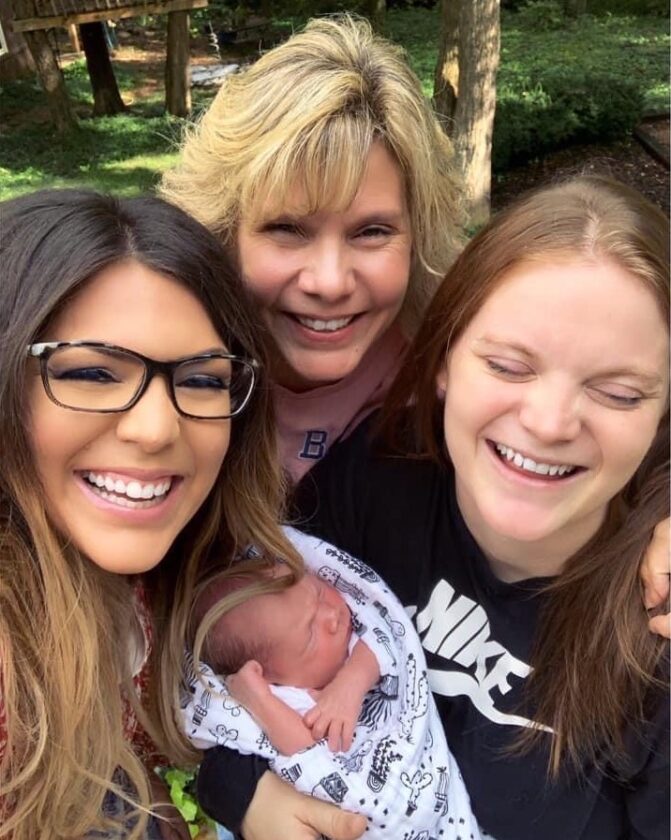
photo by: Contributed
Anna Varney, right, holds her son Kendrick, with biological sister Ashley Carlson, left, and her biological mother, Wendy Anderson-Neyssen, in 2019, shortly after giving birth.
“I don’t have a hard time talking with her,” Anderson-Neyssen says. “Sometimes you’d think it would be hard, but it’s just easy. … It’s not like we’re struggling to find anything to talk about. It’s so fun.”
During their last visit, Varney and her biological sister and mother were shopping at TJ Maxx when a woman stopped Anderson-Neyssen to remark on the obvious bond she had with both of her daughters.
“She said, ‘I wish I had that relationship with my girls,'” Anderson-Neyssen says. “I didn’t want to go into it all … I love her.”
Other News

Douglas County commissioners to discuss whether to increase the number of days fireworks can be sold in the county
Lawrence’s first bike lanes with physical barriers are installed on Ninth Street
Data center company plans up to $1,000 a year in tax, utility credits for De Soto households
Supernatural thriller filmed in Lawrence to have multiple showings at Liberty Hall
Eudora voters to decide sales tax election to fund increased fire protection in the city