‘A friendly, familiar face’: Celebrating Mother’s Day with a mom who has Alzheimer’s

photo by: Contributed Photo
Kim Luce poses with her mom, Sherry Almquist, at Grinter's Sunflower Farm in September of 2015.
Kim Luce will bring treats and flowers to her mom this Mother’s Day. She’ll sit outside and talk to her through the screened door in her assisted living facility. She hopes her mom, Sherry Almquist, will smile.
Almquist won’t know why Luce has brought her the special goodies. And she won’t have a concept of the day’s significance, because she doesn’t remember that she’s a mother.
Almquist was diagnosed with Alzheimer’s disease in 2010 — “But like a lot of people, several years before her diagnosis, clearly, we knew something was wrong,” Luce said.
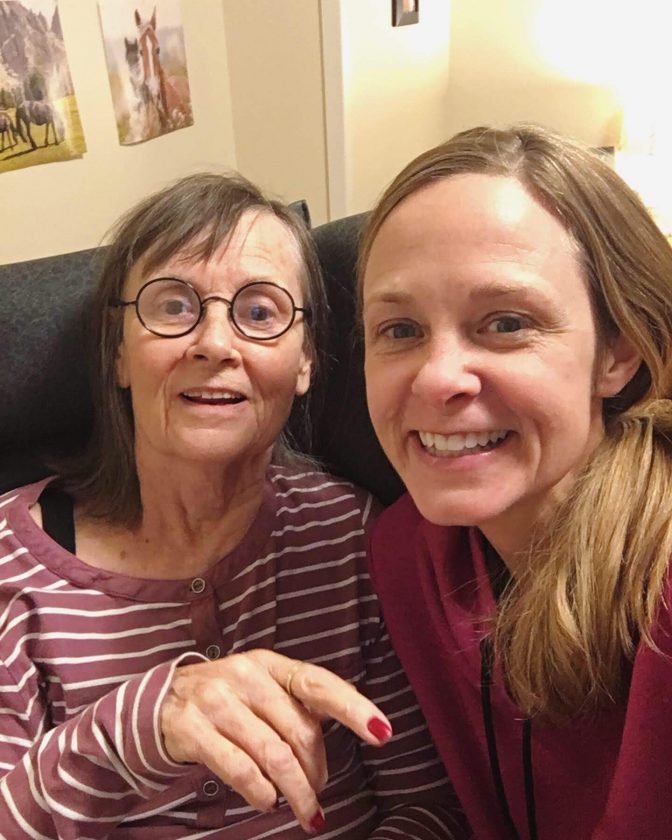
photo by: Kim Luce
Kim Luce is pictured with her mother, Sherry Almquist, in December of 2019.
Following her mother’s diagnosis, Luce quit her job to focus on being a caregiver. During the eight years she cared for her mom, Luce didn’t always have the optimistic outlook she holds today.
It was an “overwhelmingly horrible and sad” caregiving journey. But, luckily, she had help.
Luce joined a support group through the local chapter of the Alzheimer’s Association, and her peers taught her that she would have to grow into the role of a strong caregiver. Luce never had children, but she compared the process of caring for her mom to learning to raise a child — “you start slow and build skills as you go.”
For years, every day was Mother’s Day, Luce noted. She would care for her mom from 5 a.m. to 7 p.m. Then, when caring for her mom was no longer feasible, Almquist moved into Neuvant House of Lawrence, an assisted living facility that specializes in caring for people with memory loss.
But all that time with her mom allowed Luce to remain a familiar face in Almquist’s life, even as her memory faded away. Now, when she looks back at all the years she spent caring for her mom, Luce is thankful she was able to help.
“She still seems to recognize me – not that she would know who I am, but just as a friendly, familiar face,” she said. Almquist is now wheelchair bound and doesn’t speak.
Despite not being able to physically be with her mother in her room due to the COVID-19 pandemic, Luce said visiting through the screened window has still allowed them to maintain a connection.
“I want to be familiar. I don’t want to be a stranger,” Luce said.

photo by: Kim Luce
Kim Luce speaks with her mom through the screen door at Neuvant House on April 30.
Sometimes when Luce visits, her mom will fall asleep right away. That was the case the one time Luce thought playing her ukulele might brighten her mom’s day. Other times, Almquist will stay engaged as Luce talks to her and occasionally offer a smile.
That’s a way Luce feels she can communicate with her mom.
“I can’t do a lot of things, but I can still make her smile, so that’s good,” she said.
Mother’s Day isn’t a particularly challenging holiday for Luce. Her mom’s birthday, just one day after Neuvant House decided to close the facility to visitors in March, was much more difficult.
While Luce called the holiday “sad,” she said she feels “worse for people whose loved ones are more aware than my mom.” If their family is unable to visit with them in person, they will be more cognizant of the loss, she noted.
Luce said for this Mother’s Day, when so many moms residing in nursing homes likely won’t get to see their children in person, she’s thankful that her mom “is where she is in the disease.”
When Luce was a kid, Mother’s Day meant she and her brother making homemade cards. Later in life, it meant church and brunch with her mom. Sunday, it will mean a conversation through a screened window — Luce talking on the outside and, hopefully, a smile from Almquist on the inside.
Tips from the Alzheimer’s Association on caring for individuals with dementia during COVID-19:
•Increased forgetfulness is often the first symptom of an illness for people with dementia. Call a medical provider for advice if a person living with dementia shows rapidly increased confusion.
•People living with dementia may need increased reminders to remember hygienic practices. Place signs in the bathroom and elsewhere to remind people with dementia to wash their hands with soap for 20 seconds.
•In order to decrease the number of trips to the pharmacy, ask your pharmacist or doctor about filling prescriptions for a greater number of days.
•Think ahead and make alternate plans should the primary caregiver become sick.
For more information about Alzheimer’s, see alz.org or call the 24-hour hotline at 800-272-3900.
Other News

RJ Mitte, ‘Breaking Bad’ actor and disability rights champion, dies at 34

Clinton State Park and other state parks will increase overnight camping, vehicle permit fees starting next month
‘No day is like the other here’: Students from Lawrence’s German sister city discover football, new foods and new friends on exchange

GCSAA celebrates 100 years with new plaza and statue honoring its founder and first president

Go, See, Do: Library book sale, candidate forum and more