County leaders express support for plan for the Wakarusa River Valley, but say this is just a starting point
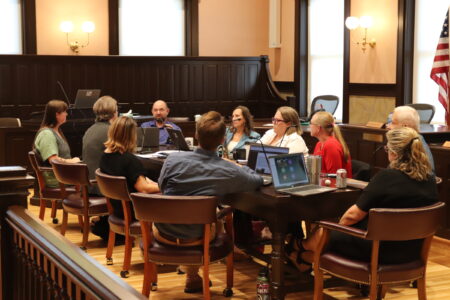
photo by: Josie Heimsoth/Journal-World
Douglas County commissioners meet on Wednesday, Oct. 7, 2026.
Douglas County commissioners saw the drafted Wakarusa River Valley plan as a starting point for shaping how the area changes as Douglas County grows.
The nearly complete Wakarusa River Valley Vision Plan is designed to be a guiding framework for balancing conservation values with the needs of the growing community. The project was led by Douglas County alongside consultants Biohabitats, Alta Design and Hoxie Collective.
As the Journal-World reported in its deeper dive of the drafted plan, the consultants met with local governments, partner agencies, students and educators from Haskell Indian Nations University, conservation organizations, advocacy groups and other community members at multiple events over the past 18 months.
Kim Criner Ritchie, the county’s sustainability manager, said when the Douglas County Open Space Plan was approved in 2024, one area highlighted was the Wakarusa River Valley.
“That … process is what identified the Wakarusa River Valley as a priority for conservation, largely because of its convergence of ecological richness, recreation opportunities, agricultural soils, cultural significance, and its resilient dysfunctions to our community,” Criner Ritchie said.
While county commissioners did not approve the plan on Wednesday, they expressed support in the plan, while emphasizing that they see it as a “starting point” for a longer conversation rather than a prescriptive development or recreation plan.
Commissioner Erica Anderson said she thought that the plan should clarify how to protect the wildlife corridor and provide space for animals when introducing recreation or other human activity. Jessica Hardesty Norris, senior ecologist at Biohabitats, said there is definitely tension between recreation and ecological preservation.
Hardesty Norris said that trails could potentially be designed differently depending on ecological sensitivity, such as a wider sidewalk in a more developed area versus a natural-surface path and wider buffers in a more sensitive area.
Another major concern was flooding and the impacts of development in the river valley. Commissioner Karen Willey said she wanted to better connect the plan with emergency management, particularly regarding flood risks and housing or other development in areas that are more vulnerable to flooding.
She suggested connecting the cities, county emergency management and other partners so the plan considers not only ecological risks but also the practical risks to people and property.
In addition, Willey said that portions of the City of Lawrence’s growth tiers extend into areas along the river and Washington Creek where the county has already conducted hydraulic studies and experienced significant flooding. Willey questioned whether some of those areas should ultimately be removed from consideration for urban development because of downstream flooding risks.
The plan also offered a series of potential pilot projects, providing examples of how strategies to achieving goals could be put into practice. For example, one proposed pilot is using property around the Wakarusa River Wastewater Treatment Plant as a model for riparian buffer management.
Many of the potential pilots and other actions identified in the plan are dependent on whether or not the Douglas County commissioners, other governments, institutions, landowners, agencies and other community partners decide to implement them.
County commissioners did not approve the plan on Wednesday. The final draft will be adopted at a later date.
“There’s a lot I love about this, and I’m excited to see how it comes to fruition and how the conversation evolves,” Willey said.
IN OTHER BUSINESS, COMMISSIONERS:
• Approved the Monarch CARES – which stands for Crisis and Respite Extended Stays – pilot program at the Lawrence Community Shelter. As the Journal-World reported, county commissioners discussed the pilot during a work session last week.
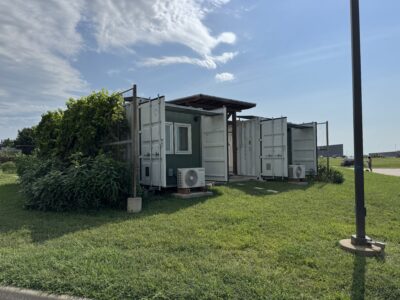
The pilot will use up to three of the “tiny homes” in the Monarch Village, located behind the shelter, in the last three months of 2026 to offer crisis respite and extended stay options for individuals with complex behavioral and medical needs following a health crisis.
• Approved a site plan for an electrical substation expansion on approximately 1.94 acres at 1645 East 400 Road. The improvements would include a new 160-by-70-foot secured work area immediately north of the existing substation area. The area is intended to give utility crews space to access, service and maintain the existing substation safely.
• Renewed a conditional use permit for Midnight Farm, located at 2084 North 600 Road. Midnight Farm is operated by Community Living Opportunities to provide residential and therapeutic services in a rural setting to persons with developmental disabilities.
County Government
County leaders express support for plan for the Wakarusa River Valley, but say this is just a starting point

As development pressures grow, Douglas County lays out drafted vision for Wakarusa River Valley
Douglas County Commissioner Gene Dorsey announces write-in campaign after losing in primary election
Douglas County commissioners support pilot idea to use ‘tiny homes’ to expand care after health crises
County to consider pilot project to use ‘tiny homes’ to house people needing behavioral health care