Kelly tells crowd county’s large reserves helped it build projects with ‘very minimal debt’; records show $55M in debt was issued
The debt issuances for public safety buildings was the county's largest in years
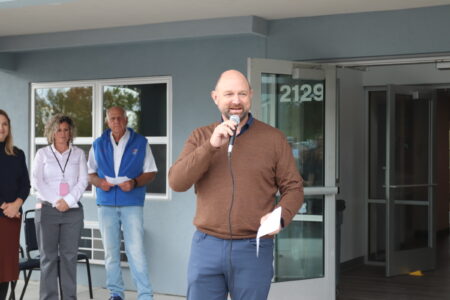
photo by: Josie Heimsoth/Journal-World
County Commissioner Patrick Kelly speaks at a ribbon cutting ceremony for Delmar Place on Thursday, Nov. 6, 2025.
The more than $100 million that Douglas County has kept in reserve accounts and rainy day funds were the subject of a barrage of audience questions directed at Commissioner Patrick Kelly at a Sunday evening candidate forum.
Kelly, who is locked in a Democratic primary battle as he seeks a third term on the commission, told the crowd he was “happy” to speak about the dollars, which are called fund balances in the language of county budgets.
“As we came out of the pandemic, and you all saw your property values really increase, we did experience some higher fund balances,” Kelly said. “We looked at this as an opportunity to save you millions of dollars.”
Then, Kelly listed his prime example of how that was the case. The county in 2025 agreed to build a pair of new buildings — an expansion to the Judicial and Law Enforcement Center and a new public safety building — that together had a construction cost of approximately $82 million.
“We were able to pay those with very minimal debt, keeping our triple-A bond rating and saving quite a bit of money,” Kelly told the crowd at the forum hosted by the Douglas County Rural Preservation Association.
What Kelly didn’t do, though, was define what he meant by “very minimal debt.” Following the forum, the Journal-World reviewed the debt issuance. As reported in May 2025 when the county issued the debt, the county used $25 million in cash reserves for the project and used $55.75 million in new debt to pay for the pair of projects.
In other words, more than 65% of the project was funded by debt. In historical terms, the debt issuance was perhaps the largest in the county’s history. Complete records for all debt ever issued by the county weren’t readily available on Monday. However, the county’s most recent financial statements show a listing of debt issued by the county dating back to 2008. During that 18-year period the largest amount of debt the county had issued at one time was $10.3 million. That makes the $55.75 million debt issuance for the public safety projects more than five times larger than the county’s next largest debt issuance in recent memory.
The Journal-World reached out midday on Monday to Kelly for additional context on his characterization of the $55 million in debt being very minimal. At about 4 p.m., Kelly responded via email that he was “going to do some checking” on the matter, and anticipated providing a response at a later date.
As for other parts of Kelly’s statement, there are numbers that back up his contention that the county was saving money by using $25 million in cash reserves to pay for a portion of the public safety buildings. When the debt was issued in May 2025, county commissioners were told by staff that the county would save an average of about $65,000 per year in interest expense for every $5 million of cash that they put toward the project. At $25 million, that would equate to an average savings of about $325,000 per year, or about $6.5 million over the course of the 20-year loan.

photo by: Josie Heimsoth/Journal-World
Milton Scott, a Democratic County Commission candidate for District 1, speaks on Tuesday, June 23, 2026 at a candidate forum.
Kelly’s opponent in the Democratic primary, Milton Scott, told the crowd on Sunday that the county has so much money sitting in fund balance, reserve accounts and “slush funds” that Kelly and his fellow commissioners easily could have done more to pass along property tax savings to residents.
“Yes, you would have money to buy the law enforcement center because you raised our taxes year after year and have a slush fund,” Scott said. “Not once has the county said to us, we have taken more than we should, and we are going to return it.”
Kelly and Scott are battling to win the Democratic nomination for District No. 1, which covers parts of central and west Lawrence. No Republican or third-party candidate has filed for the seat, meaning the winner of the Aug. 4 primary election likely will be the winner of the November general election.
Exactly how much money the county has in its rainy day accounts and fund balance also was a question posed by audience members at the forum. Most of those questions were directed to Kelly, who is the longest-serving member on the commission.
Kelly told the crowd that he did not have an exact number nor did he offer an estimate. Instead, he said the county administrator will be releasing her recommended budget in the coming days. Those budget documents will include an entire page on the county’s fund balance totals, he said.
The county’s budget documents have long included a page on fund balance totals, but that particular budget page has not provided a full look at the county’s total amount of fund balances spread across multiple funds.
For instance, the fund balance sheet included in the 2025 recommended budget listed the “2024 Actual Fund Balance” for 11 accounts. Those 11 accounts were listed as having total fund balances of $66.08 million as of the beginning of 2024.
However, when you look at the county’s audited financial statements, they show a different total. Page four of the county’s 2024 audited financial statements, for instance, states that the county began 2024 with $131.9 million of “unencumbered cash.” That is $65 million more than what was listed on the fund balance page included in Plinsky’s 2025 recommended budget that was provided to commissioners. The difference is the county’s audited financial statements provide fund balance totals for 33 different county funds, while Plinsky’s budget sheet provides balances for only 11 funds.
The county doesn’t yet have its audited financial statements for 2025, and based on recent history, the County Commission won’t have access to the audited 2025 financial statements until after the commission has approved the 2027 budget.
The county’s audited financial statements do provide a clearer snapshot of total dollar amounts that the county is holding in various rainy day funds. However, the county’s audited financial statements historically have not been completed prior to the County Commission’s deliberations on the budget. For instance, the county will begin discussions soon on the 2027 budget, but the most recent audited financial statements available to the County Commission are from 2024.
Given the lack of the 2025 audit, there is not yet an audited number to report for the county’s unencumbered cash total at the end of 2025. However, the 2024 audit does report how much unencumbered cash the county began the year with in 2025. The audit lists $145 million in unencumbered cash to begin the year. When you add in accounts receivable that were scheduled to be added to the county’s totals shortly after the beginning of the year, the amount grew to $162 million, according to the audit.
As the Journal-World reported in May 2025, the financial rating agency Moody’s reviewed the county’s finances ahead of the $55 million bond sale. The organization looked at the county’s level of fund balances and concluded that Douglas County had nearly $70 million more in fund balances than the median for a similar-sized county or city with the same high-quality credit score as Douglas County’s.
On Sunday evening, Kelly told the forum crowd that the fund balances kept by the county are important to keeping the county’s “triple-A bond rating.” However, Douglas County does not have a triple-A bond rating. The county, as it has for years, has an Aa1 bond rating, which is commonly called a double-A bond rating. It is a very high bond rating for a county or city, but is one step below the triple-A rating referenced by Kelly.
County Government
Housing Stabilization Collaborative’s request for city trust fund aid won’t be considered because it was filed late
Douglas County commissioners discuss tracking results of awarded funding to community partners

General Election Voter’s Guide

An incumbent Douglas County commissioner faces no opponent in general election

Incumbent Douglas County commissioner and newcomer challenger face off for District 5 seat