

Douglas County commissioners explore new food system priorities as nearly decade-old plan nears milestone
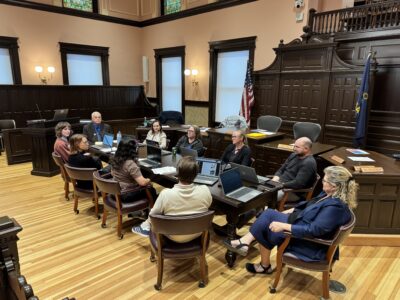
photo by: Josie Heimsoth/Journal-World
Douglas County commissioners met with county's sustainability staff on Wednesday, Feb. 4, 2026.
As the county’s Food System Plan approaches its 10-year anniversary, Douglas County leaders are rethinking priorities around food access, land health and equity.
Much of the county’s food systems work is guided by the 2017 Douglas County Food System Plan, which centers on supporting agricultural producers and food entrepreneurs, conserving natural resources, ensuring food access and health, advancing equity, and reducing food system waste.
This work is closely informed by collaboration with the Douglas County Food Policy Council, a longstanding advisory body, as well as participation in the Kansas Food Action Network. The existing Food System Plan is approaching its 10-year anniversary, and sustainability staff asked county commissioners for direction on priority food system issues to focus on during a work session on Wednesday.
Quinlan Carttar, co-chair of the Food Policy Council, said with the approaching milestone of the plan, there have been many conversations among council leadership about taking the upcoming year to reflect on what has been going well in the plan and what still reflects the goals and priorities of the county.
At the time of when the plan was crafted, the City of Lawrence and Douglas County had a shared sustainability office, but since then, they’ve become separate offices. While the departments parted in 2022, currently, the city has five members on the Food Policy Council, while the county has eight members.
Commissioner Shannon Reid said as staff are rethinking the plan, it may be an opportunity to think about opening seats up for other municipalities in the county.
Reid also said she would like to see access to healthy food somewhere in the primary goals and framework of the plan.
“I think naming access to foods, access to healthy foods, access to culturally relevant foods, just access in sort of all the forms,” Reid said. “I just think it’s a powerful word, and I think that a lot of the Food System Plan already speaks to that, but it’s not necessarily named and highlighted.”
Commissioner Karen Willey said the county wasn’t talking about soil health in the same way that it should now. She said soil health is being lost in working lands through neglect, noxious weeds, through especially woody encroachment.
“I just want to make sure that when we’re looking at the working lands piece, we’re looking at the quality of the working lands and the quality of the ecology of those lands and how that plays into having the most nutrient-dense food that we can get to people,” Willey said.
Connie Fiorella Fitzpatrick, a food systems specialist for Douglas County, said federal and state policies really do impact the ability of food system efforts to move forward, and in response, Commissioner Patrick Kelly said he would encourage staff to think about what role sustainability staff plays in advocacy when policies come into conflict with how they think to best serve county residents.
“I think it’s good to be advocating at the state and the federal level for what we need here and to be thoughtful about how to mobilize when we need to mobilize that advocacy,” Kelly said.
…
Sustainability staff also shared some of Douglas County’s food system initiatives. Fitzpatrick said staff was focused on an initiative to make it more accessible for independent retailers to accept SNAP – Supplemental Nutrition Assistance Program – with the recommendations from a Local SNAP Retailer Report for Douglas County. This was made possible by a grant from K-State Research and Extension. This grant allowed the Douglas County Sustainability Office to hire a Food Fellow to complete a study on Local SNAP Retailers.
But instead, there were some challenges at the state and federal levels that made it difficult to implement these efforts.
“In 2025, the goal was to advance this, take on the recommendations provided by this report with partners and we had to shift,” Fitzpatrick said. “A lot of this work had to shift largely … due to federal and state policies decreasing access to SNAP … and instead of following already set plans, just act in the moment and support our food security organizations and what their current need is.”
To do this, a mobilizing food systems workshop was held in October 2025, where staff met with food insecurity working groups, organizations and community members dealing with food insecurity.
As the Journal-World reported, the Food Policy Council has also been working on a plan aiming to support Indigenous farmers, chefs, and food entrepreneurs to improve access to traditional, healthy foods in the region.
The Indigenous Food Systems Study and Action Plan is currently being developed in coordination with Indigenous leaders and partners, including Haskell Indian Nations University, USDA Extension Office and the University of Kansas Office of Sovereign Partnerships and Indigenous Initiatives, with a final report anticipated in fall 2026.
“It’s been multiyear work largely because we have had to build relationships both with Indigenous focus groups, Haskell, community members and bringing all that together to collectively develop this report along with hiring local Indigenous leaders to coordinate this effort with partners,” Fitzpatrick said.
Another initiative addressing food system issues was the Food Entrepreneurship & Mobile Food Vendor Policy, which removed barriers for food trucks. In collaboration with City of Lawrence staff, the Land Development Code was amended to increase allowable vending hours from 3 to 12 hours per day, except during city-approved events. In 2024, staff and the council also partnered with the Online Restaurant Academy to launch a 6-week Foodpreneur Bootcamp Pilot to address other gaps.
IN OTHER BUSINESS, COMISSIONERS:
• Approved 2025 year-end transfers to the county’s main operational funds. Douglas County ended the year with a $6,790,096 million budget surplus after revenues exceeded projections and spending came in below estimates. Of the total surplus, commissioners approved $1,644,000 in transfers within the General Fund, along with the remaining $5,146,096 to be retained in the General Fund.
The General Fund specifically closed 2025 with a revenue surplus of $1,863,475, and it was driven by investment income exceeding projections by $1,444,096 and sales tax collections surpassing estimates by $617,120. Additionally, the county gained more revenue than expected for municipal and out-of-county prisoners housed at the Douglas County Jail and the Juvenile Detention Center.
Commissioners also approved additional transfers to other county funds, as the Journal-World reported. One of those proposed transfers is $20 million to reduce debt tied to the Judicial and Law Enforcement Center and Public Safety Building projects included in the Capital Improvement Plan.
• Discussed the county’s replacement of its current public-facing budget platform Socrata. County staff are working to develop a new platform with an in-house application, and the transition is expected to improve functionality, provide flexibility for future enhancements and reduce the reliance on third-party vendors. No action was taken, as this item was for informational purposes only.
Staff provided a walkthrough of the application’s features at the meeting on Wednesday, and explained how it enhances user experience and accessibility. This change will also result in an estimated annual savings of approximately $18,000 on the IT department’s operating budget.
• Adopted a resolution to waive Generally Accepted Accounting Principles, GAAP, requirements for 2026 with a 4-1 vote, with Commissioner Gene Dorsey opposed. Douglas County prepares its financial statements using a regulatory, or cash basis, of accounting in accordance with the Kansas Municipal Audit and Accounting Guide, KMAAG. With this method, revenues and expenditures are recorded only when cash is actually received or paid, rather than when they are earned or incurred as under the accrual basis required by GAAP. The County has used this method since 2010, and state law requires an annual waiver to maintain this regulatory basis.
• Approved the 2026 Tow Service Provider Agreement. The county authorizes annual agreements with local tow contractors to participate in a non-preferential tow rotation list used by the Emergency Communications Center staff. Non-preferential tows are those called in by law enforcement for a vehicle owner or when the scene of an accident needs to be cleared immediately for safety or traffic flow.
• Authorized the Public Works department to solicit bids for pavement marking services. The project consists of the application of yellow centerline markings, white edge line markings, and turn lane markings to approximately 186 miles of roadway. The work is completed in July and August, with a follow-up in October.
Other News
Douglas County commissioners explore new food system priorities as nearly decade-old plan nears milestone
Baldwin City officials expect to increase storm water, water utility rates for 2026 to increase reserve funds

Free State nominated for USA Today’s best brewpub contest for 2nd straight year; voting now open
The latest legal notice filings in Douglas County
State law requires residents of a county to be notified of a lot of different legal matters that are underway at ...

Haskell students holding professional clothing drive aiming to help young adults ‘dress for success’
