Douglas County’s latest financial results show nearly $134M in reserve funds, which is down from a year ago
For every dollar the county spent in 2025, it had 52 cents sitting in reserve
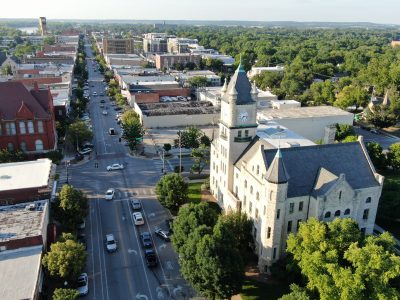
photo by: Jackson Barton/Journal-World File Photo
The Douglas County Courthouse and downtown Lawrence are pictured in an aerial photo Saturday, July 13, 2019.
A spend down of Douglas County government’s more than $100 million in reserve funds indeed began in 2025, but it didn’t reach into the county’s broadest fund, recently released financial statements show.
The county’s general operating fund — the account that funds day-to-day operations of county government — saw its reserves grow by more than $3 million last year and began 2026 more than $5 million larger than what county commissioners had expected.
The latest numbers are from the county’s 2025 fiscal audit, which county commissioners are scheduled to formally receive at their meeting on Wednesday.
After years of questions from the public about the size and purpose of the county’s more than $100 million in reserve funds, the 2025 financial statements show an overall decline in “fund balance” totals, which are dollars that aren’t budgeted to be spent but remain available for emergencies or unplanned expenses.
The county’s unencumbered cash balance totaled $133.9 million at the end of 2025. That was down from $145.8 million at the end of 2024. County officials used some cash reserves to partially pay for a pair of new public building projects, which led to the decline in overall fund balance totals.
The fund balance amounts have become a flash point with some community members, with some arguing portions of the large balances should be refunded to residents as property tax relief payments, while others have argued the county should put the money to use by providing services that currently are strained.
While down, the total amount of fund balances continues to be a significant portion of the county’s overall finances, the latest statements show. The county had total spending of $254.7 million in 2025, meaning the county ended the year with uncommitted cash equal to 52% of its total expenditures. Many public policies related to fund balances call for amounts of about 25%, or about three months worth of expenses, to be held in reserves.
The county does have such a policy, but it only covers select funds. The general operating fund, the county’s largest and broadest fund, is a fund covered by the policy. It began 2026 with $25.6 million, up from $22 million a year earlier.
The $25.6 million in reserve funds gives the county 29 cents in reserve funds for every dollar that it is budgeted to spend on general operations in 2026. That amount technically puts the county out of compliance with a 25% cap called for in county policy.
Compliance with the policy, however, has been set aside by county commissioners for the past several years. Commissioners over the past two years have noted there are multiple covered funds that are exceeding the policy caps, but have agreed to maintain the status quo while stating that they intend to have a discussion about modifying the fund balance policy at a future, undetermined date.
Providing official financial statements for the county is only one purpose of the annual audit, which is required by state law. Auditors also look for signs that a government has poor practices in tracking its finances. As reported earlier this month, the City of Lawrence’s audit found material weaknesses in the city’s finances, including problems related to grants at the Lawrence Regional Airport and to the city’s accounting software.
No such findings were made in the county’s audit. Auditors with the firm Allen, Gibbs & Houlik completed the audit this month, and reported no material weaknesses or significant deficiencies in how the county accounts for its finances.
County commissioners will receive a presentation on the 2025 audit and accept public comment on the document as part of their meeting set for 5:30 p.m. Wednesday at the Douglas County Courthouse.
Here’s a look at other findings from the 2025 audit:
• The financial statements, when compared to the county’s budget documents, show how much differently 2025 played out than what county commissioners had been told to expect.
In the summer of 2025, when the county was crafting its 2026 budget, county staff provided commissioners with an estimate of what the fund balance in the general fund would be at the end of 2025. At that point, staff was estimating the general fund would close the year with $20.5 million in fund balance totals, according to county budget documents. Instead, as the audit confirms, it ended the year with $25.6 million.
A big reason why the estimate was off, the audit shows, is because county officials in 2025 ended up spending less money than budgeted, and also collected more revenues than expected.
The county spent $88.1 million out of its general fund in 2025. That was $4.4 million less than the county budgeted to spend for the year, according to the audit. The county also received about $3.3 million more in revenues than it budgeted to receive in 2025. The biggest single revenue stream that came in greater than expected was interest earned on the county’s unused funds. That interest amount came in $1.1 million — or about 30% more — than what the county budgeted for in 2025.
• The county’s general operating fund collected about $84.3 million taxes. The bulk of it, about $67.5 million, were real estate property taxes, with the remainder being sales taxes and motor vehicle taxes. The $84.3 million in general fund tax collections was up from $81 million in general fund tax collections in 2024. That’s approximately a 4% increase.
• While tax collections were up in the general fund, total general fund spending was down in 2025. The audit lists $88.1 million in general fund expenditures in 2025, down about 5.5% from $93.2 million in expenditures in 2024.
• Total county spending — encompassing the general fund and all its specialty funds — increased significantly in 2025. Total county spending checked in at $254.7 million, up from $171.4 million in 2024. Most of the increase came in the county’s capital improvement funds, which are being used to fund major projects that include an expansion of the Judicial and Law Enforcement Center and a new public safety building at the Douglas County Jail. Capital improvement spending was up $76.5 million for the year. The county used a mix of debt proceeds and cash reserves to pay for the public safety buildings. The use of the cash reserves is largely responsible for why the county’s total fund balance amounts declined for the first time in years.
• The county’s total revenues also took a big jump in 2025, thanks in large part to proceeds from new debt that the county issued for the public safety building projects. While the county takes out the debt and agrees to pay it back over 20 years, the county gets the proceeds from the debt issuance all at once, creating a spike in the amount of revenue the county received in 2025. The county had $242.8 million in revenue in 2025, up from $185.3 million in 2024. The bulk of that new revenue came from about $55 million in debt proceeds for the public safety buildings.
• The audit shows Douglas County in 2026 is obligated to make $6.6 million in debt payments. That’s up from $2.4 million in debt payments the county made in 2025. The public safety building debt is scheduled to be paid off in 2045.
County Government
Housing Stabilization Collaborative’s new system directs rental and utility aid to more vulnerable households, review finds
Housing Stabilization Collaborative’s request for city trust fund aid won’t be considered because it was filed late
Douglas County commissioners discuss tracking results of awarded funding to community partners

General Election Voter’s Guide

An incumbent Douglas County commissioner faces no opponent in general election