County to consider pilot project to use ‘tiny homes’ to house people needing behavioral health care
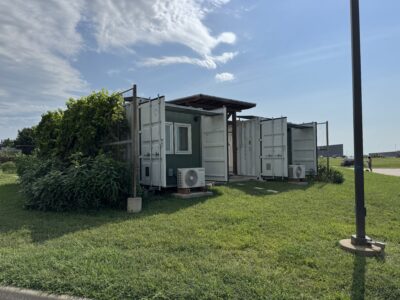
photo by: Josie Heimsoth/Journal-World
A unit in the Monarch Village behind the Lawrence Community Shelter, 3655 E. 25th St., is pictured on Thursday, Aug. 13, 2026.
Douglas County is planning a pilot program to repurpose some “tiny homes” near the city’s homeless shelter as temporary housing for people with complex behavioral and medical needs following a health crisis.
The Monarch Village was previously designed during the COVID-19 pandemic to offer private, transitional housing for families and individuals. The 12 “tiny homes” are located behind the Lawrence Community Shelter, 3655 E. 25th St.
Now, the county’s Familiar Faces initiative – which focuses on people with complex behavioral and medical needs who frequently use jails, emergency rooms, shelters and crisis services – is wanting to pilot a few Monarch units to offer crisis respite, extended stay options for these individuals.
“One of the most essential tools in the crisis continuum is the ability to offer clients the gift of time,” a memo in the agenda said. “Familiar Faces typically have medical needs that require: more time to heal, more frequent contact with home health supports, and more time to put sustainable community-based services in place.”
Douglas County commissioners will hear about the pilot – Monarch CARES, which stands for Crisis And Respite Extended Stay – on Wednesday and decide whether they support the pilot program.
According to the memo in Wednesday’s agenda, the individuals housed through Monarch CARES may have needs that exceed what the LMH Health emergency department, the Treatment and Recovery Center or the Lawrence Community Shelter can provide. Some may need ongoing medical care, personal assistance or frequent supervision while they recover from a health crisis and work toward more permanent housing or care.
The pilot will begin with one to three units available in the last three months of 2026, and a program review will be completed at the end of December. If the review’s findings prove the pilot to be effective and sustainable, the goal would be to utilize five total Monarch units to support the programming in 2027.
The individuals selected to stay in the Monarch units would be identified through data collected by the Familiar Faces initiative, and the person’s stay would last 30 to 180 days following a behavioral health or physical health crisis.
Before their stay, an individual care plan will be developed. The plan will list the services available to the individual, the members of the care team along with contact information for communication with LCS, a seven-day contact schedule that includes daily visits from the care team when necessary and appropriate, and a plan for home help and nursing support when appropriate.
The program would not expand what LCS staff are responsible for providing. The shelter would continue providing services within its existing scope, such as meals and daily cabin checks.
Outside providers would be responsible for more specialized services, which could include wound care, injections, catheter care, home health visits, assistance with bathing or dressing, or monitoring medical equipment.
The idea to launch the pilot came after LCS has allowed several people with complex health needs to stay in Monarch units for the last 18 months while Familiar Faces has arranged additional services. The agenda said those temporary stays have been associated with reductions in emergency-service and first-responder use.
The total cost to support the pilot for the rest of 2026 would not exceed $28,500, and any additional costs to provide health services would not exceed $8,000.
The County Commission will hold a work session at 4 p.m. Wednesday in the Douglas County Commission meeting room at 1100 Massachusetts St. The business meeting will follow at 5:30 p.m. The meeting will also be available via Zoom.
Other News

Douglas County commissioners to discuss whether to increase the number of days fireworks can be sold in the county
Lawrence’s first bike lanes with physical barriers are installed on Ninth Street
Data center company plans up to $1,000 a year in tax, utility credits for De Soto households
Supernatural thriller filmed in Lawrence to have multiple showings at Liberty Hall
Eudora voters to decide sales tax election to fund increased fire protection in the city