In the complex ‘ecosystem’ of city government, Lawrence’s mayor asks sustainability advisers to look at the big picture
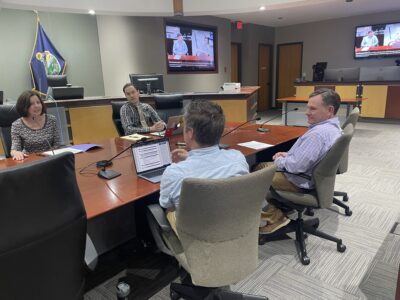
photo by: Sylas May/Journal-World
Mayor Brad Finkeldei, right, meets with the Sustainability Advisory Board on Thursday, March 26, 2026. Seated next to Finkeldei is board member Joshua Roundy, and across from him are chair Nancy Muma and board member Patrick Ross.
The City of Lawrence’s efforts to protect the environment have something in common with the environment itself: lots of parts that all depend on each other.
There’s a clean energy ordinance that could change soon. There’s the city’s strategic plan, which will soon get an update. There are two new city commissioners, a sustainability department with just a $4,000 operating budget for this year, and multiple other departments doing their own environmental work.
All of those things were touched on at the Sustainability Advisory Board’s meeting with Mayor Brad Finkeldei on Thursday night, as the advisers discussed their priorities and what would help the city most.
“Everybody has a constituency; how do we align them?” board member Joe Fearn said. “Because the lion and the mouse align in the ecosystem, with the bacteria and the grass and the trees and the storms and the weather and the geology. And they all work together in unison, even though none of them advocate for anybody else.”
A panoramic view, at the end of a discussion that started with a mouse-sized idea. Part of the reason Finkeldei was at the meeting was to discuss the board’s proposal for an energy transparency policy for renters, and board chair Nancy Muma said they were proposing it because they thought it would make a difference without costing much.
Finkeldei, however, wanted them to look more at the big picture when setting their priorities – including the clean energy ordinance, Ordinance 9744, that could be changing. “I don’t really think it’s so much about this particular project at the moment,” he said. “It’s where does this particular project fall amongst all the things we are looking at?”
And if one thing was clear on Thursday, it’s that the board has a lot of things to look at. Here’s a closer look at the lions and mice and trees and more that were on their minds.
The ‘low-hanging fruit’
Why the rental energy transparency policy, and why now? The reason, Muma said, is that “it’s low-hanging fruit and cheap.”
The policy would basically be a way to give renters more information about their utility bills before they sign a lease. Muma said different cities have implemented policies to do that in different ways, but that the board envisioned it as something that could be done without much cost to the city.
“We put this up before you guys and it didn’t get much attention,” she said of Finkeldei and the rest of the City Commission.
Finkeldei said there was a reason for that. He said the issue was not how good this idea was, but how it fit in with the many other things the city wants to dedicate staff’s time and resources to.
A transparency policy for renters might sound simple, but he said it would still involve many city staff members and departments – not just Sustainability Director Kathy Richardson, but also information technology and legal staff, among others. It would compete with other things they’re being asked to do, things the city might want to do just as much or more.
“Really, I think it’s a question of priorities,” Finkeldei said.
There were also other sustainability projects competing for the city’s attention, he said, including electrifying the city’s vehicle fleet or improving bike infrastructure.
“Should we be investing in more bike lanes?” he said. “And should we be putting effort toward that, or should we be putting effort toward this plan?”
“This is much cheaper,” Muma said of the transparency idea. “… And it has a bigger impact.”
“So, tell us that,” Finkeldei said. “And then that might help us.”
He said it was more useful to city decision-makers to have a list of many different ideas than to have just “one good idea” presented to them at a time.
“So, if we propose multiple things, it’s what you would like, rather than just coming up with the cheapest, most effective one?” Muma asked.
In response, board member Joshua Roundy said he thought the point was giving the city options for new sustainability policies that it could compare.
“We can tell them it’s the cheapest, most comprehensive one,” Roundy said. “But until we show them that, it’s not going to make sense.”
The moving targets
The city’s ecosystem doesn’t just have low-hanging fruit; it also has three big elephants shaking the trees. They are Ordinance 9744, the 2027 budget, and the city’s next strategic plan, all of which the city is still working on or hasn’t begun.
“Personally, for myself, I kind of want to know, before we greenlight a specific project like this, what are we going to do with 9744?” Finkeldei said.
Ordinance 9744 is something the advisory board has talked a lot about. It was passed in 2020 and set two clean energy goals for the city: 100% clean energy in all city government operations by 2025, and 100% clean energy citywide, including in private homes and businesses, by 2035. By the end of 2025, it was clear the city wasn’t going to meet those targets – Richardson previously said that only about 3% of the energy powering the city’s facilities now comes from renewable sources.
It’s not clear yet what will happen to the ordinance. City staff has proposed repealing it and replacing it with a new goal of “climate neutrality” by 2050. The advisory board has proposed amending it to better hold the city accountable when it fails to meet its goals, and it will be sending a letter to the commission outlining its recommendations.
The commission is not expected to discuss the ordinance and decide its fate until later this spring. Once that’s done, Finkeldei said, the city will know its new goals, and will be in a better position to think about policies for reaching them.
“What I’m hearing,” board member Patrick Ross said, “is you guys have the budget coming up, and then 9744, so it’s a matter of capacity from staff and the commission and sort of tackling those bigger issues first, then getting down to maybe the finer details.”
“Yes,” Finkeldei replied.
The 2027 budget and the next strategic plan won’t be done as quickly. The work on the budget has begun, and city commissioners gave some initial feedback on it earlier this month. But the strategic plan work won’t begin until after the commission hires a new city manager to replace outgoing City Manager Craig Owens later this year.
The strategic plan is important because it sets criteria that the city uses to measure its performance. City staff calls them KPIs – short for “key performance indicators.” Depending on how they change, the city could be aiming for different goals in the future.
“It’s not just one thing that’s a moving target, it’s multiple things that are moving targets,” board member Chris Reimer said.
“That’s a great point,” Finkeldei said. “We’re launching on the new strategic plan here soon, and our KPIs will follow from that strategic plan. So, a very fair point, which is we don’t know exactly where we’ll land at that point either.”
The other departments and the money
The other big issue for the sustainability department is money. In comparison to some parts of the city budget, Richardson’s funding isn’t even a mouse – it’s a bacterium.
Richardson told the board that in the city’s 2026 budget, about $35,000 of the operating funds for sustainability were slashed. “My budget got cut all the way to $4,000 for operating costs,” she said.
She said the department did get some help from the state of Kansas this year: a $200,000 Climate Pollution Reduction Grant that “couldn’t have come at better timing.” The city previously said the grant would be used for things like a communitywide greenhouse gas inventory and an energy plan for city facilities.
“That’s huge,” Richardson said of the grant, “because that allows us to do work that some of that $35,000 would have done.”
With the 2027 budget process coming up, the board wanted to make sure the cuts didn’t go any deeper. In the past, it’s written letters to the City Commission asking for things like extra staffing – adding an assistant to help Richardson out. But this year, Muma said, she wanted to write a letter urging the commission not to cut Richardson’s position, and not to cut the operating budget further.
“Because I think budget cutting is a big thing going on right now, we want to make sure that we at least maintain,” Muma said.
And Ross said that “it just sends the wrong message if you cut us down even further. I mean, we’re working with only $4,000 when there are multimillion-dollar decisions at stake.”
Richardson also reminded the board that the sustainability department wasn’t the only part of city government doing environmental work. Many sustainability projects happen in Municipal Services and Operations, which handles solid waste and other public works, or the Parks, Recreation and Culture department.
“When we talk about environmental sustainability and the true picture of what the city’s spending on environmental sustainability, don’t think of it as the $4,000 of the general fund,” Richardson said. “Sustainability work is currently occurring in multiple departments.”
Fearn wanted the board to know more about that and to work more closely with those other departments. He suggested that the city could even do more “in-house” consultations, where money that would have gone to an outside consultant for a study could instead be “redirected back into our own coffers, so to speak.”
“I think that educating (the board) about the existing effort with City of Lawrence employees, I think that our alignment with them would be potentially a really powerful first step – giving them a little extra juice toward their efforts, capitalizing on their expertise,” Fearn said.
He also said that in his experience of over three decades in landscaping with large organizations, “everybody has an idea, and everybody thinks that theirs is the best.”
“To me, that’s the fulcrum,” he said. “If bikes is your cup of tea, if that’s your modus, then let’s roll with you on bikes. If buses, then let’s roll with you on buses. If money’s the arbiter, then we’ve got to figure out a way to take money out of the issue.”
City Government
In the complex ‘ecosystem’ of city government, Lawrence’s mayor asks sustainability advisers to look at the big picture
Some fire stations in Lawrence respond to fewer calls than others; a look at the data and whether it means anything for Station 6
These designers want to capture Lawrence’s World Cup moment in wearable public art

About 5K Lawrence residents receive the wrong water and sewer bill from the city due to tech issue
Lawrence’s Historic Resources Commission recommends further review of proposed super-dense apartment complex in Oread neighborhood