

Lawrence’s Historic Resources Commission recommends further review of proposed super-dense apartment complex in Oread neighborhood
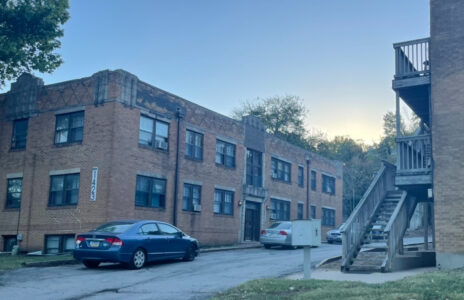
photo by: Sylas May/Journal-World
The Emery Apartments building in the Oread neighborhood is pictured in October 2025.
Lawrence’s Historic Resources Commission voted Thursday for further review of a proposed “very-high-density” apartment complex to see how the design could better fit the guidelines of the historic Oread neighborhood.
Commissioners voted 5-0 Thursday night with one abstention to refer the project planned for the 1400 blocks of Ohio and Louisiana streets to the commission’s Architectural Review Committee. The abstaining commissioner was Stan Hernly, a Lawrence-based architect who does significant amounts of historic preservation work and is part of the team working on the apartment complex.
The complex is being developed by Lawrence businessman Doug Compton and would be called The Place @ KU. With two buildings and 300 bedrooms, it would be the first super-dense project built under a zoning category in the city’s new code that does not limit how many dwelling units can be on a property.
As the Journal-World has reported, The Place @ KU would consist of a large ‘U’-shaped building on the east half of the site and a smaller multi-story building on the western end of the property. Both buildings would have rooftop decks and terraces, and the space between them would feature a courtyard, a “cocktail pool” and barbecue zone. The buildings would have a maximum height of approximately 60 feet.
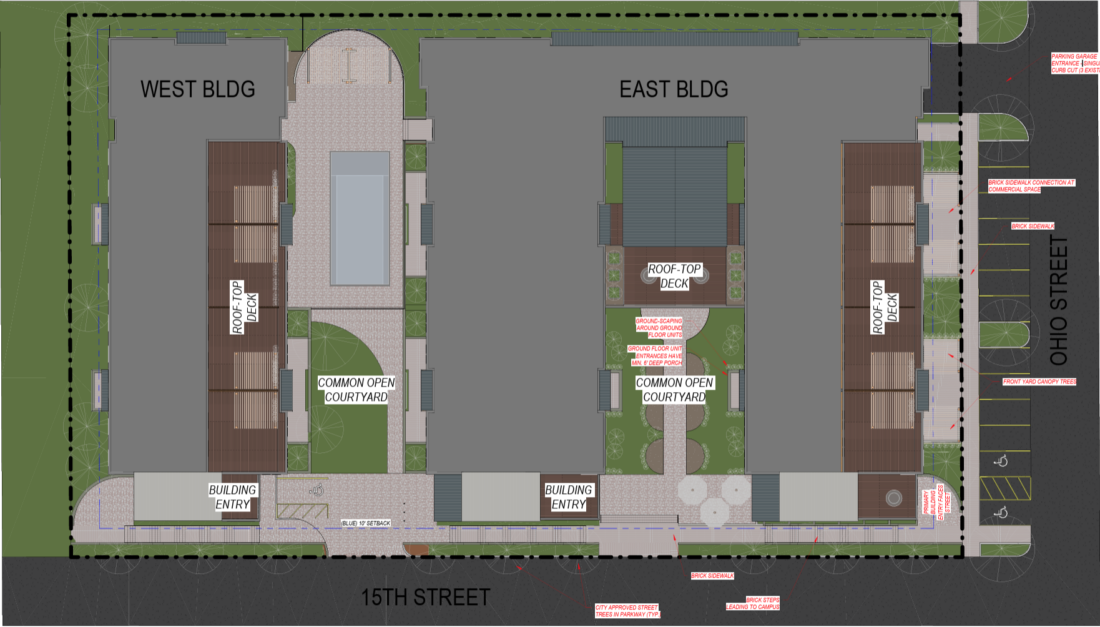
photo by: City of Lawrence
A rendering submitted to Lawrence City Hall shows the basic layout of a proposed apartment complex in the Oread neighborhood.
To build the complex, the developers would have to tear down the cluster of older apartment buildings currently on the site, and the request to demolish those was what the Historic Resources Commission was expected to vote on on Thursday. There are five buildings currently on the proposed site, and based on city staff’s initial review, two of them are “character defining” for the Oread neighborhood and built during the area’s “period of significance” between 1877 and 1945, as the Journal-World reported.
City staff was recommending that those two structures — the three-story, 12-unit Emery Apartments building at 1423 Ohio St. built in 1929 and a bungalow at 1432 Louisiana St. built in 1937 — not be demolished. But Hernly had disagreed. In a letter to the city’s Historic Resources Administrator Lynne Braddock Zollner on behalf of the developers, he wrote that Emery Apartments specifically had “serious structural problems.”
Zollner said Thursday night that after reviewing the additional information — including taking a tour of the Emery Apartments building — it was apparent that the basement walls were “leaning in several inches.” Despite the building’s historic features, such as its detailing that references the Art Deco style, she said she would agree that demolition may be appropriate.
She said that instead of recommending that the demolition request be denied, staff was now recommending that the project be referred to the commission’s Architectural Review Committee. Part of that is because the commission could not take separate votes on the demolition request and on whether The Place @ KU fit the Oread Neighborhood’s design guidelines. Both of these, the request for demolition and for new construction, were technically a part of the same request to the commission, so they would have to be voted on as a whole package.
Several of the commissioners said they felt the project was too big and unlikely to meet the neighborhood guidelines. Commission Chair Brenna Buchanan said that although she understood the need for high-density housing development, she also thought the design didn’t “meet the intent” of matching the historic guidelines.
Zollner said that with a project of “this scope and magnitude, it’s not expected to meet all the guidelines.” But she also said the developers could work with staff to include elements that were in the guidelines, such as breaking up the buildings’ mass or using materials that match other buildings in the neighborhood.
Commissioner David Dearborn said that as currently designed, the complex “would be a significant detriment to the neighborhood.” He wanted to see what changes could be made through the Architectural Review Committee and thought the original design should be treated as a “first draft.”
City Government
These designers want to capture Lawrence’s World Cup moment in wearable public art

About 5K Lawrence residents receive the wrong water and sewer bill from the city due to tech issue
Lawrence’s Historic Resources Commission recommends further review of proposed super-dense apartment complex in Oread neighborhood

City of Lawrence names longtime prosecutor as next Municipal Court judge
City leaders hope to be chosen for pilot project that rehabilitates abandoned and dilapidated homes