City staff opposes demolishing early 20th-century buildings in the Oread neighborhood for a super-dense apartment project
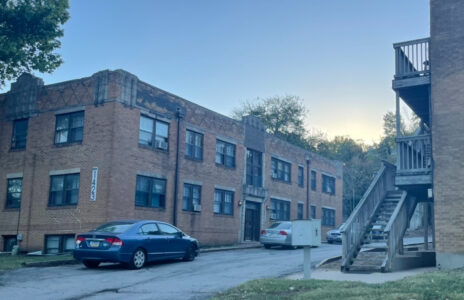
photo by: Sylas May/Journal-World
The Emery Apartments building in the Oread neighborhood is pictured in October 2025.
Two buildings in the Oread neighborhood that city staff says have historic value could be a problem for the first “very-high-density” housing project in Lawrence’s history.
The project is Lawrence businessman Doug Compton’s two-building, 300-bedroom apartment complex called The Place @ KU. It would be a first in Lawrence – the first super-dense project built under the city’s new code, taking advantage of a new category of zoning that doesn’t limit how many dwelling units can be on a property.
In order to build it, the developers would have to tear down the cluster of older apartment buildings currently on the site, in the 1400 blocks of Ohio and Louisiana streets. But now, city staff is recommending that the demolition request for two of the buildings be denied, on the basis that they are “character defining” for the Oread neighborhood and were constructed during the area’s “period of significance” between 1877 and 1945.
At its meeting on Thursday, the Historic Resources Commission is scheduled to vote on the demolition request, and it could also weigh in on the design of the new apartment buildings that Compton is proposing.
The old buildings on the roughly one-acre site are already quite dense by the Oread neighborhood’s standards. There are four apartment buildings and a bungalow there.
In a report to the Historic Resources Commission, city staff said three of the apartment buildings would be OK to demolish, because they weren’t built between 1877 and 1945. But staff is recommending against demolishing a fourth apartment building and the bungalow.
The apartment building in question is the three-story, 12-unit Emery Apartments at 1423 Ohio St. It was constructed in 1929, and staff says it “continues to exhibit architectural character” with brick detailing and stone panels that reflect Art Deco aesthetics.
“While not unique, this is one of the few buildings in the overlay [the historic area] that has detailing that references the Art Deco style,” the report reads.
The bungalow, meanwhile, is at 1432 Louisiana St. and was built in 1937. Its form and its “craftsman detailing” are similar to other historic structures in the Oread neighborhood, staff says in the report.
“Structures that are character defining for the district shall not be demolished,” the report concludes. “This project proposes the demolition of two character defining structures.”
• • •
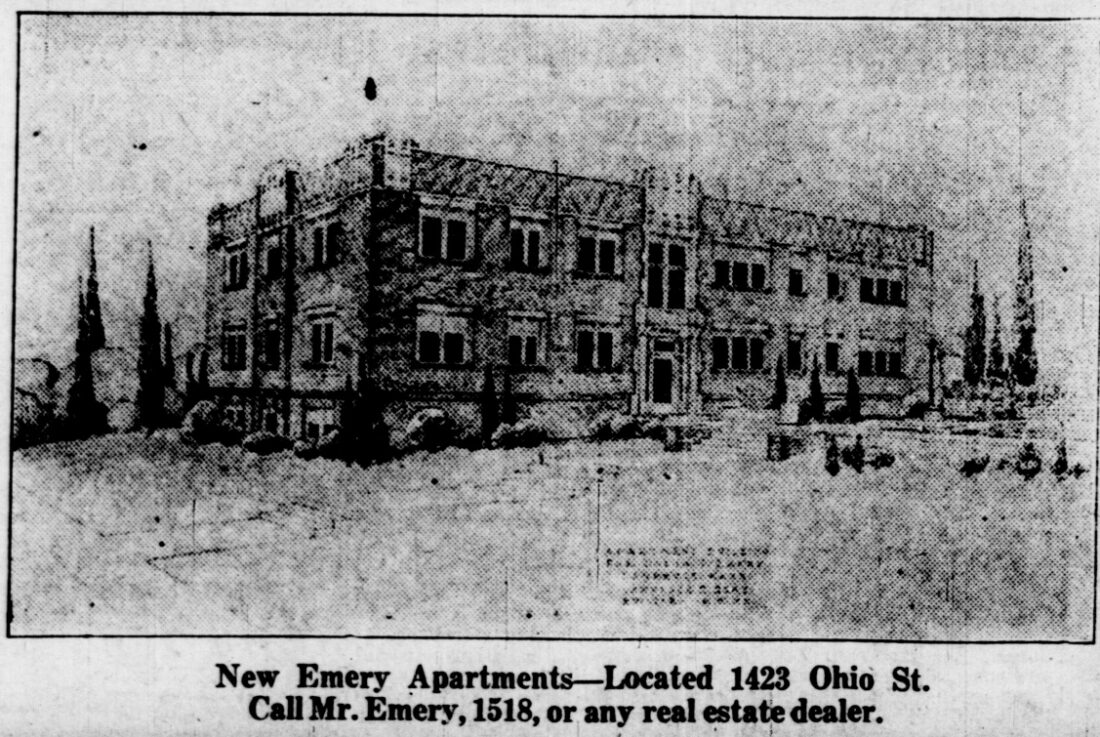
photo by: Contributed
A drawing in the Journal-World in 1929 depicts the Emery Apartments building in the Oread neighborhood with a garden on its north side.
One of the architects for the developers, Stan Hernly, argued in a letter to Historic Resources Administrator Lynne Braddock Zollner that the demolition request made sense. Hernly, a Lawrence-based architect who does significant amounts of historic preservation projects in the community, characterized the property’s current structures as “four extremely dilapidated apartment buildings and one house without historic significance.”
He didn’t say anything about the bungalow beyond that, but he said the Emery Apartments had serious structural problems, including cracked and tilting concrete foundation walls and wood-framed floors that have “serious deflection.”
Completely rehabilitating the Emery Apartments would cost about $3.6 million, roughly $350 per square foot, Hernly’s firm calculated. If the Emery Apartments were eligible for a historic listing and could get federal and state tax credits, the cost to rehabilitate the building would be about $1.6 million, which would be about $900,000 less than the cost of a new structure of the same size.
That’s if the property could qualify for a historic listing, though, and Hernly thinks that’s doubtful.
He wrote that the building does have historic integrity in that it “still looks and feels like a 1929 apartment building,” but that’s about as far as it goes: “A strong case can be made against its integrity in other aspects.”
First, he said, the site around the building is unrecognizable from what it was in the early 20th century. He submitted a drawing of the building published in the Journal-World in 1929 showing a “landscaped terraced garden” outside of the building’s north entrance that was a “characteristic feature” of the property back then.
“This character has been completely obliterated by construction of 1419 Ohio Street (the 2.5 story apartment building on the north portion of the lot), the driveway built close to the north side of the building, and construction of 1433 Ohio Street very close to the south side of the building,” Hernly wrote.
Hernly also said the building’s Art Deco features were compromised because one of the stone panels had been covered up with brick. The building had structural failures that meant the original workmanship probably couldn’t be saved. And it was not associated with any historically important person or event, he wrote.
“Based on the various levels of integrity outlined, it is my professional opinion that historic listing of the Emery Apartments building is not a viable path to pursue,” Hernly wrote.
City staff, in its report, disagreed with Hernly’s assessment. Staff said the building does meet multiple of the criteria that the National Parks Service uses to determine a building’s historic integrity. Those include that its design, its workmanship and its “feeling” are still intact, and that it’s still in its original location, the report said.
• • •
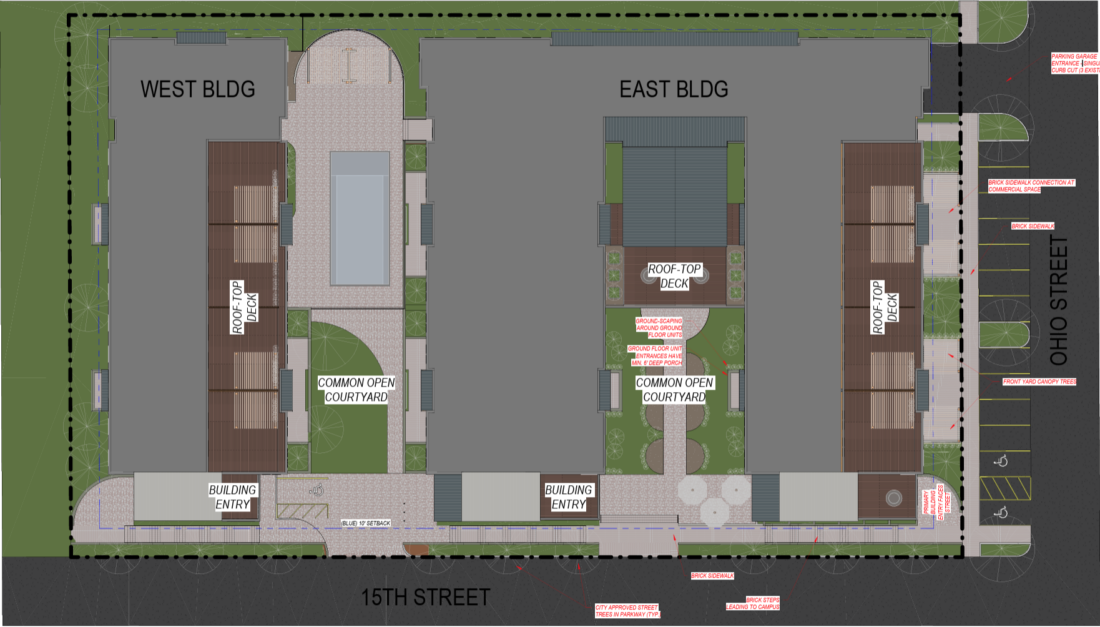
photo by: City of Lawrence
A rendering submitted to Lawrence City Hall shows the basic layout of a proposed apartment complex in the Oread neighborhood.
Even if the demolition request goes forward, the Historic Resources Commission might still ask for changes to Compton’s project. City staff said in its report that the buildings Compton is planning don’t fit the guidelines for new construction in the Oread neighborhood.
Much like downtown Lawrence, the neighborhood has a set of guidelines for new structures based on the characteristics of the existing buildings there. In higher-density areas, the guidelines includes things like breaking up larger buildings into “house-scale” elements with porches, protruding bays and other features, or making structures that gradually “step down” in height to within a story of neighboring buildings.
As the Journal-World has reported, The Place @ KU would consist of a large ‘U’-shaped building on the east half of the site and a smaller multi-story building on the western end of the property. Both buildings would have rooftop decks and terraces, and the space between them would feature a courtyard, a “cocktail pool” and barbecue zone. The buildings would have a maximum height of approximately 60 feet.
There might be room for flexibility with the guidelines because of the project’s size. The report from city staff says that “it is not anticipated that a project of this magnitude can meet all of the guidelines.”
Staff is recommending that the developers work with the city’s Architectural Review Committee to find ways to “break up the mass of the structure” and possibly include some of those “house-scale” elements.
“The demolition of the two character defining structures could be partially mitigated if the replacement project could be more compatible with the neighborhood and achieve the goals of the overlay district while increasing density which is currently a city goal,” the report from staff reads.
Now, it’s up to the Historic Resources Commission to decide what to do with the staff’s recommendations. The commission meets at 6 p.m. Thursday at City Hall, 6 E. Sixth St.
City Government
City staff opposes demolishing early 20th-century buildings in the Oread neighborhood for a super-dense apartment project

He’s photographed war zones, slums, disasters – and for the World Cup, he’s showing off ‘soccer everywhere’
Advisory board recommends city reclaim over half a million dollars after Bert Nash steps away from housing project
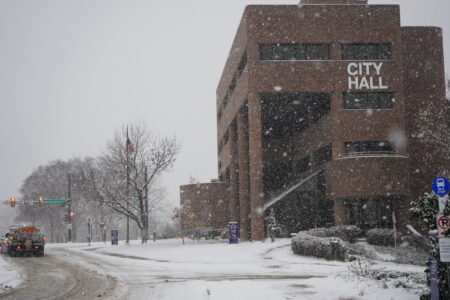
To help water customers ‘know what to expect,’ Lawrence will create a formal policy about shutoffs in cold weather

Lawrence city commissioners agree Fire Medical expansion is necessary, but opinions vary on tax increase to fund it