To help water customers ‘know what to expect,’ Lawrence will create a formal policy about shutoffs in cold weather
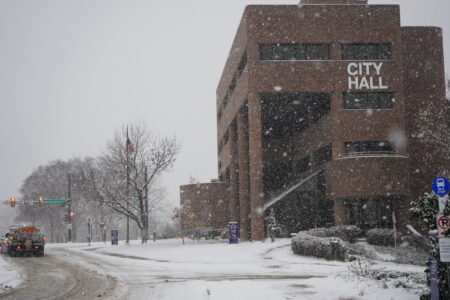
photo by: Shawn Valverde/Special to the Journal-World
A snow plow passes by City Hall on Monday, Dec. 1, 2025.
Electricity and gas companies have a special rule that governs when they can shut off services in the winter months, but you might not have known the City of Lawrence’s water service limits its cold-weather shutoffs, as well.
The city’s current practice is to not shut off customers’ water for nonpayment during weeks with especially cold temperatures, specifically weeks when the high is forecast to be below 30 degrees for multiple days in a row.
The reason you might not have known about that is that it’s just an informal practice by the city, not a formal policy. And now city leaders want that to change. On Tuesday night, the Lawrence City Commission agreed that it would like to formalize a Cold Weather Rule for city water.
“Having a clearly communicated policy can help customers understand expectations and support transparency around how essential services are administered,” utility billing manager Kristy Webb told the commission.
The practice that will be formalized into a policy is something the city “often” does to reduce the risk of damaging its meters and service lines, which might freeze if the meter pits were opened in very cold weather, Webb said. She said that if the high is under 30 but conditions are safe for staff to go out in, they sometimes put notices on customers’ doors stating that they would have been disconnected and assess them a $25 fee, half of what the city normally charges for disconnecting and reconnecting a customer.
“It’s really weather-dependent,” she said.
The city’s cold-weather practice, combined with the fact that it doesn’t disconnect customers on weeks when there are holidays, means that the winter months often have fewer shutoffs than other times of the year. January 2025 and December 2025 were the two months with the fewest water disconnections in Lawrence last year, according to the city’s data, with 108 and 121 disconnections respectively. February, however, had the fourth-highest number of any month, with 238.
Commissioner Amber Sellers was the one who wanted to discuss formalizing the cold weather practices. She said Tuesday that she would like the city to have an actual Cold Weather Rule similar to the one that electricity and gas providers regulated by the Kansas Corporation Commission have to follow.
“We know that our other utilities, whether it’s Evergy, it’s Black Hills, Atmos – all of those have the Cold Weather Rule. They use that. So as a local municipality with local utilities, it would behoove us to not go against the grain and to follow that same best practice,” Sellers said.
Webb said she reached out to other municipal utilities, including Topeka and Manhattan, to see which ones had a formal Cold Weather Rule. In her research, the only utility she could find that had one was Olathe’s, whose rule mirrors the KCC’s.
The KCC’s Cold Weather Rule is a bit different from Lawrence’s practice, and it’s in effect more often. According to the KCC’s website, from Nov. 1 through March 31, the electric and gas utilities can’t shut off services for nonpayment if the National Weather Service forecasts that the temperature will be below 35 degrees at any time during the next 48 hours.
A look at past high and low temperatures from the National Weather Service shows that in January and February 2025 in Lawrence, there were no days when electricity or gas disconnections would have been permitted under the KCC Cold Weather Rule, and there were multiple stretches in March 2025 where lows were low enough to trigger it.
The city’s informal practice, on the other hand, is based on the high temperature being less than 30 degrees. The National Weather Service data showed that there were 11 days in January 2025 that had highs below 30 degrees, eight such days in February 2025 and no days with highs under 30 in March 2025.
It could cause a backlog for city staff if the city adopted a policy that stopped shutoffs for long periods of time. Webb said that’s because the city’s staffing is normally enough to accommodate about 50 shutoffs per week. A rule that blocked them for most of a cold-weather season would mean that the city wouldn’t have the bandwidth to shut some delinquent customers off when warm weather returned.
“If we implement a Cold Weather Rule that we don’t do cutoffs for four months, that might actually mean we don’t do cutoffs for four months and additional people don’t get shut off because we don’t have the capacity to shut them off, which might build over time,” Mayor Brad Finkeldei said.
But the commission’s consensus wasn’t to make that big of a change. Commissioners instead directed staff to take what the city is currently doing and formalize it as a policy. City staff told the commission that it could be done administratively, rather than on a City Commission vote, but that they could share information on it in the regular utility billing report that the commission receives.
“I’m a little worried about making radical changes,” Finkeldei said. “… But it doesn’t sound like that’s where we’re at.”
It may not be a major change, but commissioners were hopeful it would give water customers more clarity and peace of mind.
“Consistency and continuity, they know what to expect, that’s always good,” Commissioner Kristine Polian said.
City Government
To help water customers ‘know what to expect,’ Lawrence will create a formal policy about shutoffs in cold weather

Lawrence city commissioners agree Fire Medical expansion is necessary, but opinions vary on tax increase to fund it

The Lawrence Community Shelter is an ‘iceberg,’ and its leader provides a glimpse beneath the surface
Lawrence city leaders to get first look at 2027 budget proposal with 3-mill increase for Fire Medical’s Station 6 expansion

City leaders discuss how to strengthen existing public art funding program and make it more flexible