

Big decisions lie ahead about North Lawrence corridor study’s goals
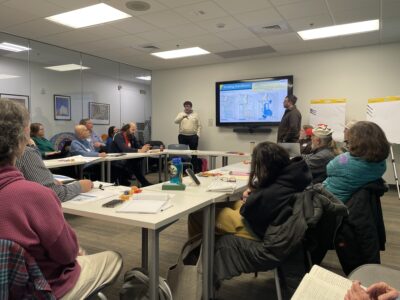
photo by: Sylas May/Journal-World
Consultants from HNTB Corporation give a presentation at the North Lawrence corridor study task force's meeting on Tuesday, Jan. 28, 2026, at the Lawrence Public Library.
The first question of the night for the North Lawrence corridor study task force was no softball: “Burger at Johnny’s, or enchiladas at La Tropicana?”
“That’s really tough,” said one committee member when they saw the informal poll at the start of the meeting. “That IS tough,” another echoed.
“This is the hard part,” joked consultant Bill Madsen. “We’re going to have to make decisions tonight.”
As it turned out, even tougher questions awaited – and still await – about the study, which will analyze land use, economic development, infrastructure and more in the area north of the Kansas River. What is the study’s goal? Whose voices should it prioritize? What kind of language should it use?
No decisions were made at Tuesday’s meeting at the Lawrence Public Library, except to meet again in the near future. Whenever that happens, the task force will have to create a statement of its vision and goals and direct the consultants with Kansas City-based firm HNTB Corporation on what to do next. The city is spending just under $400,000 for HNTB’s services on this project, as the Journal-World reported.
More public feedback will also need to be gathered. Already, a survey and multiple workshops and listening sessions have been held, and another workshop and two open houses will take place in the future, the consultants said Tuesday. The target date for the study’s completion has also been pushed back a few months, as well, from December 2026 to March 2027.
•••
Nancy Thellman would “really like to be an enthusiastic task force person,” she told the group on Tuesday. But she was having trouble picturing the final product that would eventually go to city leaders.
“I still don’t, honest to God, understand what it is you’re going to be presenting to the City Commission and what their expectations (are),” said Thellman, a former Douglas County commissioner. She wondered about the impetus for the project: “This wouldn’t be getting done unless there were some energy from the City of Lawrence to want to see this area as developable, future development … all this future stuff,” she said.
Then Melissa Sieben, the city’s director of Municipal Services and Operations, stood up along the wall of the library meeting room.
“I will make myself the target,” she said.
Sieben said the idea for the study came from seeing the diverse mix of city functions and projects that touch North Lawrence. That includes stormwater, trails and parks, even the airport north of town, which she’s the interim director for. In North Lawrence, she said, “all of these things intersect.”
“We’re truly wanting to hear everything,” she said of the many perspectives and priorities involved.
She said that in the future, the study could be a tool to help city decision makers, such as the Planning Commission and the City Commission, when they have to vote on projects on the north side. A future Planning Commission might be considering a development request in North Lawrence and then point to the study. It could then ask, “Is this the direction that our study said, ‘yeah, we’re comfortable,’ or is it close?”
So, while the study wouldn’t be a formal plan, like the Plan 2040 comprehensive plan, it would still help governing bodies know whether certain projects were in step with North Lawrence’s values and priorities.
“And so, the reason I wanted to do this study is, I don’t know what you want,” Sieben said.
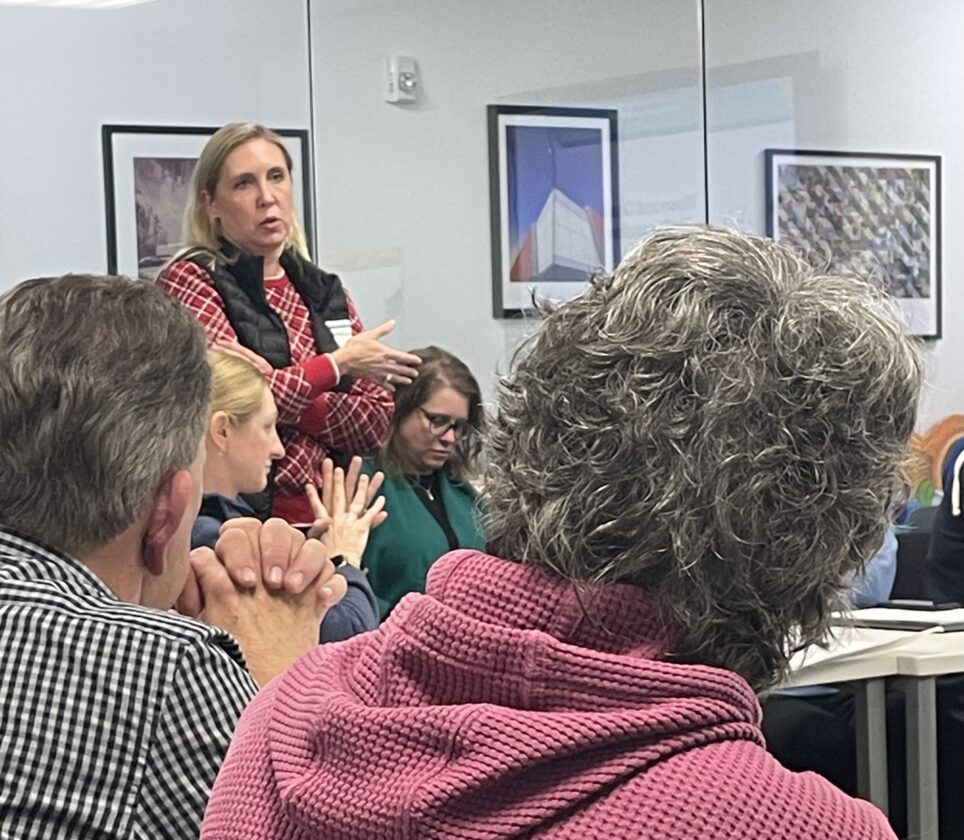
photo by: Sylas May/Journal-World
Melissa Sieben, standing, answers a question from Nancy Thellman, foreground, at the North Lawrence corridor study task force’s meeting on Tuesday, Jan. 28, 2026.
•••
At least one item on the wish list was clear: flood protection. HNTB consultant Bethany Stock said it was a top priority in the responses to the survey and public meetings.
“Stormwater, stormwater, stormwater,” she said.
Ted Boyle, president of the North Lawrence Improvement Association, had the same concern. When he has asked “mom and pop” business owners about the corridor study, he said flooding has always been a big worry – especially when new development is involved.
“Every one of them was worried about development along North Second and North Third,” he said of the businesses he spoke with, and the reason was, “they want to know, how are you going to get around building in a floodplain?”
Boyle told the consultants that in North Lawrence, “there are two flooding problems.” One of them is the river, which the levee is meant to protect against. But the other is the stormwater that runs downhill from the north, and that’s been a problem in North Lawrence for a long time.
One example he cited was the July 1993 flood, in which the underpass in North Lawrence flooded and virtually every business on North Second Street was damaged. More recently, residents have worried that potential developments to the north of the city, such as a proposed solar farm, could send more stormwater south into the neighborhood.
A document that’s been part of that conversation for a long time also got a mention on Tuesday evening. It’s the North Lawrence Drainage Study, which, among other things, suggested building a multimillion-dollar pump station — $11 million in 2005 dollars — north of the city to divert water away from North Lawrence. Thellman wanted to make sure the drainage study was part of the corridor study process.
Boyle, for his part, said new pumps had been badly needed in North Lawrence for many years, and that flooding even affects some of the other priorities the public had identified, such as safer railroad crossings. When the underpass floods and people have to detour around, he said, “I have to go over there and chase people off the railroad tracks.”
The stormwater question also involves Grant Township, the rural area north of the city, he said, and parts of the township are included in the corridor study area.
“Everything that happens in Grant Township … affects North Lawrence,” Boyle said.
•••
Things that happen across the river affect North Lawrence, too, and some on the task force said that could harm the community’s unique identity.
The conversation turned that way after John Nalbandian, a former Lawrence mayor, said he was surprised by how many of the survey responses weren’t from the north side of the river. In the survey, about 39% of the nearly 600 respondents said they didn’t live in North Lawrence.
“So many people who participated in all this who don’t live in North Lawrence,” Nalbandian said. “That really got me, too – whoa, what’s all this interest about?”
Stock said it’s because “they can see the value of North Lawrence” – that North Lawrence has “core traits” that people all over the city value.
“I’ve been telling the city and the county that for years,” Boyle replied.
Boyle said he’d led the North Lawrence Improvement Association for 30 years, and he was concerned that people on the other side of the river would try to “dictate” what they wanted North Lawrence to look like.
“The deal is, the discussion and the input of the North Lawrence residents, it feels like the mine is being salted by the people on the south side of the river,” he said.
The consultants said they didn’t yet know which ideas were more popular with North Lawrence residents versus those who lived elsewhere. That would require a more in-depth analysis of the responses, they said, which had yet to be done.
But Boyle said he had an idea of what North Lawrence residents didn’t want, or what wouldn’t be feasible there.
He said apartments weren’t something residents wanted throughout the neighborhood, and that such development should be relegated to a smaller space in the area near Johnny’s Tavern, which is “buffered by North Second Street.” He said some ideas for bicycle and pedestrian projects couldn’t even be done on North Lawrence’s narrow residential streets, and that North Lawrence was already pedestrian-friendly.
“We are a walkable neighborhood, always have been,” he said. “People come from south Lawrence to walk in North Lawrence.”
And when it comes to the character of the neighborhood, he said, “we want our residential community left alone.”
There were voices calling for more links across the river, too. One of them was Sarah Hill-Nelson, owner of the Bowersock Mills and Power Company, who wanted a pedestrian connection between North Lawrence and the Pinkney Neighborhood that could hang from the existing I-70 bridge.
“It’s a critical connector,” she said.
•••
Some gaps will have to be bridged in the study process, and they might include cultural ones, Nalbandian said. He used the idea of an “economic corridor” as an example, and said that term might mean different things to different people.
“When Ted talks about North Lawrence, he says Locust Street is an economic corridor,” Nalbandian said. Boyle began to point out the restaurants and other businesses on Locust, and Nalbandian stopped him: “It’s an economic corridor if you live in that area,” Nalbandian said, but it may not look that way to someone from elsewhere in town.
“I see this project as really having to come to grips with what I see as these potential conflicts,” Nalbandian said.
“It’s definitely threading the needle,” consultant Marshall Allen replied.
Cultural issues and the exact words being used were also on Thellman’s mind.
Earlier in the meeting, she asked the consultants about pictures in the presentation of greenhouses and farms. They were part of a page labeled “Industrial,” and Thellman said that was “to me, very problematic.”
“As a consultant, is that going to be your approach to agricultural land?” Thellman asked. “… The diversity of ag practices and enterprises that we have in Douglas County, are they going to be called industrial uses?”
The consultants said it wasn’t their intent to dictate how land should be used, or to suggest that fields should be opened up for agricultural development. But Thellman said it was important when doing a study like this to take the words seriously. “The semantics, the naming, matters,” she said.
“How we name it early on and give people some comfort in this process,” Thellman said, “is really important.”
City Government
Big decisions lie ahead about North Lawrence corridor study’s goals

City Commissioner Amber Sellers to represent Lawrence on the National League of Cities’ college towns council
City of Lawrence holding open house about effort to designate Watson Park as a local landmark

City staff to gather feedback from Commission on whether to repeal clean energy ordinance, citing ‘unrealistic’ goals and timeline
North Lawrence corridor study task force to meet next week, discuss goals and next steps
