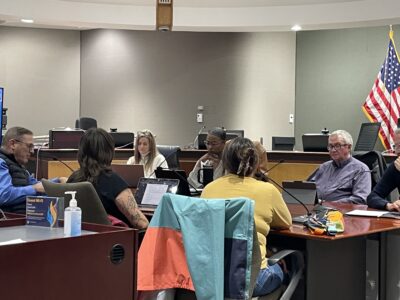
Lawrence leaders discuss how they plan to entertain, secure and serve an influx of World Cup guests
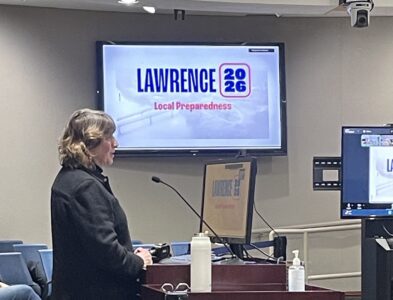
photo by: Sylas May/Journal-World
Ruth DeWitt of Explore Lawrence stands in front of the city's World Cup logo for 2026 on Tuesday, Jan. 20, 2026, at Lawrence City Hall.
One of the biggest things to realize about the World Cup, city leaders heard on Tuesday night, is how much you have to entertain people.
Of course, they’re there to watch the games. But there are only six of those, spread out over two months, in the KC area. And the rest of the time, the tens or hundreds of thousands of visitors are looking for things to do, said Ruth DeWitt, community relations director at Explore Lawrence.
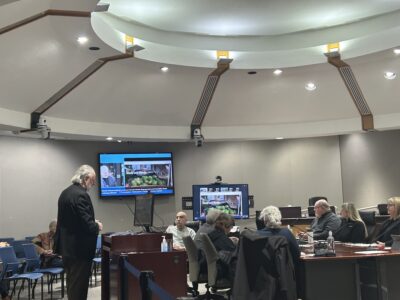
She was giving the City Commission an update on Tuesday night on the planning for the 2026 FIFA World Cup, for which several teams are eyeing Lawrence as a potential base camp.
Capturing the fans’ attention could boost Lawrence’s profile around the world, and she said many of them are there for the experience, not to go to an actual game.
She told commissioners about the “visitation ratio,” which she illustrated by comparison to the Super Bowl. When tourists go to a city for that big game, she said, a rule of thumb is that for every one person who’s actually going to the game, several more are going “to get the vibes.”
For the Super Bowl, that ratio is 1 to 5. For the World Cup, it’s about 1 to 20.
“We’re talking about four times a Super Bowl,” she said, “and we’re doing it six times over in Kansas City.”
There are already events being discussed to take advantage of that. Organizers are planning to host six to eight community watch parties during the tournament, DeWitt said, and trying to figure out which marquee matches will draw the most interest.
There’s also an effort along with the school district to look for places to hold pick-up soccer games, she said, which many fans enjoy. And more outreach and planning will be happening once Lawrence figures out what team it will be hosting, which is expected to be known at the end of this month.
The people to be entertained will include some big names, and Vice Mayor Mike Courtney said this was a great opportunity to get Lawrence more visibility internationally. Steve Kelly, vice president of economic development for the Chamber, said the area can expect “a lot of CEOs, … along with dignitaries, political leadership and that sort of thing.”
Showing those people that Lawrence is a great place to do business is a priority, he said. And the city thinks KU’s brand could play a role. KU’s branding team has already helped with a new logo for the city’s World Cup effort, DeWitt said, but the classic Jayhawk is important here, too.
“The Jayhawk is a global brand,” Assistant City Manager Brandon McGuire said. And, “in addition to being a highly recognizable brand globally, KU is a primary economic driver for our community.”
The logistics
The Jayhawk connection will start with Rock Chalk Park itself, the potential base camp site. But whichever team uses it, its players won’t be traveling alone. They’ll have lots of support staff with them, and the city has to consider the logistics for that.
DeWitt said that FIFA had partner hotels with the base camp locations, and that Rock Chalk Park’s paired hotel is the Oread. “They’re looking for a hotel of about 100 rooms that they would buy out,” she said of the process.
The big logistics tasks for the city have to do with security and transportation. Some of that is security for the team, such as police escorts as they go to the training facilities and elsewhere in town. But the discussion also touched on cybersecurity, on alerting people to ticket scams, even on ICE raids. A representative of LPD told the commissioners that immigration enforcement was not an LPD function, and that the department’s priority was to make international guests feel safe and welcome.
There was also a talk about buses and the airport. Melissa Sieben, director of Municipal Services and Operations, said “we do intend to see a surge of charter flights” at Lawrence Regional Airport. And DeWitt reminded the commission about the bus link to Kansas City that could bring fans from the area down to Lawrence for day trips. She said it would run on all days of the tournament, not just on match days: “A service, they’re predicting, every 30 minutes, coming in and out of Kansas City.”
America’s team and America 250
The four KC World Cup games where we know the teams involved are Argentina vs. Algeria on June 16, Ecuador vs. Curacao on June 20, Tunisia vs. Netherlands on June 25, and Algeria vs. Austria on June 27. But one that we don’t know is already the subject of some planning in Lawrence – the Round of 32 game on Friday, July 3.
DeWitt said that’s because there is actually a possible scenario where the U.S. men’s national team plays in that game. KC’s Round of 32 game is between the first-place team in Group K and a third-place team from Group D, E, I, J or L, and the U.S. is in Group D.
If this happened, it would draw huge crowds of domestic fans to the region, and it would coincide with the Fourth of July holiday weekend. Because of this possibility, DeWitt said, the annual Summerfest celebration in Lawrence, which has taken place on July 3 in past years, has been rescheduled for the Fourth this year.
“July 4, big celebration, mark your calendars,” she said.
Mayor Brad Finkeldei said he was excited about what the celebration on the Fourth might become this year with the World Cup and the U.S. 250th anniversary. “It could be a really, really large event,” he said.
There are some efforts to tie in the World Cup planning with events for the 250th anniversary celebration. DeWitt said a variety of historical events were in the works to help tell visitors the story of this part of America.
At the Haskell Cultural Center, she said, there would be a self-guided tour for use in multiple languages, so “they are prepared to tell that story to whatever country is prepared to come.” And other heritage groups are planning history and architecture tours about the city, its founding, and its Indigenous history, so that “people are hearing the whole story and hearing a story that represents all the people who are here.”
Cultural factors
The planners presented some statistics about World Cup visitors, including two areas particularly important for getting around in a foreign country: about 41% speak English, and about 68% have a credit or debit card.
Courtney asked about what had been done to prepare for a team with fans who spoke little English. For that, DeWitt said, the planners had been “so fortunate to tap into the KU international affairs department.”
She said the staff and students in this department were willing to help with translation tasks such as checking machine translations for accuracy, as well as providing cultural training. In fact, some people from the department had already provided some general cultural training related to the World Cup.
“They have a very wide swath of countries and cultures that they’re immersed in,” she said.
Practicing with translation apps like Google Translate and making an effort to learn more about the cultures of people coming to visit were all part of providing “radical hospitality,” said John Stipetich, deputy emergency management director for Douglas County.
Other parts of “radical hospitality” could include catering to the guests without cards, by training workers on better security for situations where they have a lot of cash on hand and on how to handle cash transactions better, DeWitt said. And Kelly said cultural education would be important to get workers to “where they’re comfortable, where they don’t step on someone’s toes accidentally.”
Of course, that fine-tuning won’t be possible until we know where the visitors will be coming from. Some teams announce their base camp sites earlier than they’re supposed to – DeWitt said Germany had already announced it would be going to North Carolina – but for the teams that are following the rules, the assignments are expected by the end of the month.
Until then, DeWitt said, “we are all on pins and needles.”
City Government
Lawrence leaders discuss how they plan to entertain, secure and serve an influx of World Cup guests
Share your preferences for Lawrence Loop trail routes through open house, online survey
City Commission approves $3.15M funding agreement with Lawrence Community Shelter
More than 2,250 people now have memberships to Lawrence rec centers — over 75% of Parks and Rec’s goal
After public feedback sessions, South Park is standing out to the Lawrence Farmers Market as a potential permanent home