99-year requirements, revolving loans and other puzzle pieces of Lawrence’s proposed housing incentives policy

photo by: Sylas May/Journal-World
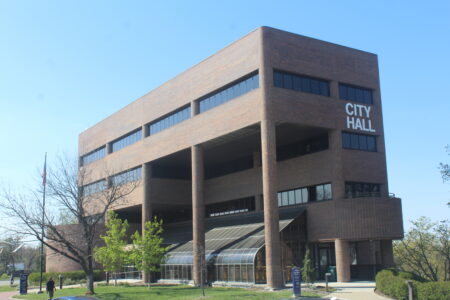
The Affordable Housing Advisory Board meets on Thursday, Jan. 8, 2026, at City Hall.
Here’s how affordable housing grants currently work in Lawrence, in a nutshell:
In the fall, developers say what projects they want to build. The city picks some it wants to fund. And it gives them sales tax money in the form of a grant.
It’s a familiar process for the city and its Affordable Housing Advisory Board. But, as AHAB member Monte Soukup admits, “if we want to try to incentivize or get specific projects, then this process doesn’t really do a great job.”
But what if AHAB could say what kind of housing it wanted and tell developers, “Bring me a project”? What if, instead of a grant, it could give a developer a low-interest loan that could recharge the trust fund as it gets repaid?
And what if developers didn’t have to wait until the fall to apply?
All of these ideas and more are being floated this year as the city develops a new Affordable Housing Incentives Policy.
When finished, the document will spell out requirements and procedures for projects seeking tax incentives or help from the Affordable Housing Trust Fund, which is funded by a special city sales tax. Affordable Housing Administrator Lea Roselyn brought the policy before the City Commission this past week to get feedback, and there will be more conversations about it in the coming months, as the goal is to have it approved by the City Commission by the end of the winter season.
The commission and AHAB have had plenty to say about the document. They’ve talked about balancing different types of development; about courting low-income housing tax credit, or LIHTC, projects; about how long projects should have to stay affordable (and how close you can get to “in perpetuity”).
And they’ve talked about what needs aren’t being met in Lawrence – especially those of people far below the area median income. The median is $72,500 for a single individual, $82,812 for a two-person household, and $103,500 for a family of four. But at 30% of the area median income, those numbers are closer to $21,000, $25,000 and $31,000, respectively.
It’s at this level that some of the biggest gaps exist – and it’s something the commission and AHAB have made a top priority.
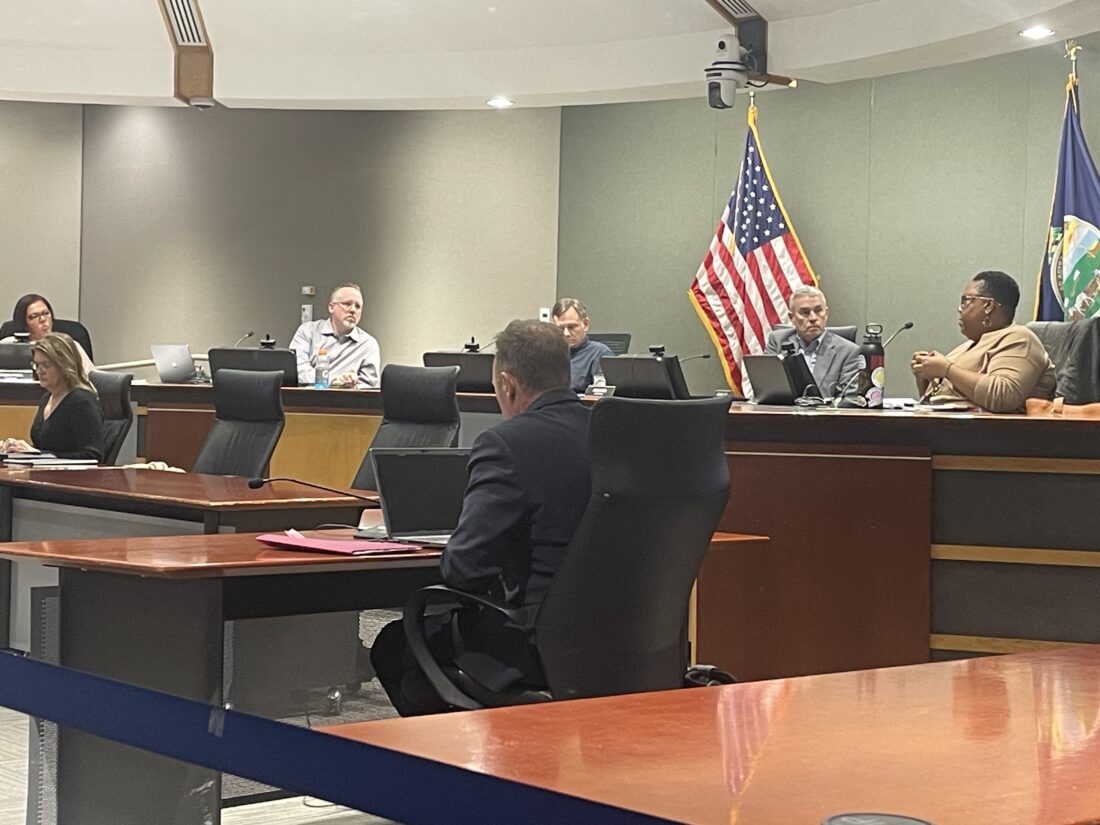
photo by: Sylas May/Journal-World
The Lawrence City Commission meets on Tuesday, Jan. 6, 2026, at City Hall.
Revolving loans
Currently, Lawrence’s Affordable Housing Trust Fund doesn’t make loans. But Roselyn said Lawrence is an exception in this regard.
On Tuesday, she told the City Commission that providing low-interest loans to developers “is a standard practice among many communities with local trust funds.”
The proposed policy would have Lawrence join those other communities in providing loans from the trust as a form of incentive. And Commissioner Amber Sellers was enthusiastic about the idea.
“As soon as Lea talked about this, ‘go with it,'” Sellers said.
Lawrence-Douglas County Housing Authority CEO Shannon Oury was big on the idea, too. She told the commission that the loans could help both nonprofits and bigger developments, but in different ways.
When Oury was on the Affordable Housing Advisory Board as one of its original members, there were big differences between the LIHTC projects that she voted on and the projects that local nonprofits were doing. The LIHTC projects brought volume, she said – perhaps 80 units that would be affordable for 30 years. The nonprofits, like her agency, Tenants to Homeowners and Habitat for Humanity, were building on a much smaller scale – “maybe we were only bringing four units.”
But the nonprofits’ housing would be helping the people at the lowest end of the income scale, which might not be the case with a big LIHTC project.
“The Housing Authority, 70% of everybody we assist is at or below 30% of AMI,” she said. “… When you can only charge rent based on 30% – you saw that number, $21,000 – you cannot rent in this town at that level unless you’re renting from one of us.” And that, she said, requires local government subsidies to make financial sense.
So the question for Oury was, “how do we assist affordable housing at that very low end without discouraging LIHTC?”
Loans were an important part of the answer, she said. That’s because LIHTC projects can make money, and giving them a loan would mean some of that income gradually flows back into the funding pool.
“People all over the country do LIHTC without any AHAB money,” she said, noting that most cities don’t have an affordable housing sales tax like Lawrence does. “… (If) most of the units are at 80% of AMI, well, that’s not very far off market, right? So how come, then, they wouldn’t be able to pay back that? … Isn’t that then a way we’re generating future funds to pay back into more affordable housing?”
Low-interest loans could be appealing to LIHTC projects, because they are part of the selection criteria used by Kansas’ LIHTC program. The applications are scored on a rubric, and a low-interest loan is one of the things that gives a project more points.
Sellers was already thinking about how a loan program’s logistics might work. She mentioned a low-interest loan program she’d heard of in Salt Lake City, and she suggested partnering with local financial institutions to make one work here in Lawrence.
“We need to be very innovative in how we can start to look at our financial institutions in our community,” Sellers said, “and say, ‘If you really believe in this community, you believe in what our strategic plan is about … then we need you to get on board and start being good partners in this.”

photo by: Mike Yoder/Journal-World
Poehler Lofts, 619 E. Eighth St., is a former warehouse built in 1904 that has been rehabbed into modern loft apartments.
30 years? 50? 99?
Poehler Lofts on East Eighth Street is a LIHTC project that’s been housing tenants since 2012. But it was also one of the applicants for trust fund money in the last cycle. It needed HVAC, sewer line and masonry repairs that the application from developer Tony Krsnich’s Flint Hills Holdings called “substantial.”
Some members of AHAB had reservations about funding it, including Vice Chair Mariel Ferreiro. Not only was the project aging, its units wouldn’t always be affordable. Many were already at market rate, she said in November, and eventually they all could be rented out at market rate.
“This isn’t a new project,” Ferreiro said. “We’ve already subsidized it quite a bit. To me, we’re setting a precedent to fund things that will be going to market rate, and I don’t feel comfortable doing that.”
Poehler Lofts did ultimately get some funding – $20,000 of its nearly $84,000 request. But the quandary AHAB faced then is one it and city leaders face now, too: Buildings don’t stay functional forever, and affordable housing doesn’t stay affordable forever.
One feature of the proposed housing incentives policy would attempt to change that last part – or at least get as close to it as the law allows.
Roselyn summed it up like this: “To receive significant assistance, a 99-year affordability period would be required.”
“Significant assistance,” here, could mean that a project was seeking a grant from the trust fund; a fee waiver; or a donation of public land. It could also mean that it was requesting more than one type of local government tax incentive – for example, if a development sought a Neighborhood Revitalization Act property tax abatement and an Industrial Revenue Bond sales tax rebate on construction costs.
Projects that meet one or more of those criteria do happen in Lawrence. In fact, one came before the City Commission less than a month ago. The Krsnich project called 9 Del Lofts II, which would provide at least 24 one-bedroom affordable housing units, was seeking a waiver of certain development fees to help it get low-income housing tax credits. It had also unsuccessfully sought money from the trust fund to help with that, and it had already gotten approval for Industrial Revenue Bonds and a Neighborhood Revitalization Act incentive.
If developers wanted a shorter affordability period under the proposed policy, they could request at maximum one tax break from local governments, or a loan from the trust fund. Then, they would have to promise 50 years of affordability instead of 99.
Compare that to the state’s LIHTC requirements, which only mandate 30 years of affordability. Mayor Brad Finkeldei wondered if the 50- and 99-year requirements would make it hard for Lawrence to compete for the limited pool of projects that get low-income housing tax credits in Kansas.
“We’ve done quite a few LIHTC projects that have less than 50 years,” Finkeldei told Roselyn on Tuesday. “… Do we expect, if we adopted this, that we’d never have a LIHTC project again in the city? Or would we expect LIHTC projects to come and be OK with the 50-year loan, or how do you see that playing out in practice?”
Roselyn said that there are municipalities comparable to Lawrence that require 99 years of affordability and can still attract LIHTC projects. But commissioners weren’t just asking about LIHTC; they were asking about lifespans, too.
Commissioner Mike Dever said it was important to remember that buildings have an expected useful life, “and whether we want them to last 100 years or not, frankly they just probably won’t.”
“The concept of perpetuity is great on paper,” he said. But the way he sees it, “a lot of these projects are designed and built to maybe last 50 years.”
“Those structures are not going to probably be around for 100 years,” Dever said.
Dever also wondered what would happen if affordable housing units with a 99-year requirement deteriorated to the point where they were no longer habitable. He wondered, is the developer “now responsible for resupplying the market with those units in the future, or are they off the hook?”
Some members of AHAB suggested that the answer might lie in something more permanent: the land the housing sits on.
“I wonder if there is a conversation or compromise of the land itself, and the requirement of affordable projects needing to be on that land,” Ferreiro told her fellow board members.
“Separate the land from the structure,” AHAB member Mark Buhler chimed in.
He brought up low-income housing projects from the 1970s around Kansas that had fallen into disrepair. “I guess you blame the owners; why not,” he said. “But it’s hard. It’s hard to keep property in a good place.”
Board member Barry McMurphy turned to him and added, “It’s hard to reinvest, too.”
“If you have 40 years on an apartment building, an apartment project, you need a lot of money to keep that in decent shape and keep it affordable,” McMurphy said.
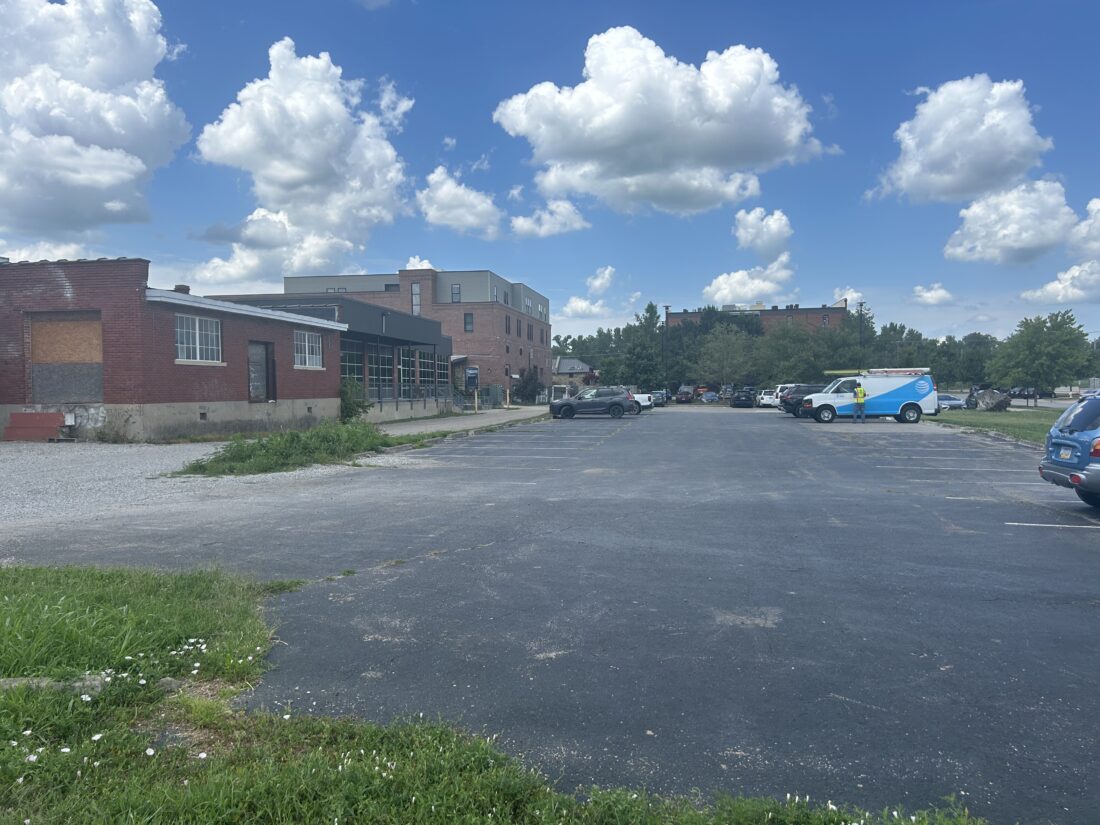
photo by: Journal-World File
A photo taken in July 2025 of a parking lot near the corner of Ninth and Delaware Streets in eastern Lawrence that is the site of a proposed loft development project, 9 Del Lofts II.
Flexibility and variety
Many needs aren’t being met by the current processes, the City Commission and AHAB seemed to agree. And one of those is the developers’ need for flexibility.
At Tuesday’s meeting, Roselyn told the commission it might make sense to think about doing the Affordable Housing Trust Fund awards on a different schedule to make the process more efficient for developers.
“Does it make sense to continue to only have an annual application cycle?” she asked the commission. “My recommendation is that that does not work for development projects.”
When AHAB met two days later, Ferreiro said that “was an interesting point to bring up.” She noted that when developers apply for things like tax breaks, they don’t have to schedule that request around an annual cycle – they can just submit it.
“The other incentives that are provided or potentially provided to development projects are received on a rolling basis, and that’s not how our trust fund application necessarily has worked,” she said.
She and Soukup both acknowledged that there would be difficulties involved in a rolling process, and she wondered if it would be possible to split the funding into multiple pots. One could be used for an annual request process like what currently exists, and another could be used more flexibly.
“It does require some folks to wait,” she said of the current process, “and perhaps plan projects at different stages and maybe either prematurely put in project applications or wait till the last minute.”
On Tuesday, Finkeldei noted that the city had seen “disjointed projects,” where a developer is hoping for tax incentives as well as funding from the trust. And it’s not just big developers who need more flexibility, he said.
He used the example of someone wanting to sell a duplex to a local nonprofit, only for the nonprofit to not have the cash available to buy it right away. The nonprofit could say, “we can apply seven months from now and get money a year later,” but taking advantage of that opportunity would be much easier if the process were more flexible.
“I do think we need to look at the process,” Finkeldei said. “And the idea of just having one allocation once a year, with certain deadlines, I do not think puts us in the best position to jump on those opportunities.”
If nonprofits have those opportunities, they can help with the other needs that local leaders want to meet. Those needs are for duplexes, condos and other nontraditional pathways to homeownership, as well as transitional housing for the lowest income levels.
Roselyn told the commission it’s harder to do low-income housing projects that will be sold to families than to do rental units. “That requires deeper subsidy,” she said.
“Homeownership units generally will not qualify for LIHTC, and it requires a community commitment to make that happen,” she elaborated. “We have not seen applications for new affordable homeownership units through the trust fund in several years.”
Sellers wanted that to change. She said developers weren’t building projects for the “missing middle” of people who would be in the market for something other than a traditional single-family home. They weren’t doing a lot of projects like condominiums and duplexes, she said; to get that housing built, the city would have to provide suitable incentives.
“Homeownership should not be relegated to a single-family detached,” Sellers said. “Homeownership could be a condo, it could be a duplex, it could be a townhouse. And these are things that we don’t have a lot of in our community that developers are not building.”
While it has been true in some years that duplex construction has lagged single-family home construction — which has been setting record lows — that wasn’t the case in 2025. As the Journal-World recently reported, the city issued building permits for 50 duplex-style housing units in 2025 compared to 36 single-family living units, which was another historic low.
But the gap is just as real on the other end of the affordable housing spectrum – housing for people making 30% or less of area median income.
Vice Mayor Mike Courtney said that many people are financially struggling and could benefit from this housing. He quoted a few statistics about how many people are living in poverty or at risk of it: “60% of people can’t afford a medical emergency, 40% don’t have $500 to their name, and 20% don’t have enough food.”
“If we’re going to make a dent in homelessness, if we’re going to make a dent with transitional housing to pick people up off their feet, I think we need to focus on the AMI 30, what that looks like, and what we can do to move the needle,” he said.
The incentive policy as currently written doesn’t actually require any housing in that category, however – unless you choose it to satisfy what Roselyn called a “menu of options.”
During her presentation to the commission, Roselyn used the example of a development of 10 homes to show how the income requirements worked. Two of the homes could be targeted at people making as much as 120% of the area median income, four more could be targeted at people making 60% to 80% of the median, and the last four would be for people making under 60%.
But then there’s the menu. You can fulfill it by setting aside at least two units for people at 30% of the median income or below. But if you don’t want to do that, you can also meet the requirement by providing two accessible units for people with disabilities, or two units with three or more bedrooms, or a mix of those three options.
Rather than waiting for developers to decide on their own to do a project for the lowest income levels, some members of AHAB were interested in a proactive approach. Soukup suggested telling developers what the city wanted to see and putting out a request for proposals.
“We’re going to go out and say, ‘We want to fund 30% AMI, and we’re going to provide X subsidy for those. Developer, bring us a project that incorporates that,'” he said.
However it’s done, both the City Commission and AHAB agreed that this type of affordable housing was a priority, and Roselyn did, too.
“The projects serving 40% to 80% AMI are needed and valuable for our community,” she said. “But those aren’t generally the housing units that people are transitioning into out of houselessness.”
“We need deeply affordable units,” she said, “to meet that commitment.”
City Government
Lawrence City Commission to weigh whether Costco should be included in STAR bond district
As they approve bikes plan, Lawrence city leaders ask about data collection, Kentucky and Tennessee streets
Lawrence city leaders want to toughen tobacco licensing rules ‘sooner than later’
Algerian government invites Mayor Brad Finkeldei, Lawrence delegation for a visit
Construction on Wakarusa Drive to resume; city manager says KDOT’s secretary has apologized for delay