City Commission approves $3.15M funding agreement with Lawrence Community Shelter
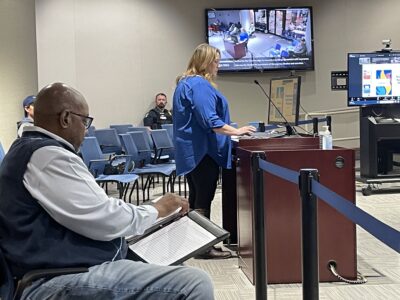
photo by: Sylas May/Journal-World
Lawrence Community Shelter Executive Director James Chiselom, left, and Misty Bosch-Hastings, director of the city's Homeless Solutions Division, at the microphone, are pictured at the Lawrence City Commission's meeting on Tuesday, Jan. 13, 2026.
Before Lawrence city leaders approved a $3.15 million funding agreement with the Lawrence Community Shelter on Tuesday, Mayor Brad Finkeldei thought back to what this meeting would have looked like a few years ago.
There was a time, he said, when “we would put the LCS contract on the agenda and we’d have 80 people in the room” wanting to criticize the shelter, say the city wasn’t doing enough to help, or say the city was spending too much money on its homeless response.
But on Tuesday, the rows of seats in the meeting room were mostly empty, and the commissioners had plenty of praise for the shelter and the city homeless team.
The agreement the commission unanimously approved on Tuesday looks a lot like last year’s. Under it, the shelter must provide 125 beds at its main building, 48 beds at Pallet 24 behind that building, and 50 beds at The Village, the community of Pallet cabins on North Michigan Street. The agreement also requires the shelter to provide winter sheltering services during severe weather; “assist with rapid rehousing and permanent supportive housing”; and provide programming and three meals a day for guests, among other services.
Misty Bosch-Hastings, director of the city’s Homeless Solutions Division, said that when she began working on homelessness with the city, the shelter had only 40 beds available. Now, she said, it has over 220, plus medical respite beds. As a result, she said, unsheltered homelessness in Lawrence has plummeted from where it was a few years ago.
She said right now in Douglas County, there were fewer than 40 people living outside; that the city had closed all encampments on its property; and that there were no deaths last winter from weather.
And LCS Executive Director James Chiselom said the shelter’s sites had provided 61,792 bed-nights over the past year and moved 127 individuals into permanent housing.
The agreement says it’s a priority for the shelter to become less reliant on city funding – that’s why it provides 10% less funding than last year. In response to a question from Vice Mayor Mike Courtney, Chiselom said the shelter was looking into fundraising and increasing engagement with donors. It also held a fundraising gala, its first such event, that raised about $83,000 after expenses, Chiselom said.
Some commissioners had questions about the finer details of the agreement and the finances behind it. Commissioner Kristine Polian asked about the shelter’s internal financial controls, and Chiselom detailed some of the shelter’s processes for handling money and said it had put someone on its board with experience in finances to provide oversight.
And Courtney wanted to know about the way the shelter’s performance was evaluated. Bosch-Hastings said she got information every day from LCS about the services it was providing and how many beds – 80, 90, 100 – were in use on a given night.
“The evaluation is daily, monthly, quarterly,” she said.
In addition to the agreement itself, Bosch-Hastings and the commission talked a bit about what might be next for the city’s homeless response. Bosch-Hastings said one of the goals was to have a day center for the homeless open by 2027. And Finkeldei said in the city’s strategic plan, the Village was intended as a short-term measure. If the city could eventually close it down and have enough capacity at LCS, he said, “we’ll see some savings.”
While some of the questions might have focused on “the lowest level possible,” Commissioner Mike Dever said, it was important to look at the big picture. He said that a staff “with the right heart” to do this work “doesn’t grow on trees.”
“I can say with 100% certainty that you’ve all done a great job,” Dever said.
City Government
City Commission approves $3.15M funding agreement with Lawrence Community Shelter
More than 2,250 people now have memberships to Lawrence rec centers — over 75% of Parks and Rec’s goal
After public feedback sessions, South Park is standing out to the Lawrence Farmers Market as a potential permanent home
99-year requirements, revolving loans and other puzzle pieces of Lawrence’s proposed housing incentives policy
City Commission to consider $3.15M funding agreement with Lawrence Community Shelter for 2026